Key Points
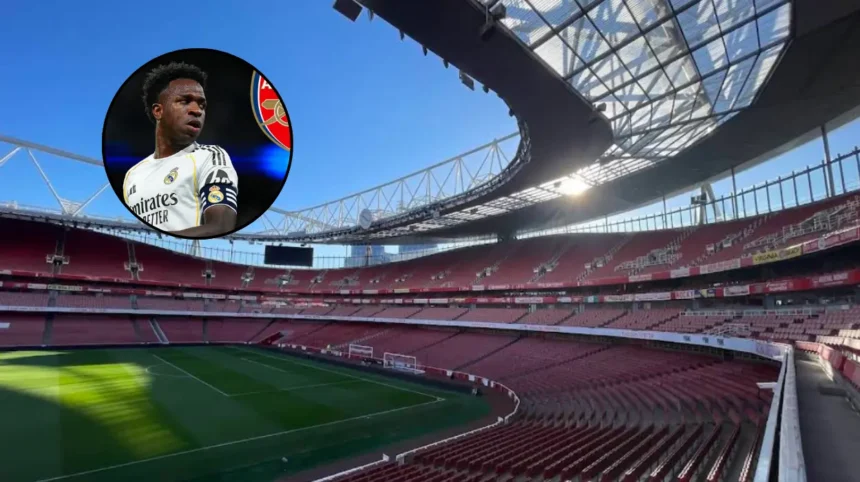
- Record Contract Offer Under Consideration: Arsenal are reportedly monitoring Real Madrid superstar Vinicius Junior, with the Gunners prepared to offer a contract exceeding £350,000 per week to make him the highest-paid player in the club’s history.
- Contract Impasse at Santiago Bernabéu: The 26-year-old Brazilian forward has entered the final year of his current deal with Real Madrid, with contract extension negotiations hitting a deadlock over wage parity demands.
- Mourinho Intervenes to Block Exit: Newly appointed Real Madrid head coach Jose Mourinho has reportedly informed club executives that his core group—including Vinicius Junior, Kylian Mbappé, and Jude Bellingham—must remain intact for the upcoming season.
- Tactical Flexibility for Mikel Arteta: Should a landmark deal materialize, manager Mikel Arteta could deploy Vinicius Junior across three distinct tactical systems, including a traditional 4-3-3, a fluid 4-2-3-1, and an aggressive 3-4-2-1 setup.
- Alternative Summer Targets: Alongside interest in Vinicius Junior, Arsenal continue to explore moves for Newcastle United midfielder Bruno Guimarães and Athletic Club winger Nico Williams, having already secured Christos Tzolis and Illan Meslier.
North London (North London News) July 29, 2026 – The speculation surrounding Real Madrid forward Vinicius Junior and a potential move to Arsenal has reached a critical juncture as conflicting reports emerge from across European football. As reported by Dane Heverin of Fox Sports, Premier League champions Arsenal are prepared to offer the 26-year-old winger the largest contract in the club’s history to secure his signature and reinforce their domestic title defence. The Brazilian international, who scored four goals during the 2026 World Cup, currently earns approximately £400,000 gross per week, but Arsenal’s hierarchy are reportedly open to surpassing that threshold if he decides to make the Emirates Stadium his home.
- Key Points
- How Could Mikel Arteta Line Up Arsenal With Three Tactical Options Including Vinicius Junior?
- 1. The Dynamic 4-3-3: Vinicius and Saka Dual-Flank Terror
- 2. The Fluid 4-2-3-1: Two-Ten Hybrid Attack
- 3. The Ultra-Aggressive 3-4-2-1: Front-Foot European Setup
- What Is The Historical Background Behind Transfers Between Real Madrid And Arsenal?
- How Could This Major Transfer Development Impact Arsenal And The Wider Football World?
However, significant financial and managerial hurdles stand in the path of any potential deal. Providing key context on the financial negotiations in Spain, Spanish football expert Terry Gibson of Sky Sports News stated:
“Vinicius Jr is currently on 15m Euros a year net. Real Madrid have offered him 20m Euros. He wants 30m Euros—just over 550,000 Euros a week net. There’s no budging on the contract from Real Madrid or Vinicius”.
Concurrently, reports published by football.london indicate that Vinicius Junior and Real Madrid remain deadlocked in negotiations, with the player’s representatives demanding salary parity with teammate Kylian Mbappé. According to details supplied by The Daily Mail, the winger has stayed away from regular club training while his future in Spain hangs in the balance.
Adding further complexity to the narrative, reports from The Telegraph highlight that newly appointed Real Madrid manager Jose Mourinho has intervened to block any prospective departure.
As reported by The Telegraph, Mourinho told Madrid executives that his core squad—specifically Vinicius Junior, Kylian Mbappé, and Jude Bellingham—is fundamental to his rebuilding plans as Los Blancos attempt to reclaim the La Liga title from Barcelona and contend for UEFA Champions League honours.
Meanwhile, contrasting reports from Spanish outlet El Nacional suggest that Arsenal manager Mikel Arteta retains reservations regarding Vinicius Junior’s defensive contribution, leading the Spanish manager to simultaneously consider Athletic Club’s Nico Williams as an alternative target.
How Could Mikel Arteta Line Up Arsenal With Three Tactical Options Including Vinicius Junior?
If Arsenal were to successfully navigate the complex financial and structural negotiations to sign Vinicius Junior, Mikel Arteta would gain one of the world’s premier inverted wingers. The addition of the Brazilian forward would allow the Spanish tactician to construct three distinct, high-potency starting line-ups:
1. The Dynamic 4-3-3: Vinicius and Saka Dual-Flank Terror
In Arteta’s preferred 4-3-3 formation, Vinicius Junior would slot directly onto the left wing, replacing Gabriel Martinelli or new signee Christos Tzolis. This setup maximizes width and provides elite one-on-one dribbling capabilities on both flanks.
- Goalkeeper: Illan Meslier
- Defenders: Ben White, William Saliba, Gabriel Magalhães, Riccardo Calafiori
- Midfielders: Declan Rice, Martin Ødegaard, Bruno Guimarães (or Thomas Partey)
- Forwards: Bukayo Saka (RW), Kai Havertz (CF), Vinicius Junior (LW)
In this framework, Vinicius Junior provides directness and explosive acceleration on the left, holding wide positions before cutting inside onto his favoured right foot. This balances Bukayo Saka’s mirrored movements on the right wing, pulling opposition low blocks apart and creating central space for Martin Ødegaard and Kai Havertz.
2. The Fluid 4-2-3-1: Two-Ten Hybrid Attack
To accommodate both Vinicius Junior and Gabriel Martinelli simultaneously, Arteta could pivot to a 4-2-3-1 system where positional fluidities allow Vinicius to operate in a free-roaming left-central channel.
- Goalkeeper: David Raya / Illan Meslier
- Defenders: Jurriën Timber, William Saliba, Gabriel Magalhães, Piero Hincapie
- Defensive Midfielders: Declan Rice, Mikel Merino
- Attacking Midfielders: Bukayo Saka (RW), Martin Ødegaard (CAM), Vinicius Junior (LAM)
- Striker: Gabriel Jesus / Kai Havertz
Under this configuration, Vinicius Junior is given the license to roam inside into the half-spaces, effectively creating a dual-ten setup alongside Ødegaard. The overlapping runs of an adventurous left-back like Piero Hincapie provide wide delivery, enabling Vinicius to operate closer to the penalty box as an auxiliary forward.
3. The Ultra-Aggressive 3-4-2-1: Front-Foot European Setup
For games requiring maximum offensive overload against deeply entrenched defences, Arteta could utilize a three-at-the-back formation similar to systems deployed during key European fixtures.
- Goalkeeper: Illan Meslier / David Raya
- Central Defenders: William Saliba, Gabriel Magalhães, Piero Hincapie
- Midfield / Wing-backs: Bukayo Saka (RWB), Declan Rice (CM), Bruno Guimarães (CM), Jurriën Timber / Gabriel Martinelli (LWB)
- Dual Attacking Midfielders: Martin Ødegaard, Vinicius Junior
- Centre-Forward: Kai Havertz
In a 3-4-2-1, Vinicius Junior operates directly behind the central striker as an inside forward. This removes wide defensive tracking duties from his mantle—addressing concerns noted by El Nacional—and allows him to concentrate his energy on transition attacks, central combination play, and direct goal threats.
What Is The Historical Background Behind Transfers Between Real Madrid And Arsenal?
The connection between Real Madrid and Arsenal in the transfer market spans two decades, defined by major player exchanges, loan agreements, and high-profile moves between North London and the Spanish capital.
As detailed by Mirror Football, past business between the two clubs serves as a reference point for potential negotiations:
- Julio Baptista and José Antonio Reyes (2006): In the summer of 2006, Arsenal and Real Madrid agreed to a notable player swap deal, with Brazilian striker Julio Baptista joining Arsenal on loan while Spanish forward José Antonio Reyes headed to Madrid. Baptista went on to score 10 goals in all competitions for Arsène Wenger’s side, including a four-goal performance against Liverpool in the League Cup.
- Mesut Özil (2013): On deadline day in September 2013, Arsenal shattered their transfer record by signing playmaker Mesut Özil from Real Madrid for £42.5 million. Özil went on to win four FA Cups during his tenure in North London.
- Dani Ceballos (2019–2021): Spanish midfielder Dani Ceballos spent two consecutive seasons on loan at Arsenal from Real Madrid, playing an integral role in Mikel Arteta’s 2020 FA Cup triumph before returning to Madrid.
- Martin Ødegaard (2021): After an initial successful loan spell during the second half of the 2020/21 season, Arsenal permanently signed Norwegian midfielder Martin Ødegaard from Real Madrid for a fee of around £30 million. Ødegaard subsequently developed into Arsenal’s club captain.
This historical framework demonstrates established operational lines between the boards of both clubs, though contractual impasses and squad valuations remain decisive factors in present-day negotiations.
How Could This Major Transfer Development Impact Arsenal And The Wider Football World?
Should Arsenal successfully secure Vinicius Junior or, conversely, if Real Madrid retain the Brazilian under Jose Mourinho’s leadership, the outcome will reverberate across multiple footballing stakeholder groups:
- Impact on Arsenal Supporters and Squad Dynamics: For Arsenal fans, pulling off a marquee signing of Vinicius Junior’s caliber would signal an aggressive statement of intent following their recent domestic successes. However, introducing a wage package exceeding £350,000 to £500,000 per week could disrupt the carefully managed wage structure overseen by Edu Gaspar and Mikel Arteta. Existing key figures such as Bukayo Saka, William Saliba, and Declan Rice might seek contract recalibrations to match top-tier squad earners.
- Impact on Premier League Competitiveness: Adding a Champions League-winning, elite-tier attacker to Arsenal’s frontline would dramatically alter tactical dynamics within the Premier League title race. Opposing defensive blocks would be forced to split coverage between Bukayo Saka on the right and Vinicius Junior on the left, severely testing the defensive depth of title rivals such as Manchester City and Liverpool.
- Impact on Real Madrid and La Liga: If Real Madrid lose Vinicius Junior due to contract stalemates, head coach Jose Mourinho would be forced to accelerate restructuring plans centered around Kylian Mbappé and Jude Bellingham. Conversely, if Madrid successfully extend Vinicius Junior’s contract, it reinforces La Liga’s retention of marquee global stars and obliges Arsenal to redirect primary transfer funds toward alternative targets like Nico Williams or midfield additions such as Bruno Guimarães.