
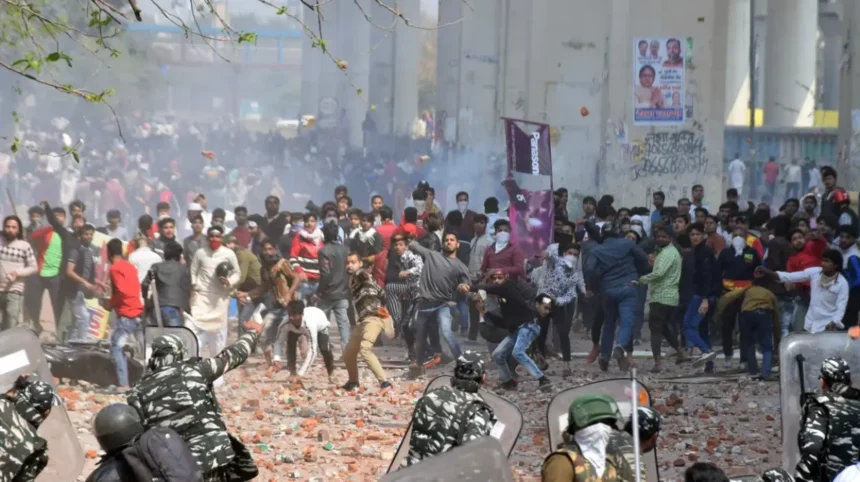
Bloodied faces, battered bodies, and broken bones—unimaginable pain yet smiles on their faces amidst the nonviolent spirit of the resolute students and youths in the streets of Delhi—give hope to a hopeless climate in India created by the Hindutva government led by Prime Minister Narendra Modi. Police brutality defines the nature of the BJP government led by Mr Modi and reveals the violent nature of Hindutva politics. If bloodied roads of Delhi write history of protests, it will definitely document the fascist play book of the Hindutva regime and its ruthless attack on protesting students and youth of India.
Misgovernance and unaccountability are the twin pillars of this government, shaped by Hindutva ideology, which upholds the interests of crony capitalist classes in India and global capitalist interests alike. All institutions of governance are ruined and compromised to achieve the objectives of the capitalist classes. Government led educational institutions and their processes have also fallen into this trap, where the legitimacy of competitive examinations is being compromised—which calls into question the integrity of the educational systems that shape not only the future of students and youth, but also the future of India.
The fall of integrity and standards in government educational institutions creates unfettered conditions for the privatisation of education, where Modi’s crony capitalist friends are waiting to be the beneficiaries, setting up their educational shops in the name of private universities. Recurring examination paper leaks are a regular feature of this government, which has failed to protect the integrity of various examinations across India. Such conditions pave the path for education as a profitable private business. This is the backdrop against which students and youth of India are asking the government to take responsibility and be accountable.
Such a minimalist demand has been met with large-scale Delhi Police violence and brutality, through which the government is trying to suppress the students’ legitimate demands. The police were supposed to maintain law and order and preserve peace, but the Delhi police behaved like uncivilised goons and street criminals rather than a disciplined force trained to keep the peace and protect human rights. The Delhi police behaved like agents of the government, breaking hands, heads, noses, faces, bones, and legs of protesting students to suppress their voice and legitimate nonviolent protest.
The tendency to suppress protests is integral to ruling classes in India. Political parties and their governments across the country use brutal police force to suppress political opposition—opposition that is central to the survival of constitutional democracy in India. The Congress regime has used lethal police force on protesting students and farmers while negotiating with the protesters. The current Hindutva regime, led by the BJP, has followed the Congress strategy while displaying its fascist playbook in action.
The brutal police action on students, youth, and women in the streets of Delhi looks as if the Delhi police and armed forces are playing Holi with the blood of Indian youth and students, while the young students and youth are absolutely nonviolent in their protest against the Modi government’s inaction on examination paper leaks. The streets of Delhi have not witnessed such a bloodbath in the history of their protests—protests that deepen democracy and citizenship rights. As the streets of Delhi turn red with the blood of Indian youth, the Hindutva government led by Modi is writing its own fascist playbook of violence, but Indian students and youth are writing the epitaph for Hindutva politics and its violent ideology.
This protest was not like any other protest witnessed by Delhi in its power corridors. It was led by nameless but inspiring young students; it was not organised or sponsored by any group or political party. The protest was spontaneous, with thousands of people participating without any fear. It was truly a leaderless and unorganised protest, yet clear in its democratic, non-violent direction.
Despite all the violence and brutality by the Delhi Police, the students and youth of India maintained discipline and a non-violent approach, even reminding the police,
“Tell your kids at home what you did today in the streets of Delhi.”
The protest was a moral force that inspired thousands of people to come together to reclaim their republic from the Hindutva goons and crony capitalists. Local doctors came to treat the injured students and faced police brutality, but that did not deter local residents from providing food and water to the students and youths in the streets of Delhi. People used various digital platforms to order food and water and send it for protesting students and youths. For the first time, the protests in the streets of Delhi were linked with the living rooms of people who were supporting the protest to protect their country and its future.
People from all walks of life came together to support the protesting students in different ways. There was no religious, caste, gender, regional, or linguistic divide among the protesters and their supporters. All came together organically around a common issue. This is the unique strength of this protest and its collective leadership, which is committed to dealing with specific issues like examination paper leaks and holding the government accountable.
This is a new wave of protest politics, shaped by the young students of India, giving hope to millions of Indians to fight, reclaim their republic, uphold the interests of the people, and save their country from a complete fascist takeover. The blood and sacrifices in the streets of Delhi by the youth and students of India have started a revolution to write the epitaph of Hindutva politics. All revolutions, revolutionaries and revolutionary histories are written in blood and sacrifice in the streets where power is buried under the feet of people.
History is no longer a witness, but an everyday reminder to revolt and regain the lost humanity of the Delhi police in the streets of Delhi by changing the government, which believes in inflicting fear and violence to domesticate Indians and destroy their democracy. But those days are over after the police suppression of the Delhi protests. Fear no more; the future is in our hands—this is the message from students and youths in the streets of Delhi. The new address for revolution is to protect secular, constitutional, and liberal democracy in India.
The views expressed in this article are the author’s own and do not necessarily reflect (North London News) editorial policy.