Key Points
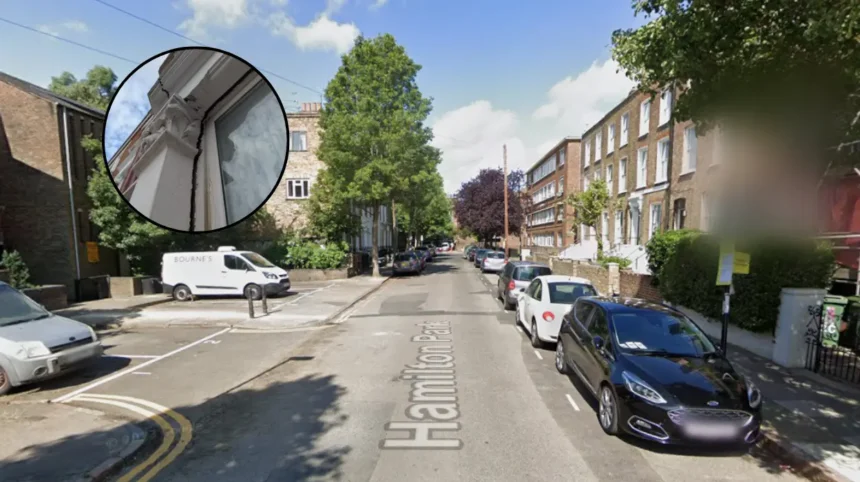
- Property Saved: A four-storey residential townhouse valued at £1.5 million located in Islington, north London, has been successfully stabilised and realigned.
- Root Cause Identified: Ground investigations revealed clay soil shrinkage extending up to 5m beneath the basement, alongside poor local drainage, causing severe movement.
- Visible Damage: The 1960s property on Hamilton Park Street suffered structural rotation, significant subsidence, and physical separation from the adjoining building.
- Innovative Engineering: Specialist firm Geobear deployed a non-invasive geopolymer resin injection technique instead of traditional concrete underpinning.
- Drastic Time Reduction: The complete remediation was executed in just nine days, compared to the standard 9 to 11 weeks required for traditional structural underpinning methods.
Islington (North London News) August 17, 2026— Ground engineering specialist Geobear has successfully rescued a four-storey townhouse valued at £1.5 million after the structure suffered severe structural damage caused by ground subsidence.
What caused the severe structural damage to the Hamilton Park Street property?
A detailed site investigation at the 1960s residential building on Hamilton Park Street established that the underlying clay soil had dried out and shrunk to depths of up to 5 metres below the basement level. This desiccation, coupled with inadequate local drainage infrastructure, compromised the ground’s load-bearing capacity and severely reduced its ability to support the heavy masonry structure.
Craig Dean, residential director at Geobear, detailed the extent of the deterioration, confirming that prolonged ground movement had led to visible structural rotation, significant downward subsidence, and physical separation from the neighbouring attached property.
How did geopolymer injection resolve the subsidence within nine days?
To rectify the settlement without causing extended disruption, engineers bypassed standard concrete underpinning techniques in favour of a modern non-invasive ground-stabilisation system using expanding geopolymer resin injections.
Craig Dean stated that
“traditional underpinning with concrete would have required project permission delays, heavy excavation, noisy equipment and weeks of curing.”
By injecting the material directly into the affected subsoil strata, the specialist team compacted the weakened soil directly beneath the existing foundations before carefully re-lifting the building back toward its original position. Craig Dean explained that “the team improved the soil beneath the foundations and carefully lifted the building back into position,” adding that
“the entire process was completed in just nine days, a dramatic improvement over the nine to eleven weeks expected for traditional underpinning.”
Explore More Islington News
Islington Mayor Congratulates Local Students on Exam Results Islington 2026
Cycle Islington Exhibition Celebrates 50 Years of Activism: Islington 2026
Background of the particular development
Subsidence remains one of the most persistent structural threats to UK residential property, particularly across North London where clay-heavy soils predominate. Clay subsoils are notoriously shrink-swell susceptible; prolonged periods of dry weather cause moisture loss that leads the subsoil to consolidate and shrink beneath shallow strip foundations.
When combined with localized drainage defects or leaking pipework—which wash away fine soil particles—the load-bearing capability of the ground plummets.
Historically, correcting structural subsidence required deep concrete underpinning. This conventional procedure involves excavating large pits beneath affected wall footings, pouring massive concrete piers, and allowing weeks for structural curing before load transfer occurs.
Beyond requiring extensive planning approvals and heavy machinery, concrete underpinning creates major disruption for homeowners, often forcing temporary displacement.
The shift toward expandable geopolymer resin injections represents a modern engineering response, leveraging controlled chemical reactions to solidify soil and hydraulic lifting pressures to restore structural levels within days rather than months.
Prediction: How this development can affect property owners and insurers
This successful nine-day remediation in Islington highlights a key shift in how residential structural repairs may be handled across London and the broader UK market.
- For Homeowners and Landlords: The validation of rapid, non-invasive ground stabilization offers a way to safeguard property values without enduring months of disruptive excavation or prolonged displacement. Property owners facing soil shrinkage can avoid heavy machinery on site while preserving neighboring structural connections.
- For Insurance Providers and Loss Adjusters: The significant time compression—from nearly three months down to nine days—sharply reduces alternative accommodation costs and overall claim payouts. Insurers are likely to increasingly favor geopolymer methods over conventional underpinning for suitable clay-soil subsidence claims.
- For the Local Real Estate Market: Establishing faster, non-disruptive remediation paths helps owners maintain marketability and structural integrity for affected properties in high-value historic or urban streets.