Key Points
- Industrial Action Suspended: The Unite union abruptly called off scheduled industrial action for over 1,500 Arriva North London bus drivers on Tuesday evening to allow members to vote on a fresh offer regarding working conditions during extreme heat.
- Extreme Working Conditions: Drivers report that driver cabs lack functioning air conditioning, relying instead on weak air-cooling systems that allow internal temperatures to exceed 40°C during persistent heatwaves.
- Garage Depots Affected: The dispute involves workers across eight major North London and regional depots: Barking, Edmonton, Enfield, Grays, Palmers Green, Stamford Hill, Tottenham, and Wood Green.
- Driver Discontent: Bus operators have expressed frustration on the picket line, informing reporters that they received zero details regarding the suspended deal prior to the cancellation of their industrial action.
- Resumption Date Set: Unite has confirmed that if the newly presented proposal is rejected by members during the upcoming ballot, full strike action will resume on Tuesday 25 August.
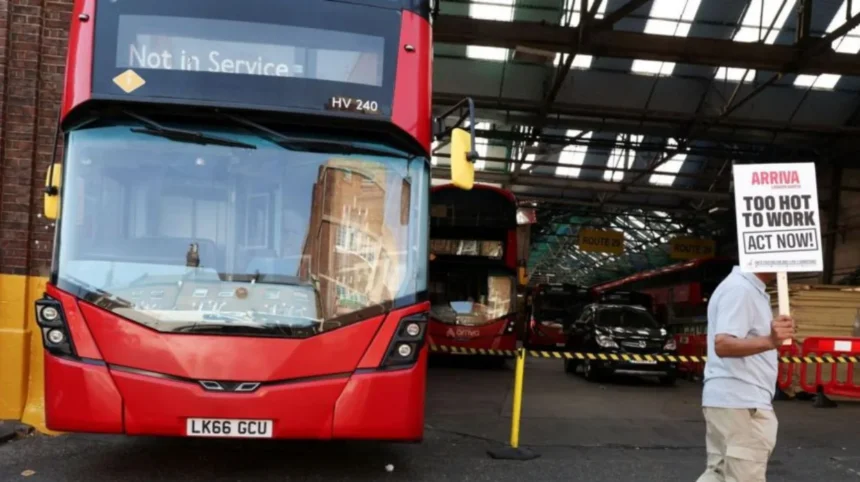
Tottenham (North London News) August 22, 2026 – London bus drivers employed by Arriva North London have voiced intense frustration after the Unite union abruptly suspended planned industrial action across the capital’s transit network following a late offer from transport bosses. The union called a temporary halt to the walkouts late on Tuesday evening, citing the need to conduct a member ballot on revised terms regarding extreme weather safety conditions. The decision left hundreds of drivers on the picket lines without immediate details regarding the substance of the agreement. Over 1,500 transit operators across eight major depots—Barking, Edmonton, Enfield, Grays, Palmers Green, Stamford Hill, Tottenham, and Wood Green—had previously walked out last Friday and Tuesday to protest unbearable working environments during recent heatwaves, where cab temperatures regularly topped 40°C.
- Key Points
- Why Did the Unite Union Suspend the Planned Heatwave Strikes?
- How Dangerous Are the Physical Conditions Inside London Bus Cabs?
- How Are Arriva North London and Transport for London Responding?
- Background of the Heatwave Industrial Dispute
- Prediction: How This Development Will Affect London Bus Drivers and Commuters
Why Did the Unite Union Suspend the Planned Heatwave Strikes?
As reported by journalists at the World Socialist Web Site, the Unite trade union announced the immediate suspension of scheduled strike action late on Tuesday evening, declaring that management at Arriva North London had submitted an updated proposal regarding driver thermal safety. In an official public update, Unite regional officer Steven Stockwell stated:
“Following talks, Arriva has made an offer to Unite members. To allow our members to have their say on whether to accept this, we have postponed strike action so they can be balloted”.
The sudden decision meant that further planned walkouts scheduled from Wednesday through Friday were temporarily shelved. However, the union warned that this suspension remains strictly conditional upon the membership’s verdict. Should the rank-and-file drivers vote down the proposed agreement, all planned industrial action will immediately resume on Tuesday 25 August.
Despite the official announcement, several bus operators on the ground expressed skepticism regarding the union’s decision-making process. Multiple drivers stationed at the Tottenham garage picket line told reporters from the World Socialist Web Site that they had not been provided with any documentation or specifics regarding what Arriva’s new deal actually entailed before the strikes were called off.
How Dangerous Are the Physical Conditions Inside London Bus Cabs?
As reported by reporter Henry Lee of the World Socialist Web Site, drivers operating routes across North London face extreme physical hazards due to a lack of proper climate control inside vehicle cabs. While modern private passenger vehicles are fitted with standard air conditioning, many Arriva buses rely solely on air-cooling ventilation systems that merely recirculate ambient air. During prolonged periods of high summer temperatures, these units routinely fail to cool the enclosed driver compartment, pushing internal temperatures above 40°C.
Speaking directly to reporters on the picket line at the Tottenham depot, John, a bus driver with 18 years of service, emphasized that solidarity across the workforce remained high despite varying equipment across different routes. As noted by the World Socialist Web Site, John stated:
“I’m here in solidarity because I know what it’s like. Because I’ve driven buses before where the heat’s abhorrent”.
Medical experts and health representatives warn that prolonged exposure to temperatures exceeding 40°C inside an operational vehicle cab creates severe occupational hazards. Drivers face acute risks of heat exhaustion, heatstroke, severe dehydration, chronic fatigue, and sudden dizziness—conditions that directly imperil both the driver and the traveling public navigating busy urban streets. Under Section 44 of the Employment Rights Act 1996, UK workers maintain a legal right to cease work if they face serious and imminent danger, a provision that Unite has encouraged drivers to utilize when cab temperatures become dangerous.
How Are Arriva North London and Transport for London Responding?
As reported by travel correspondent Simon Calder of The Independent, management at Arriva London and officials at Transport for London (TfL) have defended their ongoing operational response while urging union representatives to avoid further service disruptions.
In a public statement provided to The Independent, Wasim Mohammed, managing director of Arriva London, emphasized that safety measures were already being actively deployed across the network:
“The wellbeing of our colleagues and customers is our top priority, and we are working closely with Transport for London (TfL) to ensure appropriate support is in place. We have already introduced additional support for drivers during hot weather, including regular breaks and welfare checks – and are continuing to invest in long-term improvements, including upgraded air conditioning systems and new buses coming into our fleet.”
— Wasim Mohammed, Managing Director of Arriva London
Mohammed further clarified that retrofitting the fleet involves structural challenges, noting that “these upgrades are complex and being led by TfL as part of its extreme heat taskforce”.
Simultaneously, Lorna Murphy, director of buses at Transport for London, issued a statement addressing the widespread transit delays caused by the dispute. Speaking to The Independent, Murphy noted:
“We know that any disruption to London’s bus network can have a significant impact on our customers, and we’re working closely with Arriva to help customers travel during these periods of strike action”.
TfL advised passengers across North London to utilize digital planning tools and allow extra travel time should industrial action resume.
Background of the Heatwave Industrial Dispute
The current dispute represents the culmination of mounting frustration among London public transport workers over deteriorating environmental standards inside transit vehicles. Over the past several summer seasons, the United Kingdom has experienced recorded heatwaves, with local London temperatures reaching up to 38.1°C. Public transit infrastructure, much of it designed for cooler historical climates, has struggled to adapt.
Unite the Union originally balloted more than 1,500 bus drivers across eight major garages after repeated formal grievances regarding cab temperatures yielded insufficient structural changes. While newer electric and hybrid vehicles entering the TfL network come equipped with full cab air conditioning, hundreds of older diesel and early-generation hybrid buses remain in active service equipped only with standard air-blowers or air-cooling mechanics. These older units blow ambient outdoor air directly onto the driver, exacerbating thermal discomfort when outdoor temperatures surge.
The union mandated a series of 26 non-consecutive days of industrial action throughout August to compel Arriva and TfL to commit to fixed timelines for complete fleet retrofitting and strict maximum temperature thresholds for operational cabs.
Prediction: How This Development Will Affect London Bus Drivers and Commuters
The outcome of the upcoming ballot on Arriva’s new offer will have immediate implications for two main groups: the bus drivers themselves and the broader London commuting public.
Impact on Bus Drivers
If rank-and-file drivers vote to accept the ballot terms, it will signal a temporary compromise between labor representatives and transport operators. Drivers may gain immediate workplace concessions, such as mandatory shift rotations during heat alerts, enhanced water distribution, and accelerated fleet retrofitting schedules. However, if drivers view the proposal as an inadequate fix that fails to guarantee air-conditioned cabs, a rejection of the deal will trigger a resumption of strikes on August 25. A prolonged strike campaign will test driver resolve, maintain pressure on union leadership to secure enforceable safety thresholds, and potentially embolden bus workers at other London transport franchises facing identical heat conditions.
Impact on the Commuting Public
For millions of residents and commuters across North London, the immediate suspension of industrial action offers temporary relief from severe transport bottlenecks. However, the threat of renewed strikes on August 25 leaves public travel plans uncertain. Should industrial action resume, key bus routes serving North and East London will experience major cancellations, forcing commuters onto already congested Underground lines or alternative road transport. Over the longer term, passenger comfort may ultimately improve if this dispute accelerates TfL’s timeline for retrofitting older fleet vehicles with modern climate control systems.