
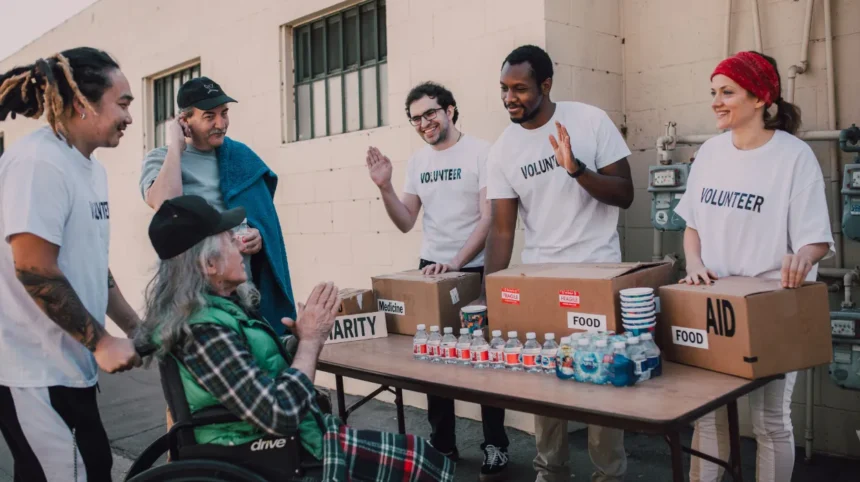
The history of volunteering is as ancient as human society itself. At its core, it rests upon the free goodwill of individuals who offer their time, unpaid labour, ingenuity, and creativity in varied service to people and the planet. Born of selflessness and solidarity—qualities integral to human existence across all spheres—it underpins the very foundation of collective life, wherein individuals sustain and champion one another, even in the face of relentless attempts at dehumanisation, preserving their benevolence both personally and collectively.
Religious monasteries, militaries, missionaries, and other institutions have long codified this freely chosen human altruism, marshalling it for public works ranging from healthcare and education to infrastructural development. From religious missions to political, economic, cultural and military missions, volunteering continues to play a major role. Yet this same altruism, in its individual and collective guises, has been conscripted by religious forces for crusades and terror, and by monarchs, ruling classes, and political parties to mobilise masses for the capture of state powers, governments, and military conquests. Colonial, imperialist, nationalist, and patriotic wars have likewise harnessed volunteering to advance their ambitions. Conversely, anti-feudal, anti-colonial, anti-apartheid, anti-imperialist, and anti-capitalist struggles for human emancipation have often employed it as an organising principle for progressive change. Peace campaigns, alongside movements to protect human rights, animal welfare, wildlife, and the natural world, are frequently steered by voluntary collectives, whose members willingly sacrifice time, labour, and creativity in society’s service.
However, the altruism that gave rise to volunteering has since been subsumed by capitalism, woven into its very structures to further exploit human labour—beyond the bounds of formal and informal employment relations alike. A burgeoning volunteering market has emerged, wherein capital appropriates free labour and creativity under the guise of offering experience, skills, credentials, and networks. These strategies have transmuted social commitment and civic participation into what are now termed civil-society organisations, employability hubs, and volunteering centres—effectively repositories of gratuitous labour for the capitalist class, dispensed in the name of future career-building.
Universities, schools, charities, educational bodies and governments have further institutionalised this system, abetted by career-counselling and employability hubs that channel youthful vigour, creativity, and toil toward organisations in search of cost-free interns and knowledge-transfer arrangements in the name of volunteering. The rise of digitalisation, online platforms, and professional networks has only deepened these volunteer networks, formalising relationships predicated on organised gratuitous labour extracted from human benevolence. Volunteers frequently perform work that would otherwise demand paid employment. The entire volunteering infrastructure is, by and large, integrated within capitalist structures, reproducing capitalist relations across myriad spheres of life while functioning as a shock-absorbing mechanism for the capitalist system itself.
It palliates capitalism’s recurrent crises, rehabilitating its image and often cloaking its fundamental weaknesses beneath a humanitarian veneer. In bestowing a respectable name upon the unpaid labour market, volunteering enables capital to exploit labour founded on altruism. Digital capitalism has vastly accelerated this expansion, intensifying the extraction of uncompensated work.
This system has spawned a dedicated service sector—the so-called third sector—critical to absorbing the shocks of capital accumulation. It diverts attention from capitalist crises and blunts the edge of anti-capitalist movements, encouraging unemployed youth and students to embrace volunteering as an opportunity, a passion, or a speculative investment in an uncertain professional future. The pervasive language of employability obscures the inherent precarity of work within a regime of jobless growth. The institutionalisation of volunteering and its seamless incorporation into capitalism have transformed human altruism, civic engagement, communal goodwill, passion, and solidarity into a commodity—gratuitous labour that inherently aids accumulation by forging an intimate nexus between the worker, the work, and the workplace, all sanctified by the rhetoric of free choice of volunteering.
Philanthropic initiatives masquerading as corporate social responsibility have further entrenched this capitalist culture of volunteering, bestowing upon capital a humanitarian visage that belies its fundamental reliance on the exploitation of labour and nature. The landscape of volunteering continues to evolve in lockstep with the exigencies and appetites of the capitalist order.
It is therefore imperative to expose how capitalism and its volunteering industry systematically misappropriate human altruism and compassion to sustain their pyramid of profit, while systematically eroding the free goodwill of individuals and collectives through institutionalised employability regimes that ultimately serve capital at the expense of individuals, society and of humanity itself.
The views expressed in this article are the author’s own and do not necessarily reflect (North London News) editorial policy.