
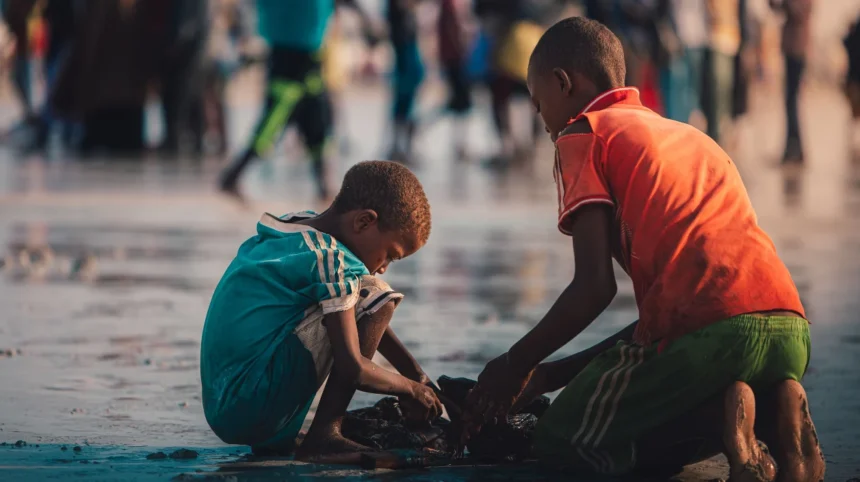
Somalia is in the throes of a deep humanitarian crisis of child hunger. While child hunger is a universal cause—for the capitalist, free people of the wretched earth, and for all those who refuse to accept a monstrous world where such horrors persist due to aid cuts, ecological devastation, and civil wars engineered by US imperialism—its essence and character remain stark. In the Global Hunger Index (GHI) 2026, Somalia features a severe score of 44.1, placing it among the countries with the highest and most alarming hunger and malnutrition levels globally.
The GHI score is based on undernourishment, child stunting, child wasting, and child mortality. It represents the degree of severity of hunger in a country. Somalia is currently facing profound food insecurity, driven by man-made climate shocks, civil war and conflict, and a steep funding drop for humanitarian aid. Nearly 1.9 million children are projected to be malnourished in 2026. UNICEF spokesperson James Elder told reporters in Geneva:
“In Somalia today, aid cuts are closing doors to healthcare, shutting down nutrition services, and pushing water, education, and protection further out of reach.”
He warned that as many as 618 health facilities could close nationwide under “severe funding scenarios.”
“This is the wrong moment to retreat,” Elder added.
AP and Reuters have reported that the drought-stricken country has recorded a 32 percent jump in the number of children treated for severe malnutrition. UNICEF has reported that one-third of Somalia’s 19 million population faces severe food shortages. The ongoing drought has devastated livestock, ruined harvests, and destroyed livelihoods. Between January and April, the displacement of 500,000 people added to the roughly 3.3 million Somalis already displaced.
Aid cuts close the doors to healthcare, shut down nutrition services, and push water, education, and protection further out of reach for the people of Somalia. Fewer facilities mean longer and more arduous journeys for mothers and their babies; longer journeys mean delays in treatment, and later treatment means a greater risk of preventable child deaths. To add insult to injury, the country is facing a worsening climate catastrophe—severe drought in some parts, civil strife and displacement, the El Niño scourge—and, on top of it, the US-Iran war has resulted in rising costs of fuel and fertilizer. At this critical moment, the resources needed to protect vulnerable children are being cut.
According to one estimate, the education sector lost $30 million USD in 2025, and major donors have reduced their contributions by more than half in 2026. More than 78,000 students have already dropped out, with another 660,000 girls and boys at risk. According to one commentator, Somalia is a country with one of the highest rates of reported violence against children. The funding cuts have affected protection services, including case management, psychological support, family tracing, and reintegration.
The story of Abdullah paints a grim picture: Abdullah, a teenager, wanted to be a mechanic and was always tinkering with machinery in his village. Non-state armed groups noticed this and offered him work and training as a mechanic. Without any opportunities where he was, and desperate to support his widowed mother, he took the offer. But it was a lie—he was thrown into the battlefield. After a failed attempt to escape, Abdullah was wounded in combat and captured by government forces. UNICEF is said to support children who have been associated with armed groups by enrolling them in training centres. After completing training in trades like cooking, electrics, and mechanics, they receive starter kits to help them launch their own businesses. But funding cuts mean that there will be no starter kits and no kickstarts for these children.
US imperialism has systematically undermined Somalia’s self-sufficiency, leaving millions of children vulnerable to acute malnutrition on one pretext or another. For decades, the dumping of heavily subsidized US surplus grain and emergency wheat into Somali markets has undercut local farmers. A survey by the General Accounting Office has revealed that large-scale food aid programmes have lowered market prices to such a degree that they destroyed incentives for local agricultural development. This erosion of the local agricultural base has transitioned Somalia from a largely self-sufficient pastoral and agricultural economy into a highly dependent, import-based one. When the global supply chain collapses or inflation spikes, Somali families are left in the lurch.
Historically, US aid to Somalia has functioned as a geopolitical tool rather than a stable humanitarian guarantee. Abrupt policy shifts from Washington have routinely triggered severe spikes in child hunger. Diplomatic rifts and allegations regarding food aid diversion—allegations unsubstantiated by the UN—have resulted in sweeping suspensions and freezes of emergency food assistance. Moreover, the US-led and backed geopolitical wars across the world, waged to cater to the industrial-military corporates, actively worsen the situation in Somalia. In a country where food self-sufficiency was stripped away decades ago, fuel, fertilizer, and imported grain prices have now doubled. This massive inflation has deprived poor families of basic nutrition and turned global political disputes into a localized crisis of childhood starvation.
It is a well-known fact that imperialism is the driving force behind the animal spirit of capitalism. Hunger, homelessness, poverty, malnutrition, and food and nutritional insecurity are on the rise due to American aid cuts. Professor Bhabani Nayak, in his compelling article entitled
“How Musk’s War on USAID Became a Death Sentence for Millions in the World,”
published in Countercurrents.org on July 17, 2026, highlights the devastating impact of shutting down the US Agency for International Development (USAID) and eliminating its $40 billion budget under the ostensible plea of maintaining efficiency and austerity. According to Professor Brooke Nicholas of Boston University—whom Prof. Nayak quotes in the said article—the discontinuation of USAID funding has resulted in the deaths of more than 262,915 adults and 518,428 children. It is estimated that 14 million people might have ultimately died as a result of this halt between January 20, 2025, and July 4, 2026. These deaths, destitution, and disease reveal much about America’s governing elites and their capitalist model of development.
Howard Zinn, in his book You Can’t Be Neutral on a Moving Train: A Personal History, succinctly offers a glimpse of hope for Somalia:
“To be hopeful in bad times is not just foolishly romantic. It is based on the fact that human history is not only of cruelty, but also of compassion, sacrifice, courage, kindness. What we choose to emphasize in this complex history will determine our lives. If we see only the worst, it destroys our capacity to do something.”
The need of the hour, therefore, is to organise a global movement in solidarity with Somalia.
The views expressed in this article are the author’s own and do not necessarily reflect (North London News) editorial policy.