Key Points
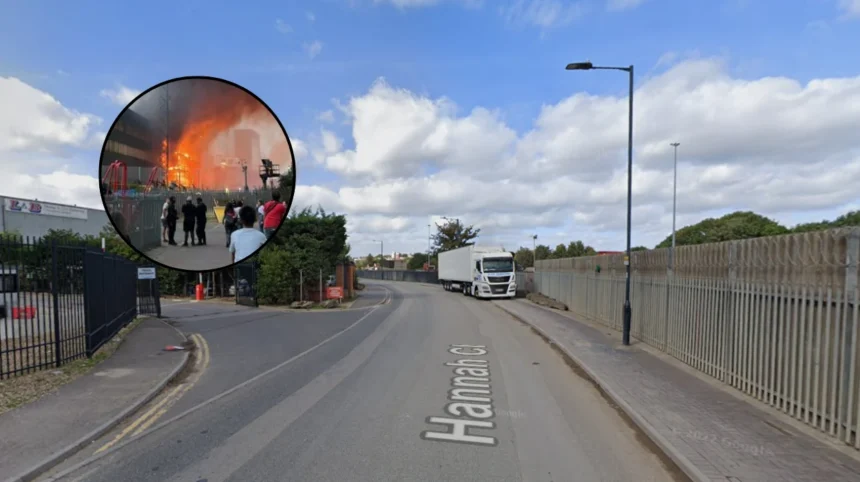
- A fire broke out at a mixed waste processing facility on Hannah Close in Neasden, North-West London, burning an industrial unit measuring about 100 metres by 150 metres.
- The London Fire Brigade received the initial call at 11:34 AM and sent 20 fire engines and roughly 125 firefighters, who used three 32-metre turntable ladders, aerial drones, a hose-laying unit, and a high-volume pump.
- Transport for London suspended the Metropolitan line entirely and stopped Jubilee line trains between Willesden Green and Wembley Park, while National Rail reported delays on routes to London Marylebone.
- Fire officials advised local residents to keep doors and windows closed due to heavy smoke and asked commuters to stay away from the area.
- No injuries were reported, and emergency officials have not yet determined the cause of the fire.
North London (North London News) August 28, 2026 — Emergency services were deployed in large numbers to North-West London following a major industrial blaze at a waste facility that sent plumes of dark smoke across the skyline, forcing the complete suspension of one London Underground line, severe delays on another, and notable disruption to national rail services.
As reported by emergency officials from the London Fire Brigade (LFB), twenty fire engines and approximately 125 firefighters were dispatched to the scene on Hannah Close, Neasden, after the emergency control room received more than 70 public calls reporting thick smoke and flames rising from an industrial estate.
The fire broke out inside a large mixed waste management unit measuring roughly 100 metres by 150 metres. Specialist firefighting teams equipped with three 32-metre turntable ladders, high-capacity water pumps, hose-laying units, and monitoring drones were deployed to suppress the fire.
How Did Emergency Services Respond To The Neasden Industrial Blaze?
According to statements released by the London Fire Brigade (LFB), the initial emergency call was logged at precisely 11:34 AM. Crews from nearby stations, including Wembley, Park Royal, and Willesden, arrived shortly after to find a significant portion of the waste storage complex engulfed in flames.
The LFB confirmed that operational crews deployed three turntable ladders to pour water onto the roof structure from an elevated position while ground units established high-volume pumping systems to secure water supply. Firefighters also utilised aerial drone footage to monitor heat signatures and guide ground teams toward active hot spots within the burning waste piles.
Because of the dense, dark smoke drifting across nearby roads and residential estates, the London Fire Brigade issued an explicit health warning. Residents living in proximity to Hannah Close were advised to stay indoors with windows and doors shut tight to mitigate exposure to smoke particles.
Explore More North London Fire News
Caledonian Road Waste Facility Fire Disrupts Islington, 2026
Huge Fire Destroys 200 Businesses in Brent 2026
Which Train And Tube Services Have Been Shut Down By The Fire?
The proximity of the burning waste plant to primary rail corridors caused immediate operational disruptions across London’s public transport network.
Transport for London (TfL) confirmed the full suspension of the Metropolitan line, while Jubilee line operations were halted completely between Willesden Green and Wembley Park. Severe delays were reported across the remainder of the Jubilee line as trains were held at platforms to manage overcrowding.
National Rail reported that line blockages near the incident area impacted regional train services running into and out of London Marylebone station. Railway operators suspended trains along affected track sections to allow fire crews safe access to the boundaries of the property and to avoid visibility risks caused by smoke drifting across the tracks.
No injuries or casualties have been reported by the London Ambulance Service or the London Fire Brigade as of Friday evening. Fire officers confirmed that investigations into the cause of the fire will begin once the premises are rendered safe and fully extinguished.
Background To The Development
Industrial waste facility fires represent a recurring challenge for emergency infrastructure across Greater London, given the concentration of recycling processing plants near key transport lines. Sites that handle mixed household, commercial, and construction materials store bulk organic and synthetic waste that can ignite under high pressure, mechanical friction, or through improperly disposed lithium-ion batteries.
Similar incidents in recent weeks highlight the vulnerability of rail transport near industrial sectors:
- On August 18, 2026, a major fire at a recycling facility in Deptford, South-East London, involved 50 tonnes of household waste, forcing National Rail to block lines serving London Bridge and causing widespread commuter delays.
- The Deptford incident marked the second major fire at that facility within a three-month window, reflecting ongoing operational safety challenges at dense urban recycling centers.
When fires erupt in close proximity to main railway arterial lines, safety regulations require network operators to halt rail traffic to prevent visibility hazards, track damage from intense radiant heat, or potential structural collapses of adjacent property walls.
Impact Prediction: How Will This Development Affect Commuters And Local Residents?
The immediate impact of the Neasden fire will be felt most acutely by daily public transport commuters, local residents, and surrounding logistics businesses.
- Commuters and Passengers: Severe delays and line suspensions on the Metropolitan and Jubilee lines will ripple through the Transport for London network into subsequent travel windows. Evening rush-hour commuters will face diverted routes, packed bus alternatives, and overcrowded transfer stations across North-West London.
- Local Residents and Air Quality: The intense smoke output from burning mixed waste materials presents air-quality concerns. Local residents are likely to experience lingering odor, soot deposition, and potential respiratory irritation if guidance on keeping windows and doors closed is ignored.
- Freight and Regional Rail Operations: Disruption on the lines connected to London Marylebone will delay regional passengers traveling between London, the Home Counties, and the West Midlands. Transport operators may be required to reschedule trains or use freight detours until fire crews clear the perimeter safely.
- Regulatory and Operational Scrutiny: Following multiple high-profile waste facility blazes across Greater London in mid-2026, regulatory authorities like the Environment Agency and local councils are expected to increase fire safety inspections and enforcement measures regarding how scrap and waste piles are stored near vital public transit tracks.