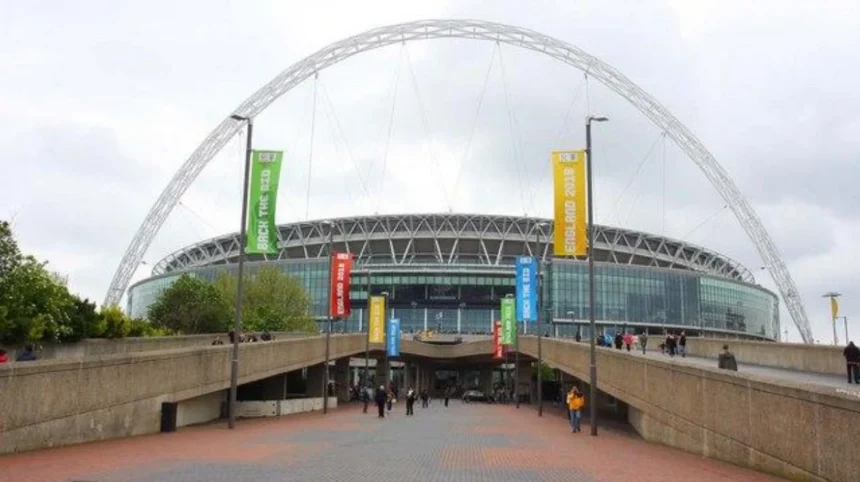
Wembley Stadium is England’s national stadium and one of North London’s most recognisable landmarks. Located in Wembley, within the London Borough of Brent, the 90,000-seat venue combines football, major sporting competitions, concerts and large-scale entertainment with a century of national history.
- What is Wembley Stadium?
- Why is Wembley Stadium historically important?
- What happened at the original Wembley Stadium?
- When did the current Wembley Stadium open?
- What makes Wembley Stadium’s architecture distinctive?
- What events take place at Wembley Stadium?
- How does Wembley Stadium support tourists and leisure visitors?
- How do you get to Wembley Stadium by public transport?
- What should visitors know about travelling to Wembley by car?
- What can you see around Wembley Stadium?
- Is Wembley Stadium suitable for a family day out?
- What makes Wembley Stadium important to North London?
- Why should Wembley Stadium be included in a North London itinerary?
- What is Wembley Stadium’s future role?
- Final thoughts on Wembley Stadium
For tourists, Wembley Stadium offers more than a matchday destination. Its architecture, stadium tours, surrounding Wembley Park district, transport connections and historic associations make the area a substantial North London attraction. The venue also provides an important link between modern London and the history of English football.
The present stadium opened in 2007 on the site of the original Wembley Stadium, which opened in 1923. The original venue hosted the 1966 FIFA World Cup Final, FA Cup Finals, the 1948 Olympic Games and major concerts. The modern stadium continues that national role with England fixtures, domestic cup finals, international sporting events and entertainment.
What is Wembley Stadium?
Wembley Stadium is England’s national football stadium in Wembley, North London. The present 90,000-seat venue opened in 2007 and hosts England football matches, major domestic finals, international sport, concerts and other large-scale events throughout the year.
Wembley Stadium is situated in the London Borough of Brent, approximately eight miles north-west of central London. It is operated as a major national sports and entertainment venue rather than as the permanent home of a conventional club football team.
The Football Association, commonly known as the FA, uses Wembley as the principal home of the England national football team. The stadium also hosts the FA Cup Final and other important football fixtures.
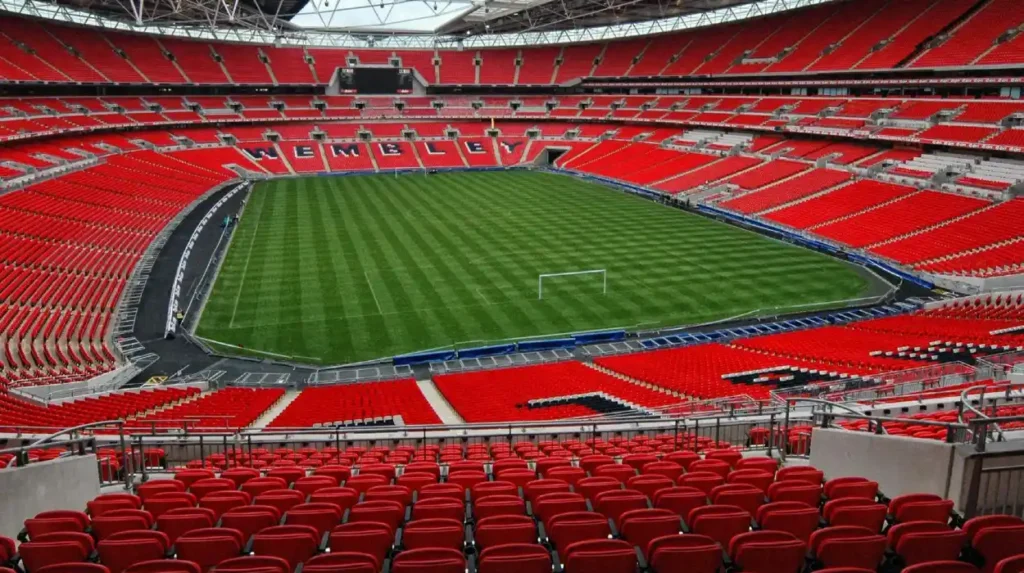
Its 90,000 seats make Wembley the largest sports venue in the United Kingdom. The stadium is also among Europe’s largest stadiums. Its scale allows it to accommodate major sporting and entertainment audiences within a single venue.
Wembley’s role extends beyond football. The venue has hosted rugby, athletics-related events, boxing, American football and major music performances. This multi-purpose function makes Wembley an important destination for visitors with different interests.
Why is Wembley Stadium historically important?
Wembley Stadium became historically important after the original venue opened in 1923 as the Empire Stadium. It hosted the first Wembley FA Cup Final, England’s 1966 World Cup victory and generations of major sporting and cultural events.
The original stadium was constructed for the British Empire Exhibition of 1924–25. Construction took place rapidly, with the stadium completed in approximately 300 days at a reported cost of £750,000.
The venue originally carried the name Empire Stadium. Its purpose was connected to the wider British Empire Exhibition, which occupied a large area of Wembley. The stadium ultimately outlasted the exhibition and developed an independent identity based on sport.
The first major event took place on 28 April 1923. Bolton Wanderers played West Ham United in the FA Cup Final. The match became known as the White Horse Final because mounted police, including the famous white horse associated with PC George Scorey, helped control the enormous crowd.
The official attendance was recorded as 126,047, while contemporary estimates placed the actual crowd substantially higher. Thousands of supporters entered the stadium and spilled onto the pitch, delaying the match.
Wembley then became the regular home of the FA Cup Final for most of the twentieth century. The original stadium closed in 2000, was demolished during the early 2000s and was replaced by the present stadium, which opened in 2007.
As you explore the modern site, you are crossing land with a deep heritage. Read about the full [Insert Anchor Text for History Article Here] to understand its origins.
What happened at the original Wembley Stadium?
The original Wembley Stadium hosted the 1923 FA Cup Final, the 1948 Olympic Games, the 1966 FIFA World Cup Final and UEFA European competition. It closed in 2000 and was demolished between 2002 and 2003 before the modern stadium opened in 2007.
The original Wembley became closely associated with England’s national football identity.
One of its defining moments came during the 1966 FIFA World Cup. England played every World Cup match at Wembley during the tournament and defeated West Germany in the Final. More than 96,000 spectators attended the showpiece match.
Wembley also formed part of the 1948 Summer Olympics. The venue continued to host major international football throughout the post-war period.
UEFA European competition added another layer to its history. Wembley hosted European Cup Finals, including finals involving some of Europe’s most prominent clubs.
The stadium was not limited to football. Wembley hosted the Live Aid concert in 1985, a globally significant music event. Artists including Queen, Michael Jackson, The Rolling Stones and Take That also performed at the original venue.
The original Wembley became equally recognisable for its Twin Towers. Those towers formed the visual identity of the stadium for much of the twentieth century.
The old stadium’s final fixture took place in October 2000, when England played Germany in a World Cup qualifier. Demolition followed, clearing the site for a new national stadium.
When did the current Wembley Stadium open?
The current Wembley Stadium opened in 2007 after the original 1923 stadium was demolished. The new venue retained Wembley’s national sporting role while introducing a modern 90,000-seat bowl, large roof structure, improved spectator facilities and a distinctive arch.
The present stadium was developed on the same Wembley site as the original ground. Its design transformed the visual appearance of the landmark while retaining the location’s connection with English football.
The new Wembley opened in 2007. The first competitive event was the 2007 FA Cup Final, continuing the long association between Wembley and England’s premier domestic cup final.
The redevelopment created a modern stadium designed for football, athletics-related use, concerts and other large-scale events. Its facilities also support modern hospitality, media operations, corporate events and spectator services.
The new venue cost approximately £798 million. Its construction produced one of the largest stadium projects in the United Kingdom and created a landmark that dominates the Wembley skyline.
For visitors, the distinction between old and new Wembley is important. The present building is not the original 1923 structure. It is a completely reconstructed national stadium built on the historic site.
What makes Wembley Stadium’s architecture distinctive?
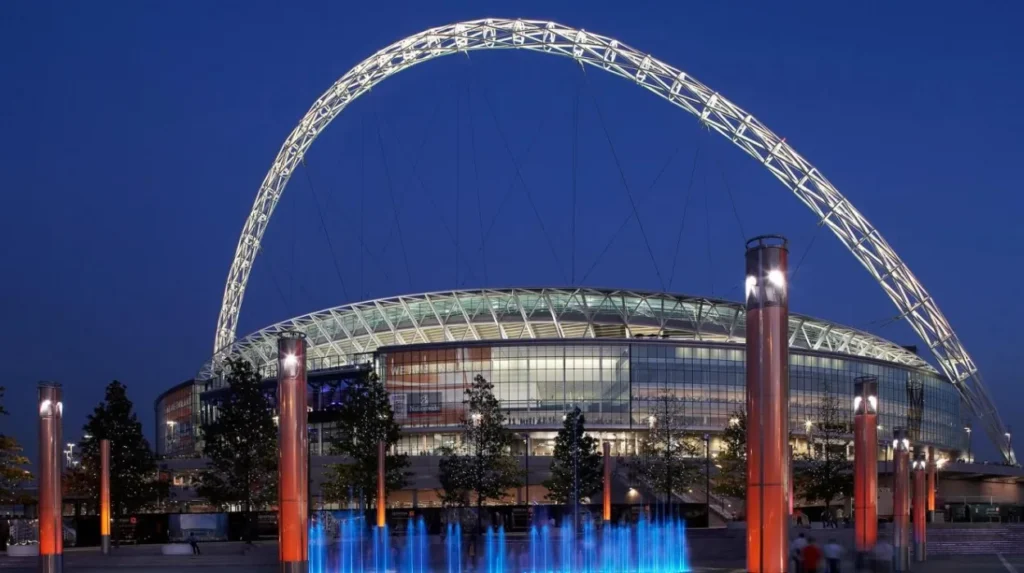
Wembley Stadium is defined by its huge 133-metre arch, circular bowl and large roof system. The arch is visible across London and provides the modern venue with its most recognisable architectural feature.
The Wembley arch is the stadium’s defining external feature. It rises approximately 133 metres above the ground and stretches across the stadium as a major structural element.
The arch performs an engineering function as well as creating the stadium’s visual identity. It supports the roof structure and reduces the need for traditional structural elements across the stadium bowl.
The roof system protects spectators from the weather. Its design also contributes to the stadium’s suitability for major entertainment events.
The stadium’s bowl contains 90,000 seats arranged to provide large-scale viewing capacity. The configuration supports football spectators while also accommodating concerts and other event formats.
The architecture creates a clear contrast with the original Wembley. The old stadium was identified by its Twin Towers, while the modern stadium is identified by the single sweeping arch.
For photographers and visitors exploring Wembley Park, the arch is one of the easiest landmarks to recognise. It is particularly prominent from surrounding streets, public spaces and transport approaches.
What events take place at Wembley Stadium?
Wembley Stadium hosts England football matches, FA Cup Finals, international football, major rugby events, concerts and other large-scale entertainment. Its 90,000-seat capacity supports national sporting occasions and major commercial events.
Football remains Wembley’s central activity. England’s senior men’s national team uses the stadium for home fixtures, while the venue also hosts important domestic football matches.
The FA Cup Final is one of Wembley’s most established annual sporting occasions. The competition is organised by the Football Association and represents one of English football’s longest-running cup competitions.
Wembley also hosts international football competitions. Its history includes FIFA World Cup and UEFA European Championship matches.
Rugby has also formed part of the stadium’s modern programme. Wembley hosted matches during the 2015 Rugby World Cup, demonstrating its ability to operate beyond football.
Music is another major part of Wembley’s identity. The stadium has hosted large-scale concerts involving internationally recognised performers. Its capacity and transport infrastructure make it suitable for events that attract audiences from across Britain and overseas.
Other sporting and entertainment events have included boxing and American football. The venue therefore functions as a multi-purpose stadium rather than a football-only attraction.
Event schedules change throughout the year. Visitors planning a trip around a particular match or concert should check the official Wembley Stadium event information before travelling.
How does Wembley Stadium support tourists and leisure visitors?
Wembley Stadium provides tourists with a combination of stadium experiences, football heritage, architecture, event entertainment and access to Wembley Park. Visitors can explore the venue through organised experiences and combine a stadium visit with attractions across the surrounding district.
A visit to Wembley works well as part of a wider North London itinerary. The stadium sits within a major regeneration area containing restaurants, shops, public spaces, accommodation and entertainment venues.
The stadium itself provides organised visitor experiences. These experiences focus on the venue’s architecture, sporting history and behind-the-scenes areas. Availability and opening times vary according to the event calendar.
Visitors interested in football history gain additional value from understanding the original stadium. The current building sits directly on the historic Wembley site, linking modern architecture with the venue’s 1923 origins.
The surrounding Wembley Park area also provides public spaces suitable for walking and photography. The large stadium arch provides a strong visual reference throughout the neighbourhood.
For domestic business travellers, the district offers practical access to central London through several transport routes. This makes Wembley suitable for combining meetings or accommodation with evening entertainment.
Digital nomads also benefit from the wider Wembley Park environment, particularly its cafés, restaurants and public spaces. However, work facilities and opening conditions vary between individual venues.
How do you get to Wembley Stadium by public transport?
Wembley Stadium has three principal nearby railway and Underground stations: Wembley Park, Wembley Stadium and Wembley Central. Wembley Park serves the Jubilee and Metropolitan lines, Wembley Stadium serves Chiltern Railways, and Wembley Central serves the Bakerloo line and other rail services.
Wembley Park Station is one of the most convenient Underground options. It is served by the Jubilee line and Metropolitan line. The station provides direct connections towards central London and other parts of the Underground network.
Wembley Stadium Station is served by Chiltern Railways. It provides rail connections between Wembley and London Marylebone, making it particularly useful for visitors arriving from central London by mainline rail.
Wembley Central Station provides another option. It is served by the Bakerloo line and additional rail services. This station connects Wembley with other parts of London and surrounding areas.
The three stations are positioned at different points around Wembley. Choosing a station based on the traveller’s starting point and final destination reduces unnecessary walking and interchange.
All three stations provide step-free access and low-level ticket machines according to Wembley Stadium’s visitor information.
Visitors attending major events should allow additional journey time. Large crowds increase pedestrian movement around stations before and after events.
What should visitors know about travelling to Wembley by car?
Wembley Stadium is primarily a public-transport destination. Drivers need to consider event traffic, parking arrangements and London’s road charging rules. Wembley Stadium’s official guidance also identifies the venue as part of Transport for London’s Ultra Low Emission Zone.
Public transport is generally the most straightforward option for major stadium events because large crowds create substantial pedestrian and road traffic.
Drivers should check parking arrangements before travelling. Stadium event parking conditions vary according to the event and local restrictions.
The Ultra Low Emission Zone, known as ULEZ, is a Transport for London road-charging scheme based on vehicle emissions standards. Wembley Stadium’s official transport guidance states that the stadium is within the ULEZ.
Visitors driving into London should check current TfL requirements before travelling because charges, exemptions and vehicle standards are subject to policy changes.
Coach travel also serves Wembley for selected events. Wembley Stadium identifies National Express as its official coach travel provider for event-specific services from locations across the United Kingdom.
What can you see around Wembley Stadium?
The area around Wembley Stadium combines the stadium itself with Wembley Park’s public spaces, restaurants, shops, accommodation and entertainment facilities. The surrounding district provides visitors with places to eat, walk, photograph the stadium and continue their North London itinerary.
Wembley Park is the principal district surrounding the stadium. Its redevelopment has transformed the area from a stadium-focused destination into a mixed-use neighbourhood.
Visitors can walk around the public areas surrounding the stadium before or after an event. The stadium arch provides a dominant landmark and an obvious photography subject.
The wider district contains restaurants serving different cuisines. This creates practical options for visitors attending evening events or spending several hours in the area.
Accommodation is also concentrated around Wembley Park and the stadium. Hotels in the area provide an alternative to staying in central London, particularly for visitors attending late-running concerts or sporting events.
The district has strong transport connections. This makes it practical for visitors to combine Wembley with other London attractions during a longer stay.
Visitors seeking a less event-focused experience should explore Wembley Park outside major match and concert periods. The area provides a different atmosphere when the stadium is not operating at full event capacity.
Is Wembley Stadium suitable for a family day out?
Wembley Stadium suits families interested in football, architecture and major events. A family visit combines the stadium experience with Wembley Park’s restaurants, public spaces and transport connections, while organised stadium experiences provide additional context about the venue’s history.
Families interested in football gain an opportunity to see one of England’s most important sporting venues.
The stadium’s scale also provides an educational dimension. Visitors can learn about the development of modern stadium design, the history of English football and the changing role of national sporting venues.
A stadium tour provides structured information rather than simply viewing the building from outside. Tour availability, access arrangements and permitted areas depend on the official visitor programme.
Families should plan around event schedules. Matchdays and concert days involve much larger crowds than ordinary periods.
Wembley Park provides additional space for families before and after stadium activities. Restaurants and public areas make it easier to extend the visit beyond the stadium itself.
What makes Wembley Stadium important to North London?
Wembley Stadium is one of North London’s strongest international landmarks. It supports sport, entertainment, tourism, hospitality, transport activity and local regeneration while connecting the Wembley district with England’s national sporting history.
Wembley’s importance extends beyond the physical stadium.
The venue attracts visitors from across the United Kingdom and overseas. Major football fixtures and concerts generate substantial visitor movement through Wembley’s transport network.
The stadium also supports surrounding hospitality businesses. Hotels, restaurants and retail businesses benefit from the concentration of visitors generated by major events.
Wembley Park has developed alongside the stadium as a large mixed-use urban district. The combination of housing, commercial activity, leisure facilities and transport infrastructure has strengthened Wembley’s role within North West London.
The stadium also provides international visibility for Brent. Images of the arch appear regularly in coverage of major football and entertainment events.
Its national role creates a clear distinction between Wembley and ordinary local sports grounds. Wembley represents England’s national football infrastructure while operating within a densely populated London neighbourhood.
Why should Wembley Stadium be included in a North London itinerary?
Wembley Stadium deserves a place on a North London itinerary because it combines national sporting history, distinctive architecture, major events, organised visitor experiences and a regenerated urban district with strong public transport connections.
A Wembley visit works particularly well for travellers interested in football and modern London.
The historic significance provides depth beyond the modern structure. The site has been associated with English football since 1923 and has hosted some of the most significant sporting occasions in the country.
The modern architecture provides a separate attraction. The 133-metre arch creates a landmark that is instantly identifiable from the surrounding area.
The transport network makes Wembley relatively easy to reach from central London. Wembley Park, Wembley Stadium and Wembley Central provide three major access points.
Visitors can also combine the stadium with Wembley Park. This creates a complete local itinerary involving sightseeing, food, entertainment and photography rather than a single-purpose stadium visit.
For football supporters, the strongest reason to visit is Wembley’s connection with England’s national team and the FA Cup. For general tourists, its architecture and historical importance provide an alternative reason to explore the area.
What is Wembley Stadium’s future role?
Wembley Stadium’s future role remains centred on England football, major domestic finals, international sport and large-scale entertainment. Its 90,000-seat capacity and established national identity secure its position as a major British sporting and cultural venue.
Wembley has already demonstrated its ability to remain relevant across different generations of sport and entertainment.
The transition from the 1923 Empire Stadium to the 2007 national stadium shows how the site has adapted to changing requirements. The original Twin Towers disappeared, while the modern arch became the defining landmark.
The venue continues to support England’s national football programme. It also remains an important location for domestic football finals and major international events.
Technological upgrades are part of the stadium’s continuing development. Wembley’s official information highlights investment in areas including the pitch, floodlights and public-address system.
Its location also strengthens its long-term relevance. Wembley has multiple railway and Underground connections, while the surrounding district contains accommodation, food, retail and leisure facilities.
For North London tourism, Wembley therefore represents both a historic landmark and an active modern venue. Its importance is not restricted to one football match or one generation.
Final thoughts on Wembley Stadium
Wembley Stadium is one of the defining landmarks of North London and England’s national sporting landscape. The modern 90,000-seat stadium opened in 2007 on the site of the original 1923 venue.
Its significance comes from the combination of history, architecture, sport, music and urban regeneration. The original Wembley hosted the 1923 FA Cup Final and the 1966 World Cup Final. The present stadium continues the national tradition through England fixtures, major domestic finals, international sport and entertainment.
For visitors, Wembley works best as a complete neighbourhood experience. The stadium provides the central attraction, while Wembley Park supplies restaurants, accommodation, public spaces and additional leisure opportunities.
The venue’s 133-metre arch, 90,000-seat capacity and century-long history give it a clear identity within London. Its three nearby transport stations also make it accessible from different parts of the capital.
For tourists exploring North London, Wembley Stadium provides a direct connection between England’s sporting heritage and contemporary London.
Where is Wembley Stadium located?
Wembley Stadium is located in Wembley, in the London Borough of Brent, North London. It is approximately eight miles north-west of central London and is surrounded by the Wembley Park neighbourhood.