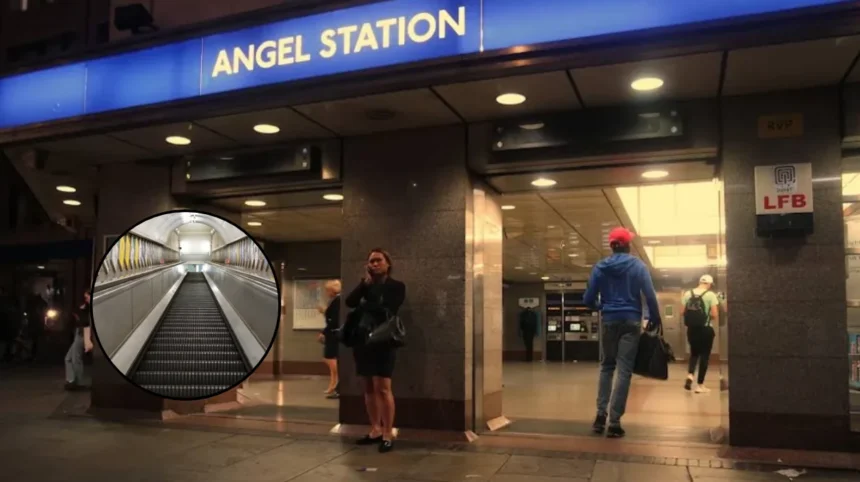
Key Points
- Partial Closure Announced: Transport for London (TfL) has confirmed that Angel Underground station will operate on an exit-only basis during weekends and bank holidays starting in early 2027.
- Weekday Operations Maintained: Escalators will run as normal on weekdays to minimise disruption for weekday commuters and peak-time travel.
- Reason for Disruptions: The measure is required to address failing, 35-year-old escalators that are becoming increasingly unreliable and difficult to maintain.
- Station Significance: Angel station houses four major escalators, including the longest continuous escalators across the entire London Underground network.
- Travel Alternatives Provided: Passenger advice recommends taking local bus routes to neighboring transport hubs, including King’s Cross St Pancras, Old Street, or Highbury & Islington stations.
- Long-Term Plan: TfL is beginning design work in autumn 2026 to replace the escalators, with weekend exit-only measures serving as an interim solution to extend their lifespan.
Islington (North London News) October 28, 2026 – Transport for London (TfL) has formally resolved its plan regarding the future of Angel Underground station, confirming that the busy North London transit hub will be restricted to exit-only access during weekends and bank holidays starting from early 2027. As reported by legal and city reporting from Time Out, the public transport body evaluated multiple operational interventions—including a potential complete closure of the station lasting up to a full year—before finalising a phased approach designed to balance urgent engineering requirements against local travel disruption.
Under the agreed strategy, weekend and bank holiday commuters will be permitted to alight from northbound and southbound Northern line trains at Angel to exit the station, but entry into the ticket hall will be prohibited. Passengers seeking to enter the Underground network from the Angel area during these periods will be instructed to utilize local bus services to access alternative nearby stations, specifically King’s Cross St Pancras, Old Street, or Highbury & Islington.
The decision follows weeks of technical assessments concerning the operational integrity of the station’s major vertical transport infrastructure. The escalators at Angel carry hundreds of thousands of passengers weekly, making partial operational availability necessary to prevent unscheduled complete outages.
What is causing the severe escalator failures at Angel Underground station?
The necessity for operational restrictions stems directly from the declining mechanical reliability of the primary escalator units at Angel station. The station relies on four primary escalators divided into two distinct sections: two operating between the main ticket hall and the mid-concourse level, and two operating between the mid-concourse level and the platform. Notably, the upper pair linking the ticket hall to the mid-concourse level holds the distinction of being the longest escalators across the entire London Underground network, measuring 60 metres (197 feet) in length with a vertical rise of 27.5 metres.
Installed during the major reconstruction of the station in the early 1990s, several of these units are now approaching 35 years of continuous service. The age of the components has led to frequent mechanical faults and increasing difficulty in sourcing replacement parts, resulting in sporadic unscheduled station closures.
As reported by Time Out, Richard Jones, Director of Asset Performance Delivery for London Underground, stated that the equipment is “becoming less reliable and increasingly difficult to maintain.” Jones further explained that implementation of the partial weekend closure plan provides essential operational flexibility:
“Making the station exit-only during specific periods will allow us to extend the working life of the escalators and give us more time to plan our next steps, with design work on replacing the escalators to begin this autumn.”
Jones added that London Underground is conscious of the inconvenience the maintenance strategy will cause:
“I understand that any disruption to the station will have an impact on customers, businesses and the local community and we will do all we can to work closely with local stakeholders to ensure that we mitigate the disruption as much as possible.”
How will the engineering schedule and travel diversions operate?
TfL has confirmed that detailed design work for the complete replacement of the escalator systems is set to commence in autumn 2026. The full replacement program represents a complex engineering project due to the depth of the station and the physical dimensions of the escalators involved.
While an exact calendar date for the commencement of the exit-only policy in early 2027 has yet to be finalised, TfL has committed to providing advance public notification once operational schedules are fixed. By keeping all escalators running in standard two-way operational modes from Monday through Friday, transport authorities aim to protect standard working-week commuter flows along the Bank branch of the Northern line.
For weekend visitors, local residents, and shoppers visiting Upper Street and the surrounding Islington area, TfL recommends planning journeys in advance. Bus routes connecting Angel to King’s Cross St Pancras (Northern, Victoria, Piccadilly, Circle, Hammersmith & City, Metropolitan lines, and National Rail), Old Street (Northern line and National Rail), and Highbury & Islington (Victoria line, London Overground, and National Rail) will serve as the primary diversionary links.
Background of the particular development
Angel Underground station, situated on the Bank branch of the Northern line between King’s Cross St Pancras and Old Street, has a complex structural history. Originally opened in 1901 by the City & South London Railway, the station initially featured an island platform configuration accessed purely by electric lifts.
By the late 20th century, severe overcrowding on the single narrow platform posed significant safety challenges. Between 1989 and 1992, London Underground undertook a comprehensive modernization project. A new northbound tunnel and platform were excavated, converting the original tunnel into an expanded southbound platform. To accommodate the increase in passenger volume and deep level, the lift shaft was decommissioned and replaced by a vast escalator incline leading to a central ticket hall.
Because the station relies entirely on escalators for passenger ingress and egress (lacking step-free lift access from the main entrance to deep platforms), the failure of multiple escalator units directly compromises safety regulations regarding station evacuation. In recent years, aging infrastructure across older London Underground lines has required sustained capital investment, with escalator overhauls representing one of the most mechanically demanding elements of subsurface network maintenance.
Prediction: How this development can affect local businesses, residents, and weekend commuters
The introduction of exit-only restrictions at Angel station is anticipated to significantly alter travel patterns and commercial footfall across Islington and the N1 postal district.
Commercial Footfall and Local Economy
Upper Street, Chapel Market, and the surrounding commercial precincts rely heavily on weekend retail, dining, and nighttime economy footfall. While incoming visitors will still be able to arrive directly at Angel station via the Northern line, the added friction of navigating alternative bus or walking routes to depart the area at the end of their visit may deter casual leisure visitors. Local trade associations and retail operators may see a shift in peak shopping hours or reduced evening weekend revenue as visitors elect to patronize areas with fully accessible transport hubs.
Residential Disruption and Surface Transport Pressure
For residents living in Angel, Barnsbury, and Canonbury, weekend travel outward from the neighborhood will require additional travel time. Local surface transit networks—specifically key bus routes along Islington High Street and Upper Street—are likely to experience increased congestion and higher passenger density during peak weekend hours as passengers transfer toward King’s Cross or Highbury & Islington.
Precedent for Infrastructure Upgrades
If the weekend exit-only model successfully mitigates mechanical wear while avoiding a total station shutdown, TfL may adopt similar phased operational strategies for future deep-level escalator replacements across other aging Underground stations, balancing long-term asset renewal against urban mobility needs.