Key Points:
- Transport for London (TfL) is considering full or partial closures of Angel Underground station in Islington for up to a year due to failing escalator infrastructure.
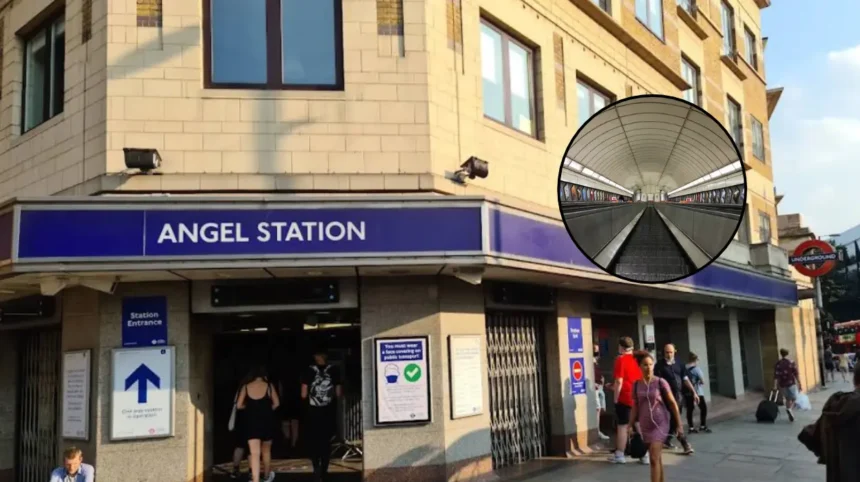
- Angel station handles nearly 12 million passengers annually and features the longest escalators on the London Underground network, measuring 200 feet (61 metres).
- One of the station’s three 35-year-old escalators broke down in April, with a second unit reported to be on the verge of imminent failure and the third requiring urgent overhaul.
- Initial proposed mitigation measures include making the station exit-only during off-peak periods, evenings, and weekends starting from November.
- Replacing bespoke deep-level escalators typically requires extensive heavy engineering, structural access work, and prolonged station operational restrictions.
Islington (North London News) October 17, 2026 – Major London Underground hub Angel station could be forced to close its doors to passengers for up to a year as transport bosses struggle to resolve critical mechanical failures across its deep-level escalators. Transport for London (TfL) is evaluating radical operational plans—including a complete 12-month closure or severe restricted opening hours—to facilitate the comprehensive replacement of the station’s crumbling mechanical staircases. The station, located on the Bank branch of the Northern line in the Borough of Islington, serves almost 12 million passengers every year and relies entirely on escalators to move commuters between the deep-level ticket hall and platform levels.
- Key Points:
- Why is Angel station facing a potential year-long closure?
- What operational measures are Transport for London currently evaluating?
- How significant is the financial burden of TfL escalator maintenance?
- Background of the particular development
- Prediction: How this development can affect passengers, local businesses, and the Islington community
As reported by Chief Political Correspondent Rachael Burford and News Reporter Tom Place of The Evening Standard, TfL engineers have warned that the station’s 35-year-old escalator infrastructure has reached a point of breakdown. In April, one of the three 200-foot (61-metre) escalators at Angel station suffered a major mechanical breakdown and was removed from service. Transit officials now believe that a second escalator is on the brink of immediate failure, whilst the final remaining unit requires emergency refurbishment. Because Angel station lacks passenger lifts and features standard deep-level access stairs that cannot accommodate primary station traffic, operating with only one functional escalator presents major safety risks regarding overcrowding and emergency evacuation protocols.
Why is Angel station facing a potential year-long closure?
As reported by Rachael Burford and Tom Place of The Evening Standard, the immediate catalyst for the proposed closure is the severe mechanical deterioration of the station’s three primary escalators, which were originally installed during the major reconstruction of the station between 1989 and 1992. Angel boasts the longest escalators on the London Underground network and the second-longest in the United Kingdom, featuring a vertical rise of 90 feet (27 metres) and a incline length of 200 feet.
Replacing escalators of this size presents significant structural and logistical engineering challenges. Transport safety standards mandate that heavy escalator components—including large truncheons, drive gearboxes, step chains, and steel trusses—must be dismantled and extracted through narrow subterranean shafts. As reported by The Evening Standard, TfL is currently considering making the station exit-only during off-peak periods, evenings, and weekends starting as early as November to facilitate initial engineering assessments and immediate stabilization work. However, engineers caution that safely replacing all three massive escalator mechanisms may ultimately require shutting the station down completely to ensure public safety and accelerate heavy construction timelines.
What operational measures are Transport for London currently evaluating?
As reported by The Evening Standard, transit planners are reviewing several phased disruption models to keep passengers moving while minimizing risk. The proposed interim plan would restrict access by making Angel station exit-only during non-peak hours, effectively preventing passengers from boarding Northern line northbound or southbound services from Angel during evenings and weekends.
Under severe congestion management mandates, if a second escalator fails before major replacement work commences, TfL would be unable to maintain safe two-way passenger flows during peak hours. In that event, the transport authority would have no alternative but to implement an immediate full station closure. During any full closure, Northern line trains would pass through Angel station without stopping, forcing commuters to divert through nearby transport hubs such as King’s Cross St Pancras, Old Street, or Highbury & Islington, or rely on local bus routes along Upper Street and Pentonville Road.
How significant is the financial burden of TfL escalator maintenance?
As reported by Rachael Burford and Tom Place of The Evening Standard, the crisis at Angel station highlights broader financial and operational pressures facing London’s public transport infrastructure. According to financial figures cited by The Evening Standard, TfL spent £1.3 million on reactive maintenance call-outs for escalators across the London Underground network over a single operational period, reflecting the escalating costs of maintaining aging equipment.
The specialized nature of deep-level Underground escalators means that replacement parts are rarely available off-the-shelf. Many components require custom fabrication, extending lead times and driving up costs. Transport analysts note that years of constrained capital investment have forced TfL to rely heavily on reactive repairs rather than proactive asset replacement, leaving key network bottlenecks vulnerable to sudden infrastructure failures.
Background of the particular development
Angel station originally opened in 1901 as part of the City and South London Railway. For nearly a century, the station operated with a narrow island platform serving both northbound and southbound tracks, alongside a traditional lift system down from street level. By the late 1980s, severe overcrowding on the narrow platform prompted a massive redevelopment project.
Between 1989 and 1992, London Underground completely rebuilt Angel station, constructing a new southbound tunnel and converting the old island structure into an extra-wide platform. As part of this overhaul, the original lift access was permanently decommissioned, and a new ticket hall was built with an entrance on Islington High Street. To connect this street-level ticket hall to the platforms far below, engineers installed two flights of high-capacity escalators, including the record-breaking 200-foot main incline.
Because the 1990s redesign relied exclusively on escalators for vertical transit, Angel station was left without modern passenger lifts or redundant staircase access routes capable of handling daily traffic. As a result, the station’s operational viability remains entirely dependent on the continuous performance of its three main escalators.
Prediction: How this development can affect passengers, local businesses, and the Islington community
If Transport for London proceeds with a full or partial 12-month closure of Angel station, the impact on key stakeholder groups across N1 and central London will be substantial:
- Daily Commuters and Rail Passengers: Nearly 12 million passengers use Angel station each year. A prolonged closure or evening/weekend restriction will add significant travel time to daily commutes. Passengers will be forced to walk or take buses to alternative stations such as King’s Cross St Pancras or Old Street, leading to increased pedestrian congestion along Pentonville Road and City Road.
- Local Retail, Hospitality, and Cultural Venues: Angel serves as the primary gateway to Islington’s Upper Street retail corridor, Chapel Market, the Business Design Centre, Sadler’s Wells Theatre, and numerous restaurants, pubs, and venues. Restricted evening and weekend station access will reduce footfall, directly impacting local traders, theatre patrons, and nighttime economy businesses that depend heavily on visitors arriving via the Northern line.
- Surface Transport Infrastructure: Diverted passenger traffic will place heavy pressure on local surface transport. Bus routes along Upper Street, Essex Road, and Pentonville Road will experience heightened demand during peak and off-peak hours, potentially causing local road traffic delays and crowding on key bus corridors.
- Accessibility and Vulnerable Passengers: Passengers with reduced mobility, elderly travelers, and parents with buggies who rely on step-free or low-exertion transport options will face added travel friction, as surrounding transit routes and detour paths may require longer walking distances or navigating busier street-level intersections.