
Islington, in North London, has a rich history of historic churches, former burial grounds, Victorian-era memorials and landscaped public gardens. Its cemeteries and churchyards reveal how the area developed from a rural parish landscape into a densely populated part of London.
- Why Are Islington’s Historic Cemeteries and Burial Grounds Important?
- Which Historic Cemeteries and Burial Grounds Are Located in Islington?
- What Is the History of Bunhill Fields Burial Ground?
- Where Can You Find Spa Fields Burial Ground in Islington?
- What Can You Discover at St Luke’s Church Gardens?
- Where Is the Historic Burial Ground at Seward Street Recreation Ground?
- Why Is Joseph Grimaldi Park Important to Islington’s Burial History?
- What Is the History of St Mary’s Churchyard on Upper Street?
- Where Can You Find the Former Jewish Burial Ground at Balls Pond?
- Which Other Historic Churchyards Can You Explore in Islington?
- St James Burial Ground, Clerkenwell Green
- St John the Baptist Burial Ground, St John Square
- Former St James Burial Ground, Pentonville Road
- Holy Trinity Burial Ground, Cloudesley Square
- St Mary Magdalene’s Former Burial Ground, Holloway
- Why Did Islington’s Historic Burial Grounds Close During the Nineteenth Century?
- Where Is Islington Cemetery and Why Is It Historically Important?
- What Can Visitors Expect at Islington Cemetery?
- What Is the Difference Between Islington Cemetery and St Pancras Cemetery?
- How Can Visitors Explore Islington’s Historic Cemeteries and Burial Grounds?
- Which Historic Burial Grounds Can You Visit Around Old Street?
- Which Burial Grounds Are Worth Exploring Around Clerkenwell?
- Which Historic Sites Can You Explore Around Upper Street?
- Can You Combine Islington Cemetery with Other North London Attractions?
- How Can You Research People Buried in Islington’s Historic Cemeteries?
- How Do Islington’s Historic Burial Grounds Contribute to Local Heritage Today?
- How Can Historic Burial Grounds Help Visitors Understand Islington’s Past?
Historic burial grounds in Islington also preserve important evidence of London’s religious traditions, public health challenges, social history and changing attitudes towards death. Some remain recognisable as churchyards, while others have become public gardens, green spaces or protected historic sites.
For visitors, exploring these locations provides an opportunity to understand Islington beyond its theatres, restaurants, Georgian streets and modern residential neighbourhoods. Each surviving site connects the present urban landscape with earlier generations of Londoners.
Why Are Islington’s Historic Cemeteries and Burial Grounds Important?
Islington’s historic cemeteries and burial grounds preserve centuries of religious, social and architectural history. They document population growth, changing burial customs, Victorian public health reforms and the lives of notable Londoners through surviving monuments, churchyards and landscaped spaces.
Islington’s burial history reflects the transformation of London between the medieval period and the nineteenth century. For centuries, residents buried their dead in churchyards attached to local parish churches. These burial spaces served religious communities and provided the main locations for recording deaths and maintaining family memorials.
Population growth changed this arrangement. Islington expanded rapidly during the eighteenth and nineteenth centuries as housing, manufacturing, transport and commercial activity developed. Existing churchyards faced increasing pressure as the number of residents grew.
The problem was particularly serious in central London. Small burial grounds became overcrowded, creating concerns about sanitation, public health and the condition of urban neighbourhoods.
The Metropolitan Burial Act 1852 introduced an important change in London’s burial arrangements. It provided a framework for establishing burial boards and opening larger cemeteries outside densely populated districts.
Islington’s historic burial sites therefore represent different stages of London’s development. Medieval parish traditions, eighteenth-century religious communities, nineteenth-century municipal cemeteries and modern public gardens all form part of this history.
Historic England and Islington Council recognise several former burial grounds as archaeological heritage assets. Their significance extends beyond surviving gravestones because archaeological remains beneath gardens and recreation grounds preserve evidence of earlier burial practices.
Which Historic Cemeteries and Burial Grounds Are Located in Islington?
Islington contains several historic burial grounds, including Bunhill Fields, Spa Fields, St Luke’s Gardens, St Mary’s Churchyard and Seward Street Recreation Ground. Other important sites include Joseph Grimaldi Park, the former Jewish burial ground and historic Clerkenwell churchyards.
The London Borough of Islington contains historic burial sites from different religious and historical periods. Some remain visible as landscaped gardens, while others survive beneath modern recreational spaces.
Historic England’s Islington Archaeological Priority Areas Appraisal identifies four particularly important post-medieval burial sites:
- St Luke’s Church Gardens.
- Seward Street Recreation Ground.
- Spa Fields Park.
- Joseph Grimaldi Park.
These locations are recognised for their archaeological importance because earlier burial remains survive beneath their present-day landscapes.
Other historically significant locations include St Mary’s Churchyard, Bunhill Fields Burial Ground, the former Jewish burial ground at Balls Pond and several former parish burial grounds.
The distinction between a cemetery and a churchyard is important. A churchyard is traditionally associated with a church, whereas a cemetery is a dedicated burial site that operates separately from an individual church building.
Islington’s historic burial landscape includes both types. Visitors can therefore explore different burial traditions within a relatively small geographical area.
What Is the History of Bunhill Fields Burial Ground?
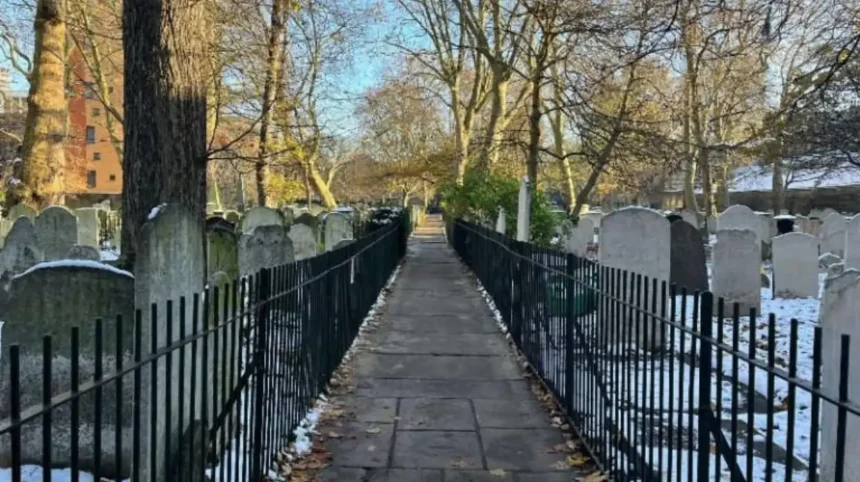
Bunhill Fields is one of London’s most significant historic nonconformist burial grounds. Located in Islington, it contains the memorials of influential religious figures, writers and thinkers, including William Blake, John Bunyan and Daniel Defoe.
Bunhill Fields stands on City Road, close to Old Street. Its name is associated with the historical term Bone Hill, reflecting traditions concerning the disposal of human bones in the area.
The burial ground became an important place of interment for Protestant nonconformists. Nonconformists were Christians who worshipped outside the established Church of England.
The site was particularly significant for religious groups whose members experienced restrictions on burial within conventional Anglican churchyards.
Burials took place at Bunhill Fields between 1665 and 1853. Historical estimates suggest that approximately 120,000 to 123,000 people were buried there.
The burial ground contains more than 2,300 monuments, including simple headstones and elaborate memorials. Its historical importance also comes from the number of influential individuals associated with the site.
Which Famous People Are Buried at Bunhill Fields?
Several important figures from British religious and literary history are associated with Bunhill Fields.
John Bunyan (1628–1688) was a Christian writer and preacher best known for The Pilgrim’s Progress. His work became one of the most influential books in English religious literature.
Daniel Defoe (c.1660–1731) was an English novelist, journalist and political writer. He is best known for Robinson Crusoe, published in 1719.
William Blake (1757–1827) was a poet, painter and printmaker. His works include Songs of Innocence and of Experience and the poem commonly known as Jerusalem.
George Fox (1624–1691) founded the Religious Society of Friends, commonly known as the Quakers.
Thomas Bayes (1701–1761) was an English statistician and Presbyterian minister. His name is associated with Bayes’ theorem, an important principle in probability and statistical reasoning.
These individuals give Bunhill Fields international cultural importance. The site connects visitors with developments in religious freedom, literature, philosophy and scientific thought.
What Can Visitors See at Bunhill Fields Today?
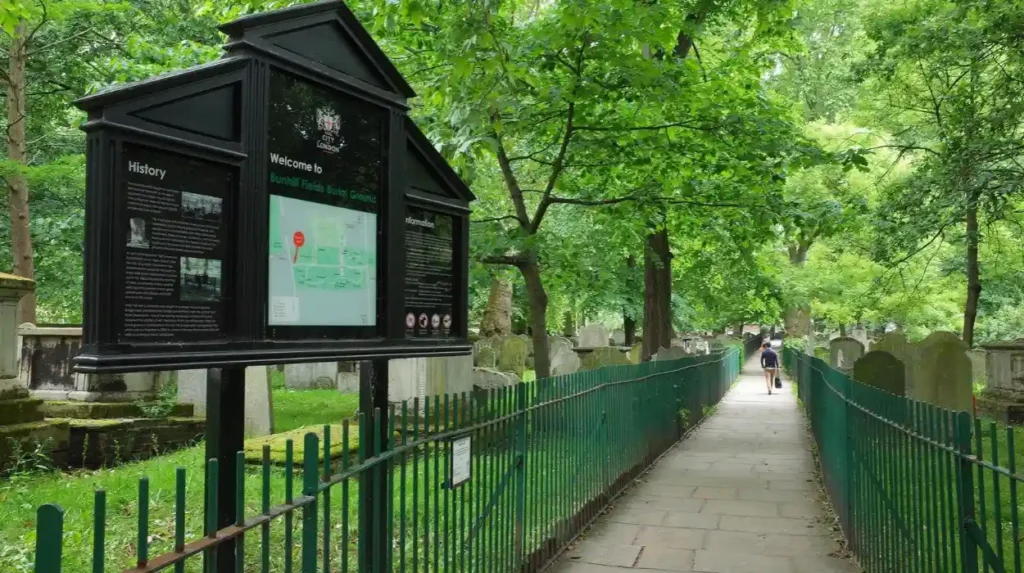
Bunhill Fields operates as a historic public open space managed by the City of London Corporation. Its landscape contains gravestones, memorials, mature trees and landscaped pathways.
Visitors can examine the surviving monuments and explore the relationship between the burial ground and surrounding City Road neighbourhood.
Historic England recognises the site as an important heritage location. Its historic monuments and landscaped setting make it particularly valuable for understanding London’s nonconformist history.
Where Can You Find Spa Fields Burial Ground in Islington?
Spa Fields Burial Ground is situated around Spa Fields Park in the Finsbury area of Islington. Its history includes eighteenth-century religious development, commercial burial operations and nineteenth-century overcrowding, with archaeological remains preserved beneath today’s public landscape.
Spa Fields is located near Exmouth Market and Northampton Road. The area is now a public green space within a busy part of central Islington.
Its burial history began during the eighteenth century. The site originally contained the Pantheon, an entertainment venue that later became associated with religious activity.
In 1776, the Countess of Huntingdon acquired the property for religious purposes. A chapel associated with the Countess of Huntingdon’s religious movement subsequently occupied the site.
The burial ground developed during the 1780s when land was leased to private burial operators. The site became an important place of burial for residents in the surrounding districts.
The burial business eventually experienced serious problems associated with overcrowding and poor management. These conditions reflected wider difficulties affecting London’s urban burial grounds during the eighteenth and nineteenth centuries.
Historic England identifies Spa Fields Park as an archaeological priority area because the former burial ground survives beneath the modern landscape.
Why Is Spa Fields Historically Significant?
Spa Fields illustrates the relationship between religious institutions, commercial burial businesses and urban development.
The site also demonstrates how former burial grounds became public spaces as London introduced new approaches to cemetery management and public health.
Its modern appearance does not reveal the full extent of its historical use. Archaeological evidence remains important for understanding the number of people buried there and the development of the surrounding Finsbury neighbourhood.
Visitors exploring Exmouth Market can include Spa Fields Park in a local heritage walk.
What Can You Discover at St Luke’s Church Gardens?
St Luke’s Church Gardens preserves the former burial ground of St Luke’s Church near Old Street. Established in 1733, the burial ground served a growing population before closing in 1853 and becoming a public garden.
St Luke’s Gardens is situated near Old Street in the southern part of Islington. It is associated with St Luke’s Church, an eighteenth-century church built to relieve pressure on the overcrowded parish of St Giles-without-Cripplegate.
The church was constructed in 1733. Its burial ground served the local population for more than a century.
As the surrounding neighbourhood expanded, the burial ground became increasingly important to the local community. Burials continued until the nineteenth century, when the site closed in 1853.
The former churchyard eventually became a public garden. The church building itself underwent a different transformation and now houses the London Symphony Orchestra’s LSO Discovery activities and educational facilities.
This combination of historic religious architecture and cultural activity makes the location an important part of Islington’s heritage.
What Makes St Luke’s Gardens Important?
The burial ground demonstrates how historic religious spaces were adapted to meet changing urban needs.
Its archaeological significance extends beneath the visible garden. Historic England identifies St Luke’s Gardens as one of the borough’s four important post-medieval burial grounds.
Visitors exploring Old Street can also appreciate the surrounding architectural development, which includes historic commercial buildings, former industrial properties and modern offices.
Where Is the Historic Burial Ground at Seward Street Recreation Ground?
Seward Street Recreation Ground in Clerkenwell occupies a former burial site associated with unclaimed bodies from St Bartholomew’s Hospital. Its archaeological remains preserve evidence of historic hospital burial practices and changing approaches to public recreation.
Seward Street Recreation Ground is located in Clerkenwell, an area with a long history of religious institutions, hospitals and working-class neighbourhoods.
The site originally served as a burial ground for unclaimed bodies associated with St Bartholomew’s Hospital.
St Bartholomew’s Hospital, founded in 1123, is one of Britain’s oldest hospitals. Historically, hospitals faced the challenge of arranging burials for patients who died without relatives or identifiable burial arrangements.
The Seward Street site was used by the hospital from around 1740. It received bodies that were not claimed by relatives.
Archaeological investigations have revealed important information about burial practices at the location. Historic England records several phases of burial and evidence of different treatments of human remains, including remains associated with post-mortem examinations.
These findings make the location particularly significant for the history of medicine and hospital care. Historic England
How Did the Burial Ground Become a Recreation Space?
The burial ground eventually closed as London’s burial practices changed during the nineteenth century.
From 1891, the site was converted into a public playground and maintained by the local vestry.
Today, the recreation ground serves nearby residents and school communities. Its modern recreational purpose contrasts with its earlier use as a place for hospital burials.
The site demonstrates why archaeological protection remains important even when former burial grounds no longer look like cemeteries.
Why Is Joseph Grimaldi Park Important to Islington’s Burial History?
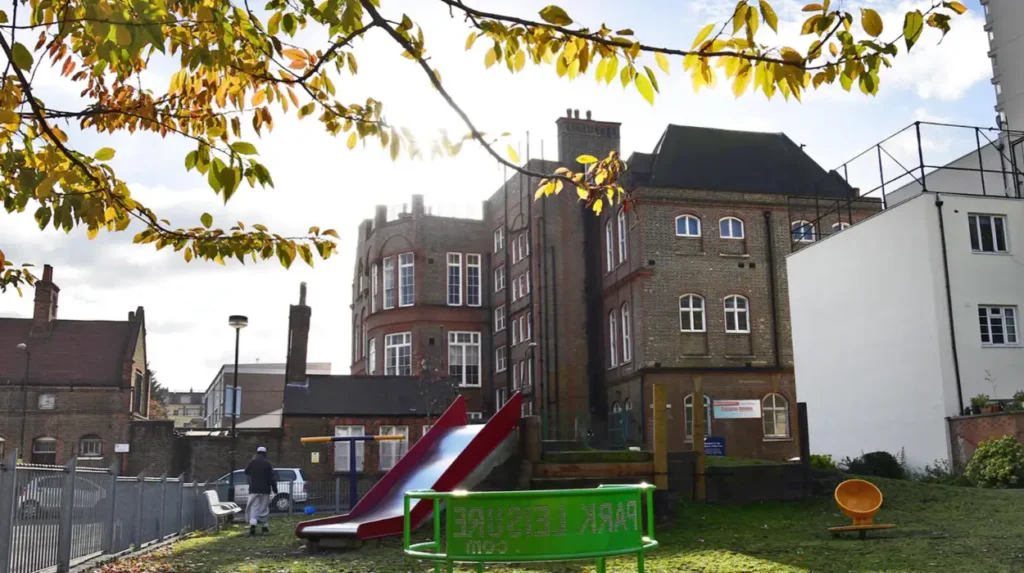
Joseph Grimaldi Park is a historic burial site in Pentonville associated with the nineteenth-century clown Joseph Grimaldi. It preserves the memory of an influential theatrical performer while forming part of Islington’s protected post-medieval archaeological landscape.
Joseph Grimaldi Park is located in the Pentonville area of Islington. It is associated with Joseph Grimaldi (1778–1837), one of the most influential performers in the history of British pantomime.
Grimaldi transformed the theatrical clown into a recognisable stage character. His performances helped establish the traditions of modern British pantomime.
His connection with Islington gives the burial ground additional cultural importance.
The park is also included in Historic England’s archaeological assessment of post-medieval cemeteries in Islington. Its former burial use makes it significant beyond its association with theatre history. Historic England
What Is Joseph Grimaldi’s Connection with British Theatre?
Grimaldi became famous for his energetic performances, expressive facial make-up and comic stage routines.
His character helped establish the traditional pantomime clown, often associated with exaggerated costumes, physical comedy and audience interaction.
His influence continued long after his death in 1837. His autobiography, published posthumously, also provides an important record of his professional life.
For visitors interested in Islington’s cultural history, Joseph Grimaldi Park connects two important heritage themes: historic burial practices and the development of popular British entertainment.
What Is the History of St Mary’s Churchyard on Upper Street?
St Mary’s Churchyard is the historic burial ground of Islington’s ancient parish church on Upper Street. The churchyard was enlarged in 1793, closed for burials in 1853 and converted into a public garden in 1885.
St Mary’s Church occupies an important position in Islington’s religious history. Historical records mention the church in 1163, making it one of the area’s earliest documented Christian institutions.
The original parish church served the wider Islington community for centuries. As the population increased, additional churches and chapels were established to serve expanding neighbourhoods.
The churchyard was enlarged in 1793 to accommodate additional burials. However, growing demand eventually made further burial use impractical.
Burials ended in 1853. The former churchyard was subsequently converted into a public garden in 1885.
Who Is Associated with St Mary’s Churchyard?
One particularly important figure associated with the churchyard is Richard Cloudesley, a local charitable benefactor who died in 1517.
Cloudesley left two fields of pasture land to the parish of St Mary Islington. The income generated from this property supported charitable activities and became the foundation of the organisation now known as Cloudesley.
His tomb became an important historic memorial. The London Museum records its restoration during 2017, marking the 500th anniversary of his charitable legacy.
The tomb is also associated with the development of the surrounding Cloudesley estate. London Museum
What Happened to the Original St Mary’s Church?
The eighteenth-century church building was badly damaged during the Second World War.
A German bombing raid on 9 September 1940 destroyed most of the building, although its tower and spire survived.
The church was rebuilt during the 1950s and dedicated in 1956. Its present appearance therefore combines surviving historic architectural features with post-war reconstruction.
The churchyard remains an important green space on Upper Street. Visitors can examine its mature trees, garden layout and surviving memorial features while exploring the wider Islington town centre.
Where Can You Find the Former Jewish Burial Ground at Balls Pond?
The former Jewish burial ground at Balls Pond, also known as Kingsbury Road Cemetery, is an important part of Islington’s nineteenth-century religious heritage. Established in 1843, it reflects the development of London’s Jewish communities and their burial traditions.
The former Jewish burial ground is associated with Kingsbury Road in the Balls Pond area of Islington, near Newington Green.
The site is also known as the Old Reform Jewish Burial Ground. Its establishment in 1843 reflects the growth of organised Jewish communities in nineteenth-century London.
During this period, London’s Jewish population expanded as families established businesses, religious institutions and residential communities across the capital.
Dedicated burial grounds provided Jewish communities with places to maintain religious burial traditions and commemorate deceased family members.
Islington Council’s historical cemetery records identify the site as an important former burial ground and provide information about its historical records.
Why Is the Balls Pond Burial Ground Important?
The cemetery provides evidence of London’s religious and cultural diversity during the nineteenth century.
Jewish burial customs have particular religious significance. Traditional Jewish burial practices emphasise the respectful treatment of the deceased, prompt burial and the preservation of cemetery grounds.
The former Balls Pond site therefore contributes to the wider understanding of how different religious communities shaped Islington’s historical landscape.
Visitors should distinguish the historic burial ground from ordinary public gardens. Access arrangements and the condition of the site require checking before planning a visit.
Which Other Historic Churchyards Can You Explore in Islington?
Islington contains several former church burial grounds associated with historic parishes, including Clerkenwell Green, St John Square, Pentonville and Cloudesley Square. Their surviving records provide evidence of religious life and population growth.
Not every historic burial ground in Islington survives as a recognisable cemetery. Some have become gardens, developed urban spaces or areas where archaeological remains remain beneath modern buildings.
Several former churchyards are particularly relevant to the borough’s history.
St James Burial Ground, Clerkenwell Green
Clerkenwell Green is an important historic location associated with religious and political history.
The former St James burial ground served the local parish between 1561 and 1853, according to Islington Council’s cemetery records.
The site reflects Clerkenwell’s long-standing importance as a centre of religious institutions, workshops and residential development.
The surrounding neighbourhood contains historic buildings and architectural features that help visitors understand its earlier character.
St John the Baptist Burial Ground, St John Square
St John Square in Clerkenwell is associated with the former burial ground of St John the Baptist.
The burial ground served the parish between 1723 and 1853.
Clerkenwell’s religious history extends back to medieval times, particularly through its association with the Priory of the Knights Hospitallers of St John of Jerusalem.
The former burial ground forms part of this wider religious heritage.
Former St James Burial Ground, Pentonville Road
Another historic burial site was associated with the former Pentonville Chapel, later known as St James.
Islington Council records burials between 1790 and 1855.
The location reflects the religious and residential expansion of Pentonville during the late eighteenth and nineteenth centuries.
Holy Trinity Burial Ground, Cloudesley Square
Holy Trinity was an important nineteenth-century religious institution in the Cloudesley Square area.
Its burial records cover the period from 1829 to 1854.
The church and burial ground are associated with the residential development of Barnsbury and surrounding neighbourhoods.
The surviving parish records are particularly useful for local historians and family researchers.
St Mary Magdalene’s Former Burial Ground, Holloway
The former burial ground associated with St Mary Magdalene provides another example of Islington’s historic churchyard landscape.
The chapel was built in 1812 on an existing burial ground. The surrounding grounds were historically used for burials and later became landscaped public gardens.
The location illustrates how religious buildings and burial spaces developed together as Holloway expanded.
The historic churchyard landscape is particularly relevant to visitors exploring the area’s nineteenth-century architecture and residential development.
Why Did Islington’s Historic Burial Grounds Close During the Nineteenth Century?
Islington’s historic burial grounds closed mainly because population growth created overcrowding and public health concerns. The Burial Acts of the 1850s supported the development of larger cemeteries outside densely populated neighbourhoods.
During the eighteenth and nineteenth centuries, London experienced considerable population growth.
Islington developed from a relatively rural settlement into a busy urban district. New housing, roads, commercial buildings and transport connections increased the local population.
Traditional parish churchyards were not designed to accommodate such rapid growth.
Repeated burials in limited spaces created overcrowding. Public concern about sanitation and the management of human remains increased.
The Metropolitan Burial Act 1852 formed part of a wider government response to these problems.
The legislation supported the establishment of burial boards and larger cemeteries beyond the most densely populated areas.
Islington established its own burial arrangements during this period. The churchyard of St Mary Islington closed in 1853, while a new cemetery opened at East Finchley in 1854.
The change represented a major development in London’s burial system.
How Did the New Cemetery System Change Islington?
The nineteenth-century cemetery system introduced larger burial landscapes with planned pathways, landscaping and separate burial sections.
These cemeteries provided greater capacity than traditional churchyards.
They also created a different relationship between burial grounds and residential neighbourhoods. Instead of placing all burials beside parish churches, communities increasingly used dedicated cemetery sites beyond central urban districts.
This development influenced cemetery architecture, landscape design and municipal administration across London.
Islington’s surviving historic burial grounds preserve evidence of the transition from traditional parish burial to organised municipal cemetery management.
Where Is Islington Cemetery and Why Is It Historically Important?
Islington Cemetery is located on High Road in East Finchley, within the London Borough of Barnet. It opened in 1854 as a municipal cemetery serving Islington and remains an important part of the borough’s burial history.
Islington Cemetery is located at 278 High Road, East Finchley, London N2 9AG.
Although its name connects it with Islington, the cemetery is geographically situated in the neighbouring London Borough of Barnet.
The cemetery opened in 1854 following the introduction of the Metropolitan Burial Act 1852.
Islington’s parish authorities acquired land for the new cemetery as part of the transition away from overcrowded churchyards.
The cemetery formed part of a wider development involving St Pancras Cemetery. Both burial grounds occupied adjoining land at Finchley and shared elements of their original landscape planning.
Historic England identifies the combined St Pancras and Islington Cemetery landscape as the first Burial Board cemetery in London. Its original layout dates to 1854, with a major extension in 1877.
What Can Visitors Expect at Islington Cemetery?
Islington Cemetery contains a large landscaped burial environment with mature trees, memorials, historic graves and pathways.
Its design reflects nineteenth-century cemetery planning, when landscaped grounds became an important feature of urban burial spaces.
The cemetery provides a quieter setting than central Islington’s commercial streets.
Its location in East Finchley also makes it suitable for visitors exploring the northern parts of London.
What Is the Difference Between Islington Cemetery and St Pancras Cemetery?
St Pancras Cemetery and Islington Cemetery occupy adjoining sections of the wider historic cemetery landscape.
Their original administrative arrangements were separate, even though their landscape design and development were closely connected.
St Pancras Cemetery is managed by the London Borough of Camden, while Islington Cemetery is managed by the London Borough of Islington.
The combined historic landscape received Grade II* registration as a park and garden from Historic England in 2002. Historic England
How Can Visitors Explore Islington’s Historic Cemeteries and Burial Grounds?
Visitors can explore Islington’s historic burial grounds through independent heritage walks, local history trails and visits to public gardens. Old Street, Clerkenwell, Upper Street, Finsbury and East Finchley provide useful starting points.
Islington’s historic burial grounds are spread across different neighbourhoods. Visitors can organise their exploration around geographical areas rather than attempting to visit every site in one journey.
The borough’s historic streets, churches and public gardens provide useful connections between individual burial grounds.
Which Historic Burial Grounds Can You Visit Around Old Street?
Old Street is a useful starting point for exploring southern Islington.
St Luke’s Gardens provides access to the former burial ground of St Luke’s Church.
Bunhill Fields is also within walking distance of Old Street and offers a particularly important collection of historic memorials.
Visitors can combine these locations with nearby cultural and architectural attractions.
Which Burial Grounds Are Worth Exploring Around Clerkenwell?
Clerkenwell offers several historic locations associated with former religious institutions and burial grounds.
Seward Street Recreation Ground provides evidence of historic hospital burial practices.
Clerkenwell Green and St John Square connect visitors with the area’s former parish burial landscape.
Spa Fields Park is another useful stop, particularly for visitors exploring Exmouth Market and Finsbury.
Which Historic Sites Can You Explore Around Upper Street?
St Mary’s Church Gardens is an accessible historic location near Upper Street.
Visitors can examine the former churchyard, the surviving architectural features of St Mary’s Church and the memorial associated with Richard Cloudesley.
The surrounding streets also contain Georgian and Victorian buildings that illustrate Islington’s residential development.
Can You Combine Islington Cemetery with Other North London Attractions?
Islington Cemetery in East Finchley can form part of a wider North London heritage visit.
Visitors can combine the cemetery with nearby residential neighbourhoods, local parks and historic sites.
However, the cemetery is outside the London Borough of Islington, so visitors should account for the additional travel distance.
The distinction is useful when planning a walking itinerary or researching the borough’s official heritage locations.
How Can You Research People Buried in Islington’s Historic Cemeteries?
Visitors researching family history can use cemetery registers, parish burial records, historical archives and memorial inscriptions. The London Archives and Islington Council provide valuable resources for identifying burial locations and tracing historical residents.
Historic burial grounds are important resources for genealogy, the study of family history through documentary evidence.
Parish registers record baptisms, marriages and burials. These documents help researchers establish family relationships, identify historical addresses and trace generations of residents.
St Mary’s Islington has particularly valuable historical records. Its parish archive includes burial registers dating from 1558 to 1893.
The records are held at The London Archives under reference P83/MRY1.
Islington Council also provides historical cemetery information, including details about burial registers and their locations.
Researchers should distinguish between the original burial location and the present archive holding the records. A historic churchyard does not necessarily retain its original burial register.
For people researching burials at Islington Cemetery and St Pancras Cemetery, online records are also available through Deceased Online, although access fees can apply.
What Information Should Family Researchers Collect?
Researchers should begin with the deceased person’s full name and an approximate date of death.
Additional information improves the accuracy of searches. Useful details include:
- Approximate burial date, such as 1850 or 1900.
- Parish or neighbourhood, such as Clerkenwell or Islington.
- Family members’ names, such as parents or spouses.
- Religious affiliation, where known and relevant.
- Historical residential addresses, such as Upper Street or Pentonville Road.
These details help narrow searches across historical parish registers and cemetery records.
Explore More Area Guide
How Islington’s Theatre Culture Developed: History and Key Venues
What Is the History of Islington’s Former Workhouses?
How Do Islington’s Historic Burial Grounds Contribute to Local Heritage Today?
Islington’s historic burial grounds preserve archaeological evidence, support local biodiversity and provide public green spaces. Their protection maintains connections with religious history, medical developments, literary heritage and the borough’s changing urban landscape.
Historic burial grounds are more than former places of interment.
They contribute to the identity of local neighbourhoods and preserve physical evidence of earlier generations.
Their historical significance extends into several areas.
Archaeological research: Human remains, grave structures and burial arrangements provide evidence about historical populations and burial customs.
Religious heritage: Former churchyards and dedicated burial grounds demonstrate how different religious communities maintained their traditions.
Literary and cultural history: Sites such as Bunhill Fields connect visitors with important writers, thinkers and religious leaders.
Public green spaces: Former churchyards such as St Mary’s Church Gardens and St Luke’s Gardens provide landscaped spaces in densely developed neighbourhoods.
Medical history: Seward Street Recreation Ground preserves evidence associated with historic hospital burial practices.
Historic England’s archaeological assessment identifies these sites as important heritage assets. The assessment supports their consideration during planning, development and conservation decisions. Historic England
Why Does Protecting Former Burial Grounds Matter?
The historical value of a burial ground does not disappear when burials stop.
Archaeological remains can survive beneath modern parks, playgrounds and developed properties.
Construction work, landscaping and infrastructure projects can affect these remains if their historical significance is not properly considered.
Heritage protection helps local authorities assess development proposals and preserve important archaeological evidence.
For visitors, these protected spaces also provide opportunities to understand how Islington developed across different historical periods.
How Can Historic Burial Grounds Help Visitors Understand Islington’s Past?
Islington’s historic burial grounds provide a direct connection between the borough’s medieval origins, eighteenth-century religious communities and Victorian urban expansion. They help visitors understand how local neighbourhoods developed through changes in population, architecture, religion and public health.
The surviving burial grounds reveal different aspects of London’s history.
Bunhill Fields demonstrates the importance of nonconformist religious communities. St Mary’s Churchyard preserves the history of Islington’s ancient parish. Spa Fields illustrates the commercial burial practices of eighteenth-century London, while Seward Street provides evidence of historical hospital burial arrangements.
Together, these sites explain how religious institutions, public health policies and population growth influenced the physical development of Islington.
The surrounding neighbourhoods also retain historic streets, churches, public buildings and residential architecture.
Visitors exploring these locations can connect their experience with the wider historical development of the borough. Explore the full [History of Islington and Its Historical Development] to understand how the area’s medieval settlements, religious institutions and Victorian expansion shaped its present-day identity.
The continued preservation of these burial grounds also demonstrates the importance of protecting London’s archaeological heritage. Their future relevance depends on conservation, responsible public access and careful management of historic landscapes.
Islington offers an important collection of historic cemeteries, former churchyards and burial grounds for visitors interested in North London’s history. Bunhill Fields, Spa Fields, St Luke’s Gardens, Seward Street Recreation Ground, Joseph Grimaldi Park and St Mary’s Churchyard each preserve different aspects of the area’s past.
The former Jewish burial ground at Balls Pond and historic Clerkenwell burial sites add further evidence of Islington’s religious and cultural diversity.
Islington Cemetery in East Finchley provides another important connection with the borough’s nineteenth-century cemetery development, although it is geographically located in Barnet.
These locations offer more than historical memorials. They preserve archaeological evidence, support local green spaces and provide a deeper understanding of London’s social, religious and cultural development.
For tourists, local residents and history enthusiasts, exploring Islington’s historic burial grounds offers a valuable way to discover the heritage behind the modern streets of North London.
What are the most famous historic cemeteries in Islington?
Bunhill Fields, Spa Fields, St Mary’s Churchyard, St Luke’s Gardens and Joseph Grimaldi Park are among Islington’s most historically significant burial grounds. Each preserves evidence of London’s religious, cultural and social history.