Council results are the official outcomes of local elections that decide who controls a borough council and who represents each ward in North London. They matter because they shape housing, planning, waste, roads, schools, parks, and local services that affect daily life in areas such as Barnet, Haringey, Camden, Islington, Enfield, Hackney, and Brent.
- What are the council results in North London?
- How do council elections work?
- Which North London councils usually matter most?
- Why do council results matter locally?
- How are council results reported?
- What changed in the 2026 London results?
- How do turnout and demographics affect results?
- What do the numbers show?
- How should readers use council results?
- What does the future of council results look like?
- Why are council results important to North London readers?
What are the council results in North London?
Council results are the declared votes and seat totals from borough elections. They show which party or group won each ward, which councillors were elected, and whether any council gained overall control, lost it, or stayed in no overall control. In London, voters elect councillors for 32 borough councils, and 1,817 seats were contested across the capital in the 2026 local elections.
North London council results matter because borough councils are the local government tier closest to residents. They decide local budgets, set council tax levels, manage planning applications, run housing services, collect bins, maintain streets, and oversee many community services. When results change, policy priorities change with them.
Council results also feed into wider political analysis. They show how voters respond to national issues, local service performance, and candidate selection. In 2026, London results showed major shifts in some boroughs, including a Conservative gain in Westminster, a Reform UK win in Havering, and Liberal Democrat strength in Sutton and Richmond upon Thames.
How do council elections work?
Council elections use ward-based voting to choose councillors who serve fixed terms and represent local areas. Most London borough elections use multi-member wards, so residents usually select two or three councillors on one ballot paper. Polling stations in London are open from 7am to 10pm, and voters must bring accepted photo ID to vote in person.
Each borough is divided into wards. A ward is a smaller local area inside a borough. Each ward elects councillors who speak for residents on local issues such as rubbish collections, planning disputes, antisocial behaviour, and traffic schemes. In many London boroughs, residents vote for more than one candidate, which means the top vote-getters win the seats.
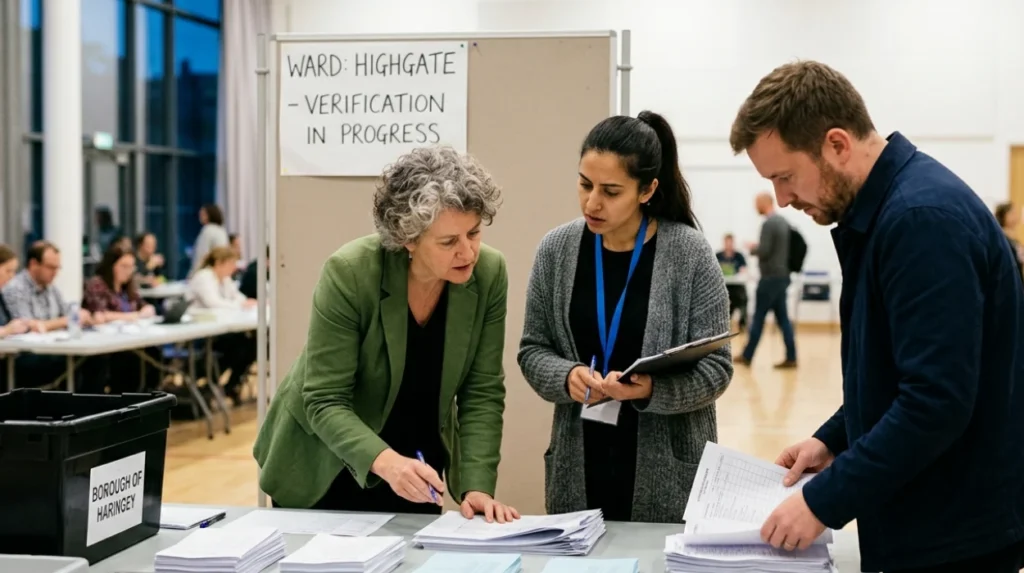
The counting process follows polling day. Some boroughs start counting overnight, while others begin on Friday morning. In 2026, results were scheduled to arrive from around 2.30am through Saturday evening, with Croydon, Lewisham, and Tower Hamlets counting later. That timing explains why council results often unfold over one or two days rather than appearing all at once.
Which North London councils usually matter most?
North London council results usually attract attention in Barnet, Camden, Enfield, Hackney, Haringey, Islington, and Brent because these boroughs are large, politically active, and often competitive. These councils cover dense urban neighbourhoods, major transport corridors, and high-demand housing markets, which keeps local elections closely watched.
Barnet often draws attention because it is one of the largest London boroughs and has switched political control in recent cycles. BBC coverage before the 2026 election noted that Barnet was won by Labour for the first time in 2022, showing how quickly power can change in a closely balanced borough.
Haringey is another important borough because its results have wide political significance. BBC reporting in April 2026 said Haringey had 44 Labour councillors, 7 Liberal Democrats, 4 Green Socialist Alliance councillors, and 2 independents before the election. That composition made the borough a key test of whether Labour could retain control.
Why do council results matter locally?
Council results matter because they decide who controls local spending, planning, housing, and public realm decisions. They also determine the balance of power between ruling groups and opposition councillors. In practical terms, the winning side sets the agenda for the next council term.
Local results affect everyday services. A council with a strong majority can move faster on policy and budgeting. A council with no overall control must negotiate between groups, which often produces slower decisions and coalition-style bargaining. North London residents notice those changes in planning approvals, regeneration schemes, and service delivery.
Results also matter because London borough councils run large populations and diverse communities. Turnout is often low by national standards, so even modest vote swings can produce major seat changes. Electoral Commission and BBC material has repeatedly shown that local elections are often decided by a relatively small share of voters, which increases the impact of turnout differences.
How are council results reported?
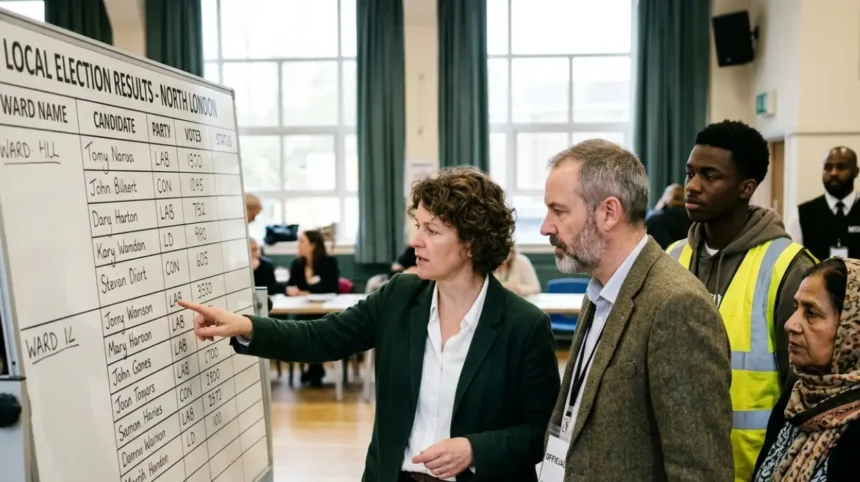
Council results are reported ward by ward, then combined into borough totals. The key figures are seats won, vote share, turnout, and control of the council. Official declarations come from the returning officer, and news outlets then summarise the result as hold, gain, loss, no overall control, or majority control.
A full result usually includes the winning candidate’s name, party, vote total, margin, and turnout for the ward. Borough-wide reporting then shows how many councillors each party has after all wards are declared. This is the level most readers want because it reveals who governs the borough.
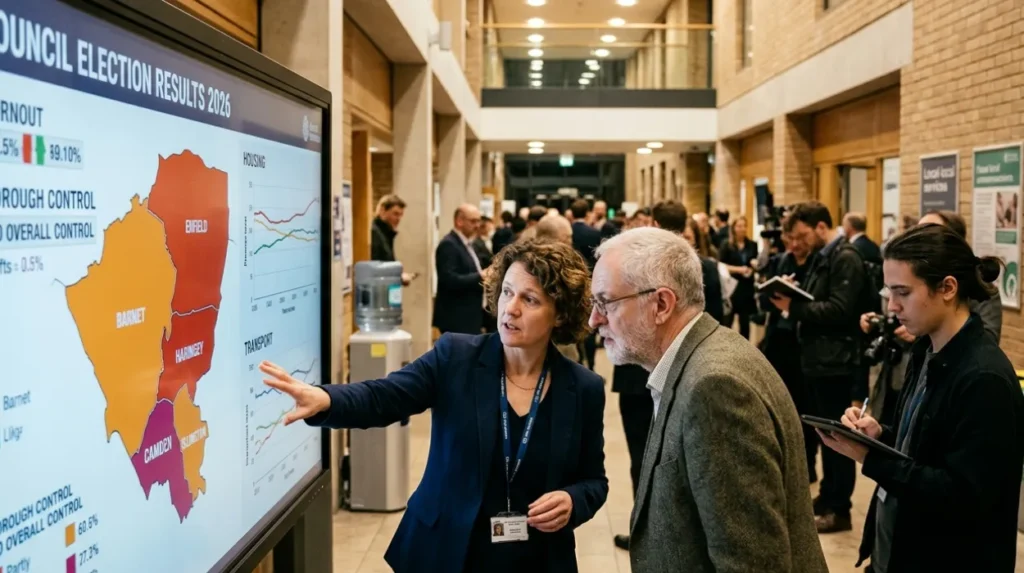
In North London, these results are often published alongside maps and live updates. That format helps readers understand not only who won, but where gains and losses happened. It also helps political analysts compare outer borough trends with inner London trends.
What changed in the 2026 London results?
The 2026 London council results showed a fragmented capital, with different boroughs moving in different directions. Conservative, Liberal Democrat, Labour, Green, and Reform UK gains all appeared in the city’s early declarations. That pattern matters for North London because it shows how local contests no longer follow one simple London-wide trend.
The Evening Standard reported that the Conservatives took Westminster from Labour, the Liberal Democrats held Sutton and Richmond upon Thames, and Reform UK won Havering. The Independent also reported that Labour held Hammersmith and Fulham, while the Greens won the Hackney mayoralty. These outcomes show that local identity and borough-level issues shape results as much as national politics.
For North London readers, the broader lesson is clear. Borough elections are increasingly competitive, and results can shift sharply from one cycle to the next. That makes each local election a high-value political event rather than a routine administrative exercise.
How do turnout and demographics affect results?
Turnout and demographics strongly affect council results because local elections are usually decided by smaller, more motivated electorates. In London borough elections, turnout has often sat well below general election levels. That means a council can change hands even when only a fraction of residents vote.
Electoral Commission reporting and BBC coverage have both highlighted low participation in local elections. BBC reporting noted that in 2018 only just over one in three registered voters took part nationally, and many areas saw turnout around one in four. An academic-style summary from the University of Wolverhampton also noted that London borough turnout in 2018 averaged 38.9%, showing the level still sits below national general election participation.
This matters in North London because boroughs differ sharply in age profile, housing tenure, ethnicity, and income. Those differences affect which issues dominate the campaign and which parties can mobilise supporters effectively. A party that turns out its base well can win more seats even without a large lead in total votes.
What do the numbers show?
The numbers show that London council contests involve large-scale local decision-making and relatively modest voter participation. In 2026, 1,817 council seats were contested across London, and more than six million Londoners were eligible to vote. That makes the results significant both politically and administratively.
The 2026 London election guide also confirmed that five boroughs elected mayors alongside councillors: Croydon, Hackney, Lewisham, Newham, and Tower Hamlets. This adds another layer to the result because voters choose both council representation and executive local leadership in those areas.
For North London specifically, the data confirms that councils remain the central unit of urban governance. These elections decide the composition of bodies that control large budgets, manage thousands of council homes, and make planning decisions that shape neighbourhoods for years. The scale is local, but the consequences are long-term.
How should readers use council results?
Readers should use council results to understand local power, track service priorities, and judge how well their borough reflects their vote. Results also help residents plan future engagement with planning, housing, and ward-level issues. For journalists and publishers, they provide a strong foundation for borough analysis, trend stories, and map-led coverage.
A borough result should never be read in isolation. It needs context from the previous election, ward-level swings, turnout, and candidate selection. For example, BBC reporting on Haringey before the 2026 vote showed Labour held 44 seats and faced a stronger challenge than in many recent cycles. That kind of baseline makes the result easier to interpret once declarations arrive.
Council results also help residents understand what happens next. A council with a clear majority often implements its manifesto faster. A fragmented council often spends more time negotiating, which can slow major decisions. In both cases, the result directly affects the pace and direction of local government.
What does the future of council results look like?
The future of council results in North London depends on turnout, housing pressure, transport issues, and party competition across boroughs. The trend points toward more volatile local contests and less predictable borough control. London results in 2026 showed that no party can assume automatic control of every borough type or voting pattern.
North London will remain politically important because it contains some of the capital’s most watched boroughs. Places such as Barnet, Camden, Enfield, Haringey, Islington, Hackney, and Brent combine dense populations with strong issue-based voting. That mix keeps elections competitive and results closely followed.
For publishers, council results are evergreen because the structure stays the same even when the political outcome changes. The question of who won, by how much, and what it means for residents remains relevant after every election cycle. That makes “council results” a stable search topic with recurring news value and strong local SEO potential.
Why are council results important to North London readers?
Council results are important to North London readers because they determine who controls the services people use every day. They also show how local communities vote on housing, cleanliness, transport, and development. The results are not abstract political data; they shape borough policy and local spending.
North London is politically diverse, and that diversity appears clearly in local elections. Some boroughs lean Labour, some are competitive between Labour and the Conservatives, and others give room to the Liberal Democrats or Greens. The 2026 London results confirmed that local identity and issue voting still dominate many borough contests.
The practical value of council results is simple. They tell residents who governs, who opposes, and who is likely to shape the next four years of local decisions. For anyone following North London politics, that information is central, recurring, and highly actionable.
What are council results in London?
Council results are the official outcomes of local elections showing which parties and councillors won seats in each borough and ward.