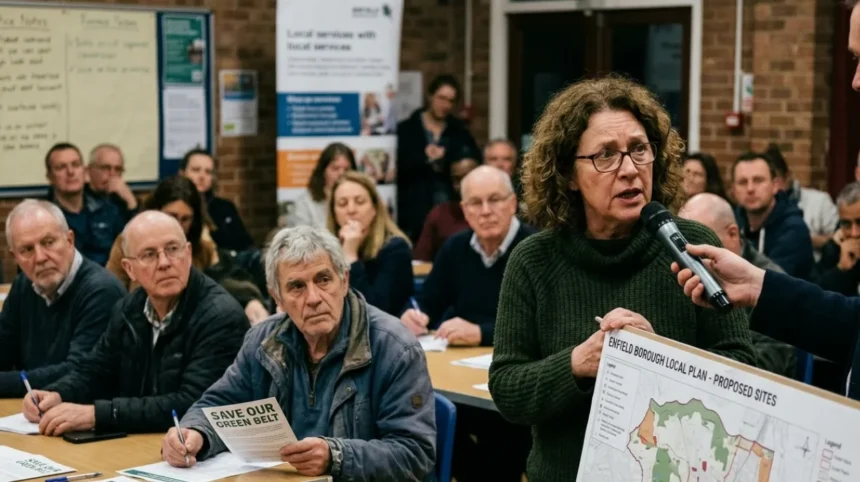
The Enfield “New Town” housing programme proposes thousands of homes on Green Belt and sensitive sites, making it one of the most contested planning processes in North London over the next decade. Objecting to these plans is a structured legal‑political process, not just a complaint. You can influence outcomes by engaging at multiple levels: local‑plan consultations, individual planning applications, council decisions, and parliamentary scrutiny. This guide explains exactly how to object effectively, using Enfield‑specific rules, national planning law and real‑world examples.
- What are the Enfield “new town” housing plans?
- Why would someone object to these new town plans?
- What is the legal framework for objecting in Enfield?
- How do you find the relevant planning documents in Enfield?
- When should you object to a new town housing scheme?
- How do you write a strong objection letter to Enfield Council?
- What evidence and data strengthen an Enfield objection?
- How do petitions and community campaigns fit into these objections?
- How does the appeal and judicial‑review process work in Enfield?
- How can North London residents stay involved beyond the first objection?
What are the Enfield “new town” housing plans?
The Enfield “new town” housing plans are a government‑backed proposal to build around 21,000 homes on former Green Belt and other land in Enfield, mainly around Crews Hill and the M25 corridor. The project forms part of a wider “New Towns Taskforce” initiative to meet national housing targets, with up to 50% of the units designated as “affordable” in the current outline proposals. The scheme is being developed under the Levelling Up and Regeneration Act 2023, which allows the government to designate certain areas for accelerated development and compulsory land‑use changes.
These proposals are much bigger than a single housing estate. They involve changing the Enfield Local Plan, altering Green Belt boundaries, and triggering hundreds of individual planning applications for roads, utilities, schools and housing phases. Because the plans are “strategic” rather than site‑specific, objections must often target both the Local Plan and the National level, as well as local council decisions.
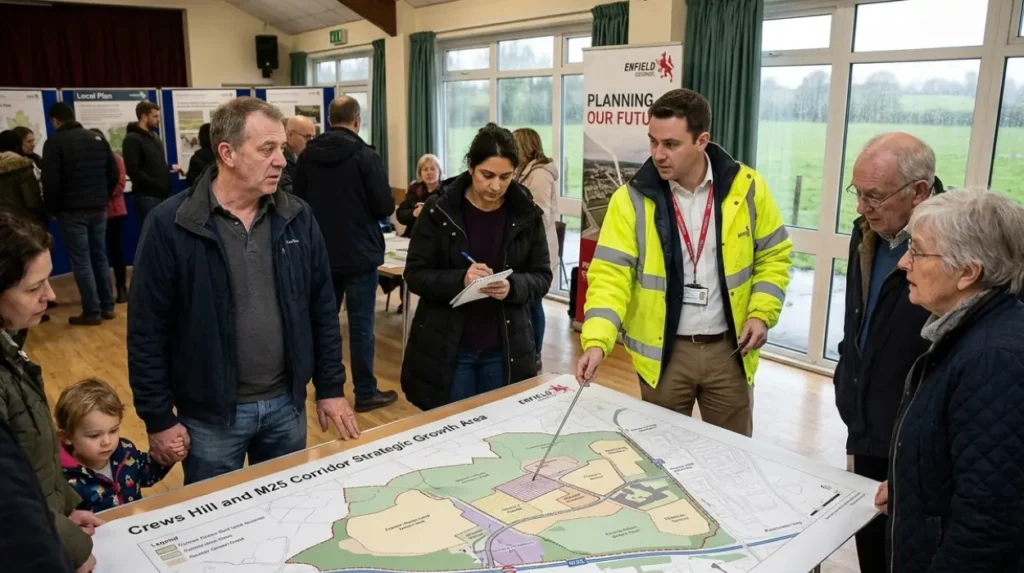
Key locations mentioned in the published material include Crews Hill, the M25 corridor, fields near Enfield‑road junctions, and other large tracts of land currently designated Green Belt or semi‑rural. Minutes from the Enfield‑wide New Towns Taskforce working group and local‑plan documentation show that the current preferred option is a “northern corridor” running from Crews Hill east towards the M25, with phased housing clusters.
Why would someone object to these new town plans?
Objecting to Enfield’s new town housing plans is usually based on concerns about loss of Green Belt, traffic, pollution, school capacity, affordable‑housing delivery, and long‑term environmental impact rather than simple “not‑in‑my‑backyard” sentiment. Enfield’s Green Belt is one of the largest in London, covering more than 40% of the borough, and it has long been protected by the National Planning Policy Framework (NPPF) to prevent urban sprawl and preserve open‑air space. The New Town proposals would remove hundreds of hectares from Green Belt, which opponents argue is inconsistent with the government’s own climate‑and‑biodiversity targets.
Additional concerns include:
- Traffic and highways: Appraisals for the 21,000‑home option suggest a need for 10‑plus new road‑junction improvements and upgrades to the A10, M25 slip‑roads and local access routes, with increased congestion and potential air‑quality breaches.
- Schools and services: Enfield already faces pressure on school places; the Taskforce’s own modelling shows a need for multiple new primary and secondary schools, which would require long‑term capital and staffing commitments.
- Affordable‑housing performance: Past Enfield‑area schemes have often underdelivered on promised affordable units, leading objectors to argue that future New Town schemes are unlikely to meet their 50% target in practice.
From a planning‑law perspective, valid objections must relate to “planning‑related” issues such as overdevelopment, environmental impact, heritage, highway safety, employment, and housing policy, not purely private worries like loss of view or noise from construction.
What is the legal framework for objecting in Enfield?
In Enfield you can object to new town housing plans through a combination of national planning law, the Local Plan process, and democratic channels such as petitions, council meetings and parliamentary avenues. The main legal instruments are the Town and Country Planning Act 1990, the Planning and Compulsory Purchase Act 2004, and the National Planning Policy Framework (NPPF), which sets the rules councils must follow when deciding planning applications and preparing Local Plans.
At the local level, Enfield Council’s Local Plan sets where development is allowed and how much housing the borough must deliver. Changes to this plan—such as deleting Green Belt land for a new town—must go through a formal consultation process under Regulation 18 and Regulation 19 of the Town and Country Planning (Local Planning) (England) Regulations 2012. During these stages, residents and organisations can submit written representations, and the council must consider them before deciding whether to submit the revised Local Plan to the Planning Inspectorate for examination.
Beyond the Local Plan, individual planning applications for housing sites are handled under the determination and appeal system. If Enfield Council refuses an application, the developer can appeal to the Planning Inspectorate; if the council approves it, objectors can force a High Court judicial review if they can show a serious legal error, such as a breach of NPPF or failure to consult properly. In practice, the most effective objections combine early‑stage policy input (Local Plan) with scrutiny of specific site applications.
How do you find the relevant planning documents in Enfield?
To object effectively you must first locate the current Enfield Local Plan, the published New Town options, and any specific planning applications on the Enfield Council planning portal and the government’s planning.mendale website. The Enfield Council planning‑applications search lets you look up proposals by postcode, address, or application number and download all documents, including the design and access statement, environmental‑impact assessments, and transport‑assessments.
For the strategic “new town” plan, documents are published via:
- Enfield Council’s Local Plan page, which lists the latest draft Regulation 18 and Regulation 19 versions, officers’ reports, and consultation summaries.
- Government‑level “New Towns Taskforce” pages, which outline the national framework and how Enfield’s 21,000‑home scheme fits into broader targets.
The Planning Portal’s national database (planning.mendale.gov.uk) also mirrors most Enfield applications, so you can search by postcode and then cross‑check against the council’s own portal. When you find a document, note the application number, decision date, and the type of consultation (Local Plan Reg‑18/Reg‑19, or full planning permission). This information is essential for any formal objection or appeal.
When should you object to a new town housing scheme?
The best time to object is early in the process—at the Local Plan consultation stage, when the outline framework is still being shaped, and again at the detailed planning‑application stage for individual sites. For the Enfield‑wide New Town scheme, the Regulation 18 consultation in 2021 invited comments on the preferred location and scale of development, including the 21,000‑home option. Objectors who submitted then were able to point to specific policy gaps, such as inadequate Green Belt‑protection wording or weak air‑quality mitigation measures.
Once the council finalises the Local Plan and submits it to the Planning Inspectorate, objections shift to the Regulation 19 stage, where submitters can reiterate or refine their points. After inspectorate examination and adoption, the legal framework is locked in, so later objections to individual housing sites must work within those rules.
For site‑specific housing applications, Enfield Council runs a standard 21‑day public‑consultation period from the date of publication. Objections received after the closing date are usually treated as “late representations” and may be disregarded, so timing is critical. In practice, effective objectors monitor both the Local Plan and the council’s weekly planning‑list so they can respond quickly to each new phase of the New Town scheme.
How do you write a strong objection letter to Enfield Council?
A strong objection must be concise, fact‑based, and firmly grounded in planning‑policy documents, clearly stating how the proposed scheme breaches the Local Plan or the NPPF. Each objection should include the application number or Reg‑18/Reg‑19 reference, the address or site location, and your name and address so the council can verify it is a genuine local concern.
Structure your letter this way:
- Introduction paragraph: State that you object to the proposal and briefly summarise the main issue (e.g., “this application would remove 27 hectares of Green Belt without adequate mitigation for air quality or traffic”).
- Policy‑based arguments: For each concern, quote the relevant section of the Enfield Local Plan or NPPF (for example, NPPF paragraph 145 on Green Belt) and explain how the scheme fails to meet it.
- Evidence: Attach maps, traffic surveys, school‑capacity data, or independent reports if available; without evidence, many objections are treated as “opinion only.”
Examples of valid planning‑related grounds include:
- Overdevelopment of land protected by the Green Belt or the Local Plan’s Green Infrastructure policies.
- Inadequate highway‑safety provision leading to increased accidents or congestion.
- Failure to provide sufficient affordable housing or school land.
Avoid private issues such as “my view will be blocked” or “my house value will fall,” as these are not planning‑related and are usually discounted. Instead, reframe personal concerns into planning arguments; for instance, glare from new windows can be framed as a amenity impact issue under NPPF.
What evidence and data strengthen an Enfield objection?
Strong objections to Enfield’s new town housing plans combine local‑specific data—such as traffic counts, school‑staffing figures and air‑quality monitoring—with national policy references to show that the scheme is inconsistent with legal and strategic frameworks. Enfield Council’s transport‑assessment for the 21,000‑home option, for example, acknowledges that the scheme would require junction‑capacity upgrades and could increase congestion on the A10 and nearby slip‑roads, which opponents can cite as evidence of traffic‑impact.
Useful evidence types include:
- Traffic and highway data: Local traffic counts, collision statistics from Enfield’s Road Safety Unit, and Transport for London‑leaflet‑level modelling that show junctions would operate beyond acceptable capacity.
- School‑capacity studies: Council‑published school‑capacity reports and admissions figures that demonstrate existing schools are full or oversubscribed, weakening the claim that infrastructure can absorb 21,000 new residents.
- Environmental‑impact assessments: Local reports on air‑quality breaches near the proposed sites, or biodiversity‑audit data showing loss of habitats or ancient woodland.
Residents can also commission independent experts—for example, a transport planner or an acoustics engineer—to produce short reports backing their objection. These reports must state the expert’s qualifications, methodology and clear conclusions, and they are usually treated as more weighty than purely anecdotal comments.
How do petitions and community campaigns fit into these objections?
Petitions and organised community campaigns are central to objecting to Enfield’s new town housing plans because they demonstrate collective concern and can force council debates or national‑level scrutiny. Enfield residents have used the council’s e‑petition system to demand a full council debate on the Local Plan, gathering over 3,000 signatures to push for a Reg‑19‑stage review and a public vote on the New Town framework.
A successful petition typically:
- Is clearly framed around a specific ask (e.g., “hold a full council debate on the Local Plan before submission to the Planning Inspectorate”).
- Links to evidence, such as council officers’ reports or independent studies, to show that the request is reasonable.
- Is promoted through local‑group meetings, WhatsApp groups and social media so that a large cross‑section of residents sign.
Community groups such as the Enfield Society, Enfield Roadwatch and local‑town residents’ associations have published coordinated responses to the Reg‑18 and Reg‑19 consultations, using their combined technical expertise to critique specific sites and policy wording. These responses are often cited in council reports, giving them more influence than scattered individual letters.
How does the appeal and judicial‑review process work in Enfield?
If Enfield Council refuses a new town‑related housing application, the developer can appeal to the Planning Inspectorate; if the council approves it and residents believe the decision is legally flawed, the only route is a High Court judicial review, which is narrow but binding. Appeals are heard by the Planning Inspectorate under the Town and Country Planning Act 1990, and decisions are based on whether the council’s decision was in line with the Local Plan and NPPF, not on whether more people objected.
Judicial review is a higher‑threshold route. It requires demonstrating that the council made a serious legal error, such as:
- Ignoring a statutory requirement (e.g., proper consultation on the Local Plan).
- Failing to apply its own Local Plan or the NPPF to the decision.
- Relying on wrong facts or omitting key evidence.
Judicial‑review applications must be filed within three months of the decision and usually require a lawyer specialising in planning law. Community groups have used this route in other London boroughs to challenge large‑scale housing‑scheme approvals, and it can be combined with continued public‑pressure campaigns and further Local Plan‑level objections.

How can North London residents stay involved beyond the first objection?
Remaining involved in Enfield’s new town housing plans means tracking the adopted Local Plan, responding to each new planning application, and engaging through council committees, local‑group meetings and parliamentary contacts. Once the Local Plan is adopted, the council must still publish all new housing applications and the public‑consultation period remains open for residents to comment.
Residents can:
- Join or form local planning‑watch groups that monitor the council’s weekly planning list and issue collective responses.
- Write to their local councillors and MPs, asking them to raise constituents’ concerns about Green Belt‑loss, traffic and school‑capacity in council meetings and parliamentary debates.
- Attend council planning‑committee meetings or webcasts, where major New Town‑related applications are decided and objections can be summarised by councillors.
The Enfield‑wide New Town scheme is expected to unfold over at least 15–20 years, in multiple phases, so sustained engagement is more effective than a single objection. By combining early‑stage policy input, data‑based objections, petitions and long‑term monitoring, North London residents can exert meaningful influence on how, where and when Enfield’s new town housing is built.
How do I object to new housing developments in Enfield?
You can object by submitting comments during Local Plan consultations or on individual planning applications through Enfield Council’s planning portal.