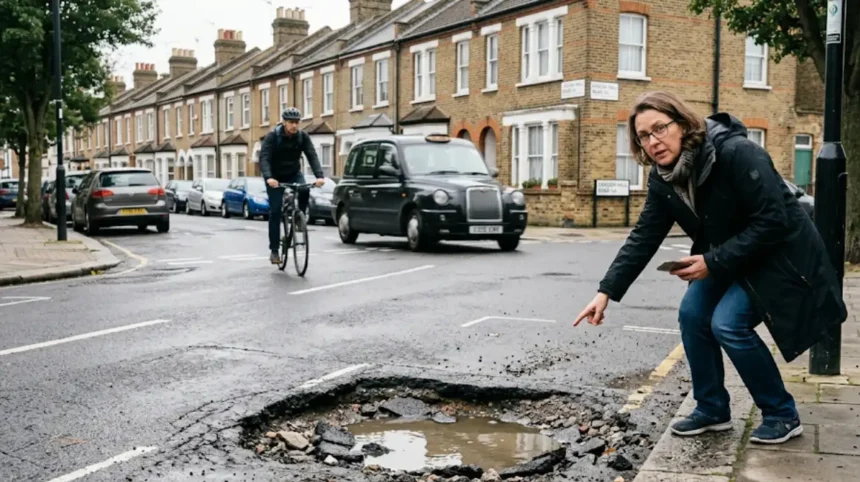
A pothole is a hole formed in a road surface when the pavement wears away. In North London, you report dangerous potholes to your local borough council for local roads or to Transport for London (TfL) for main “Red Route” roads. A dangerous pothole must be at least 40mm deep on roads or 25mm deep on pavements to qualify for repair.
- What Is a Dangerous Pothole and When Must You Report It?
- Which Organization Controls Road Maintenance in Your North London Area?
- How Do You Report a Pothole to Your Local Borough Council Online?
- How Do You Report a Pothole on a TfL Red Route or Main Road?
- What Information Must You Include When Reporting a Pothole?
- How Quickly Will Your Reported Pothole Be Repaired After Submission?
- What Should You Do If Your Reported Pothole Remains Unfixed After Weeks?
- Can You Claim Compensation for Vehicle Damage or Injury From a Dangerous Pothole?
- How Frequently Does Your Borough Inspect Roads for Potholes Without Public Reports?
- What Recent Changes Have Improved Pothole Repair Speed in London Boroughs?
- How Do You Report Potholes on Boundary Roads Between Two Boroughs?
- What Are the Most Effective Ways to Ensure Your Pothole Report Gets Prompt Action?
North London residents face thousands of potholes across boroughs like Hackney, Islington, Brent, Camden, Haringey, and Enfield. These road defects form quickly during winter weather and create serious hazards for drivers, cyclists, and pedestrians. The problem intensified after years of infrastructure neglect, with London’s roads ranked among the worst in the UK for surface condition. Understanding the exact reporting process ensures your local council can fix dangerous holes before they cause accidents or vehicle damage.
What Is a Dangerous Pothole and When Must You Report It?
A dangerous pothole is a road defect measuring 40mm depth or more on roads, or 25mm depth on pavements. You must report it immediately when you spot it because councils only repair potholes they know about. Failure to report leaves the hazard unfixed and puts other road users at risk of accidents.
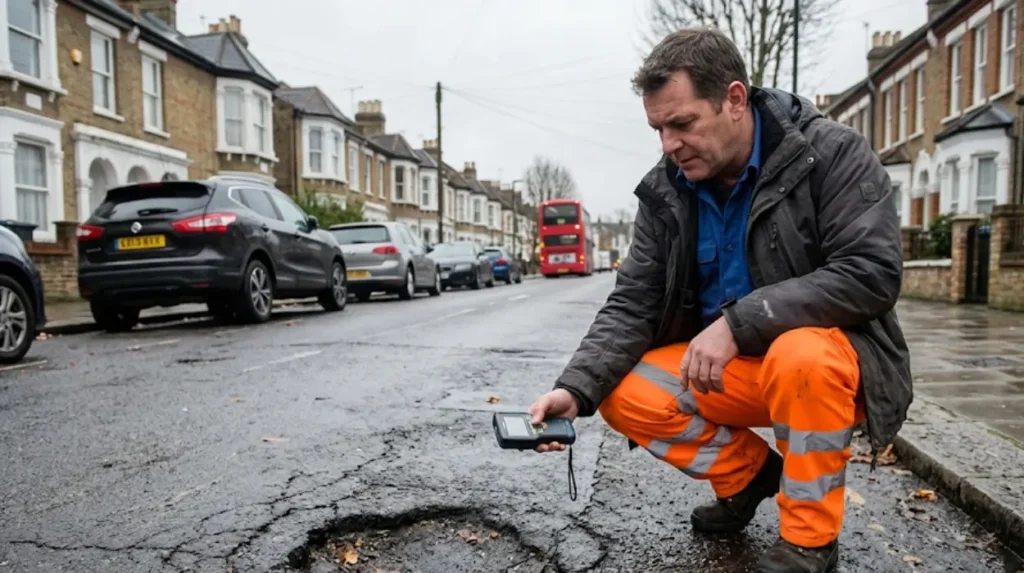
The legal definition matters for claims and repair prioritization. Most UK councils use threshold-based criteria: typically 40mm deep and 300mm wide before classing a defect as a pothole needing planned repair. Anything smaller gets recorded for monitoring but often remains unfixed until further deterioration. Local authorities measure defects manually on-site or increasingly use 3D scanning technology to capture depth, width, and severity digitally.
Potholes form when water penetrates the road base, freezes, expands, and weakens the pavement structure. Traffic loads then crush the weakened surface, creating a hollow. Other surface defects include damaged or missing paving flags or kerbstones. A defect can form quickly and become a hazard within days of initial cracking.
North London’s climate accelerates this process. The region experiences frequent rain between October and March, combined with temperature fluctuations that cause repeated freezing and thawing cycles. This weather pattern explains why pothole reports spike each winter. The RAC Foundation found that 56% of local highway authorities set their minimum investigation level at exactly 40mm depth.
Which Organization Controls Road Maintenance in Your North London Area?
Road maintenance responsibility depends on road type. Your local borough council maintains most residential streets and local roads. Transport for London (TfL) maintains “Red Routes” marked by double red lines. Boundary roads have specific maintenance agreements where one borough takes responsibility.
North London includes six main boroughs with road maintenance duties: Hackney, Islington, Brent, Camden, Haringey, and Enfield. These boroughs sit alongside neighboring areas like Waltham Forest, Barnet, and Harrow. Each borough operates its own highways repair team and sets individual response timescales.
Islington Council maintains most roads in Islington, including pavements, but not the entirety of the road network. Roads with red lines on the side are TfL-maintained “Red Routes.” These include major arterial roads like Holloway Road, North Circular Road sections, and Silverdale Road. Double red lines mean no stopping at any time, and TfL handles all pothole repairs on these routes.
Boundary roads create complexity. Islington’s neighboring boroughs are Hackney, Haringey, Camden, and the City of London. Each boundary road has a specific maintenance agreement where one borough takes responsibility for repairs. If you cannot determine which side of the boundary you’re on, report the pothole to both boroughs to ensure coverage.
Hackney Council processed 424 reports in the past week and fixed 1,154 issues in the past month through their online system. This volume demonstrates why accurate reporting to the correct authority matters. Misdirected reports waste time and delay repairs.
How Do You Report a Pothole to Your Local Borough Council Online?
Report potholes online through your borough’s official “Report a Problem” webpage. You need the location (street name and postcode), a description of the problem, and optional evidence like photos. Hackney uses reportaproblem.hackney.gov.uk, Islington uses My Islington, and most boroughs accept reports via the free Love Clean Streets app.
The online reporting process follows four consistent steps across North London boroughs:
- Enter your postcode or street name and area to locate the problem on an interactive map
- Pinpoint the exact pothole location by clicking on the map
- Enter details including depth estimate, width, lane position, and proximity to junctions
- Confirm the report and submit your contact details if you want repair updates
Hackney Council’s system shows real-time statistics: 97,245 total updates on reports and 1,154 fixes in the past month. This transparency helps residents track council performance.
Islington Council offers two online options: the My Islington portal and the Love Clean Streets phone app. The app automatically detects your location and displays the responsible authority’s colors. You take a picture, enter basic details, and post the report within seconds.
The Love Clean Streets app is available on Google Play and Apple stores for free. It works across multiple boroughs including Redbridge, Ealing, and others in the Love Clean Streets Family. The app pinpoints exact locations and sends reports to the responsible organization automatically.
When reporting, include specific details that help crews locate the issue quickly:
- Street name and nearest municipal building number
- Nearest cross-street name
- Lane location (northbound lane, turning lane, etc.)
- Whether the pothole is on the road or footway
- Proximity to junctions
- Approximate size and depth measurements
Uploading a picture of the pothole strengthens your report significantly. Photos provide visual evidence of severity and help crews prioritize emergency repairs.
How Do You Report a Pothole on a TfL Red Route or Main Road?
Report potholes on TfL-managed Red Routes directly through TfL’s Street Care service at streetcare.tfl.gov.uk or by calling the 24-hour Street Faults Contact Centre at 0845 305 1234. TfL also accepts email reports at streets enquiries@tfl.gov.uk.
TfL maintains the Transport for London Road Network (TLRN), which includes major arterial roads across London. These roads carry heavier traffic volumes and require different repair protocols than local borough streets. TfL’s process prioritizes potholes posing risk to the traveling public, making serious defects safe or repaired within under an hour.
The TfL Street Care service launched in December 2019 to make reporting quicker and easier. The online map shows whether problems have already been reported and what actions have been taken. This prevents duplicate reports and helps residents track repair progress.
TfL’s pothole repair process follows strict intervention levels:
- Most serious potholes exceeding intervention levels are rectified within under an hour
- Remaining potholes exceeding intervention levels are addressed within maximum 28 days
- Minor potholes below intervention levels are recorded but not automatically repaired within set timescales
Contact TfL through these channels:
- Phone: 0845 305 1234 (24 hours a day, seven days a week)
- Minicom: 0845 600 1723
- Email: streets enquiries@tfl.gov.uk
- Web: streetcare.tfl.gov.uk or www.tfl.gov.uk/streets
- Post: Customer Services, TfL London Streets, 4th floor, Zone G7, Palestra, 197 Blackfriars Road, London SE1 8NJ
The 24-hour Street Faults Contact Centre handles urgent or serious faults immediately. Call this number for potholes causing immediate danger or vehicle damage risk.
What Information Must You Include When Reporting a Pothole?
Your pothole report must include the exact location (street name, postcode, nearest building number), defect size and depth description, and lane position. Include whether it’s on the road or footway and proximity to junctions. Uploading a photo strengthens your report.
Specific location details prevent crews from searching incorrectly. Include:
- Full street name
- Nearby postcode (even if approximate)
- Nearest municipal or commercial building number
- Cross-street name at the nearest intersection
- Exact lane position (e.g., “second lane from curb, northbound direction”)
Size and depth descriptions help assess risk severity. Estimate measurements using visual参照s:
- 40mm depth equals approximately 1.6 inches (fitting a standard car key vertically)
- 300mm width equals approximately 12 inches (roughly the width of a adult foot)
Describe the defect’s shape: circular hole, elongated crack, or irregular崩裂. Note if the pothole has exposed underlying materials like gravel, soil, or pipe infrastructure.
Lane position matters for safety during repair. Specify:
- Which lane the pothole occupies
- Whether it’s in a turning lane, straight-through lane, or merge area
- Distance from junction (e.g., “15 meters before the traffic light at Holloway Road”)
Road or footway classification determines which department handles the repair. Road potholes affect vehicles; footway potholes (pavement) affect pedestrians and cyclists.
Photo evidence provides objective severity documentation. Take photos from multiple angles including:
- Close-up showing depth
- Wider shot showing location context
- Angle with a reference object (phone, foot, or measuring tape) for scale
Your contact details are optional but recommended if you want repair status updates. Councils cannot provide updates without knowing who to contact.
How Quickly Will Your Reported Pothole Be Repaired After Submission?
Repair times vary by borough and severity. Islington repairs 95% of identified potholes within 72 hours and achieved 100% compliance by autumn 2025. Emergency repairs are attended within 2 hours, high-priority repairs within 24 hours, and normal repairs within 14-28 working days.
Response times depend on three factors: pothole depth, location on road hierarchy, and traffic volume. Harrow Council sets a target repair time of 30 minutes for severe potholes. A further 16 councils aim to patch within one hour, and five within 90 minutes. The most common response time for urgent problems is two hours, with 79 councils targeting patch repair within this period.
At the opposite end, some councils take several days to intervene on less critical defects. The fastest councils in Great Britain fill severe potholes within minutes. Cumbria, Flintshire, and South Lanarkshire act “immediately” on highest-risk potholes.
Islington’s performance exceeds national averages. The council’s target to repair or make safe 95% of potholes within 72 hours of identification became 100% compliance by autumn 2025. This improvement reflects increased staffing and better prioritization systems.
Hackney’s data shows 1,154 fixes in the past month across all reported issues. This translates to approximately 38-39 daily repairs. Given 424 weekly reports, the council maintains a backlog but processes most requests within reasonable timeframes.
TfL’s emergency protocol addresses serious potholes within under an hour. Less critical but still dangerous potholes get repaired within 28 days maximum. Minor defects below intervention levels are recorded for monitoring but not automatically scheduled for repair.
Rain and freeze conditions delay repairs. Councils prioritize emergency repairs during active hazardous weather but may postpone planned maintenance until conditions stabilize. Winter months see increased pothole formation but also slower repair rates due to weather limitations.
What Should You Do If Your Reported Pothole Remains Unfixed After Weeks?
Follow up by submitting a second report referencing your original submission date, then contact your borough’s highways department directly by phone. If the pothole causes vehicle damage or injury, document the defect with photos and measurements for potential compensation claims. Persistent unaddressed hazards may warrant contacting your local councilor for intervention.
Initial investigation typically occurs within 10 working days of report submission. If no action follows this period, escalate through these steps:
- Submit a duplicate report with original submission date noted in the description
- Call your borough’s highways repair team directly using published contact numbers
- Request a case reference number for your follow-up
- Ask for the pothole’s priority classification and scheduled repair date
Council response times vary significantly. At the slowest end, some councils take several days to intervene. If your pothole exceeds 40mm depth and remains unfixed beyond 28 days, it qualifies for escalation.
Contact your local councilor if the issue persists. Councilors can request urgent attention from highways departments and track repair progress through internal systems. They often have direct contact with senior highways managers.
Document the defect thoroughly for potential claims. Take dated photos showing:
- Exact location with street signs visible
- Depth measurement using a ruler or measuring tape
- Width measurement
- Vehicle damage if applicable (tire puncture, suspension damage)
- Any injury context if a pedestrian or cyclist fell
Most councils consider defects 40mm deep or more as dangerous potholes eligible for compensation claims if damage occurs. Pavement defects must be 25mm deep or more to qualify.
Fill That Hole, run by the UK’s national cyclists’ organisation, allows users to report themselves whether and when potholes have been fixed. This independent tracking system helps residents monitor council performance and identify chronic neglect areas.
Can You Claim Compensation for Vehicle Damage or Injury From a Dangerous Pothole?
Yes, you can claim compensation if a pothole 40mm deep or more causes vehicle damage or pedestrian/cyclist injury. The road defect must meet the legal depth threshold, and you must prove the council knew about it or should have discovered it through routine inspection. Document the defect with photos, measurements, and your report submission date.
Claim eligibility requires meeting specific criteria:
- Pothole depth of 40mm or more on roads, 25mm or more on pavements
- Proof that the defect caused actual damage or injury
- Evidence that the council failed to repair despite knowing about the hazard
Most councils set minimum investigation levels based on depth. 56% of local highway authorities use exactly 40mm as their threshold. 14% require 50mm or more, while 20% investigate defects between 20-30mm depth.
Successful claims require documentation:
- Original pothole report submission date and reference number
- Photographs showing depth and width measurements
- Vehicle repair invoices or medical treatment records
- Witness statements if available
- Weather conditions at the time of incident
Councils defend claims by arguing they inspected regularly and the defect formed recently. Islington inspects all borough roads routinely with frequencies varying between monthly, quarterly, six-monthly, and annually based on road usage. If inspection records show the council checked the location within the past month and the pothole wasn’t recorded, the council may argue the defect formed after inspection.
TfL’s 15% repair rate for reported potholes has drawn criticism from cycling organizations. TfL ranked 194th worst out of 212 for filling reported potholes, fixing only 35 of 236 reports. This poor performance strengthens claim arguments against TfL for Red Route incidents.
Consult a solicitor specializing in highway defect claims for complex cases. Many offer no-win-no-fee arrangements for pothole compensation claims.
How Frequently Does Your Borough Inspect Roads for Potholes Without Public Reports?
Boroughs inspect all roads routinely with frequency depending on road usage. Islington inspects monthly for high-traffic roads, quarterly for medium usage, and annually for low-traffic residential streets. TfL identifies defects through regular inspections but relies heavily on public reports for timely detection.
Inspection frequency correlates with road hierarchy:
- Monthly: Major arterial roads with high traffic volumes
- Quarterly: Secondary roads with moderate traffic
- Six-monthly: Residential streets with lower traffic
- Annually: Very quiet rural or private roads
This tiered approach prioritizes resources for roads where potholes create greatest danger. High-traffic roads experience faster deterioration and affect more road users.
TfL attempts to identify all defects through inspection but explicitly states that public reports are “always welcome”. The Street Faults help line operates 24 hours daily because many defects first emerge after inspections and require immediate public notification.
Hackney’s system processed 424 reports in one week, demonstrating that public reporting drives most defect detection. This volume suggests routine inspections identify only a fraction of active potholes.
Winter weather accelerates pothole formation. Freeze-thaw cycles create new defects within days after inspection. Public reporting fills this gap by catching rapidly emerging hazards between scheduled inspections.
Councils document inspection routes and dates in internal systems. If you claim compensation, request inspection records for your road to prove the council knew about the defect or should have discovered it through routine patrol.
What Recent Changes Have Improved Pothole Repair Speed in London Boroughs?
Redbridge Council trials spray injection patching that fixes potholes in two minutes without road closure. This technique allows 120 daily repairs with vehicles passing immediately after repair. Islington achieved 100% pothole repair within 72 hours by autumn 2025 through increased staffing and improved prioritization.
Spray injection patching uses specialized equipment that injects adhesive and aggregate into the pothole simultaneously. The process:
- Requires no road closure
- Takes approximately two minutes per repair
- Allows vehicles to pass immediately after completion
- Creates durable repairs lasting multiple years
Redbridge conducts up to 120 road repairs daily using this technique. This volume represents a 3-4x increase over traditional patching methods requiring road closures and curing time.
Islington’s performance improvement from 95% to 100% compliance within 72 hours reflects systematic changes:
- Increased highways repair team staffing
- Better prioritization algorithms matching defect severity to response time
- Real-time tracking systems monitoring repair progress
- Dedicated emergency response teams for critical potholes
London’s Annual Local Authority Road Report warned there is “no quick fix” to road conditions despite increased funding. Infrastructure deterioration spans decades and requires sustained investment beyond short-term repair programs.
Sadiq Khan and the Department for Transport have committed additional funding for road maintenance, but industry reports warn implementation faces challenges including workforce shortages and material cost increases.
How Do You Report Potholes on Boundary Roads Between Two Boroughs?
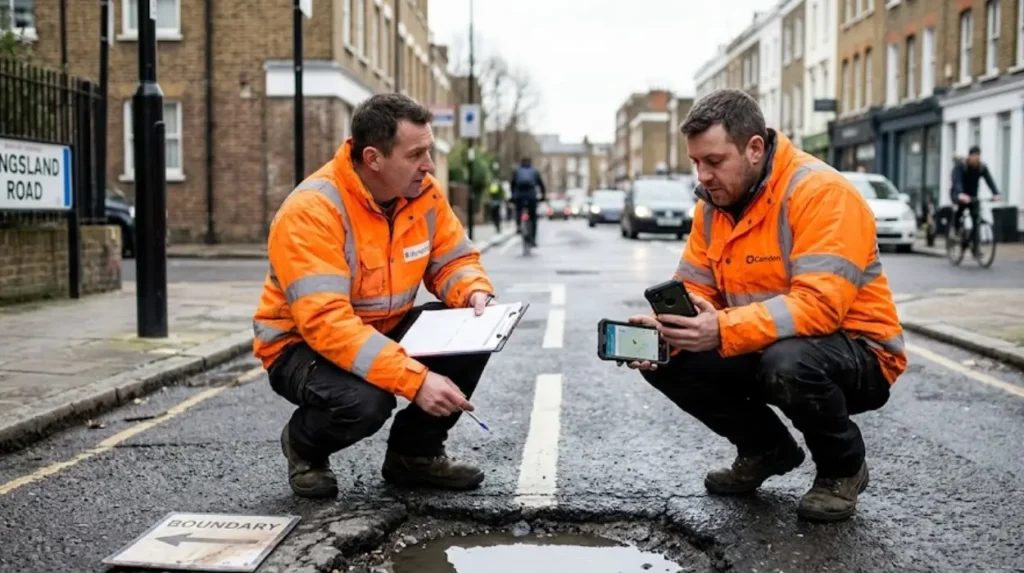
Report boundary road potholes to both boroughs when uncertain which side you occupy. Each boundary road has a specific maintenance agreement assigning responsibility to one borough. Submitting duplicate reports ensures coverage and prevents the defect from being ignored by both authorities.
Boundary roads create jurisdictional confusion. Islington’s boundaries touch Hackney, Haringey, Camden, and the City of London. Streets like Kingsland Road, granting access between Islington and Hackney, or Holloway Road crossing Islington and Camden, require careful determination of which borough maintains them.
Maintenance agreements specify responsibility based on:
- Road centerline position (one borough owns the left side, another owns the right)
- Historical transfer agreements from past decades
- Current traffic authority designations
When uncertain, report to both boroughs using each authority’s online system. Include in both reports: “Boundary road—please confirm responsibility if this falls under your jurisdiction.”
This approach prevents the “not our road” rejection that delays repairs. Both councils receive the report, and the responsible authority acts while the other acknowledges non-responsibility.
The Love Clean Streets app automatically detects location and sends reports to the responsible organization, which could be Islington, another borough, or TfL for main roads. The app’s geographic intelligence reduces boundary confusion but manual double-reporting remains safest when uncertainty persists.
What Are the Most Effective Ways to Ensure Your Pothole Report Gets Prompt Action?
Submit reports with precise location details, exact measurements, and photo evidence through official borough channels. Use the Love Clean Streets app for automatic location detection. Follow up within 10 working days if no investigation occurs. Report urgent hazards via phone for immediate attention.
Effective reporting follows these principles:
Precision matters: Include street name, postcode, nearest building number, cross-street, and exact lane position. Generic descriptions like “near the park” delay repair.
Measurement documentation: Estimate depth and width using visual参照s. Photos with measuring tape provide objective evidence.
Channel selection: Use official borough webpages or the Love Clean Streets app. Third-party sites like Fill That Hole forward reports but add processing time.
Photo evidence: Upload at least one clear photo showing depth and location context. Multiple angles strengthen the report.
Follow-up timing: Contact the borough after 10 working days if no investigation occurs. Early escalation prevents indefinite delays.
Emergency phone reporting: Call 24-hour Street Faults centers for immediate hazards. TfL’s 0845 305 1234 number handles urgent cases.
How do I report a pothole in North London?
You can report a pothole through your local borough council’s online reporting system if it is on a local road. If the pothole is on a TfL Red Route marked with double red lines, report it directly to Transport for London through its Street Care service or contact centre.