Key Points
- Scheme Duration: Essential structural reinforcement works on the A41 Brent Cross Flyover will require reducing traffic to a single lane in each direction for up to two years.
- Project Investment: The £10.8 million renewal scheme is funded by the Department for Transport (DfT) to restore the load-bearing capacity of the 1965 concrete flyover.
- Weight Restrictions: Completion of the structural strengthening will allow Transport for London (TfL) to remove the safety-critical 7.5-tonne weight limit imposed in October 2022.
- Seasonal Work Pause: Work on the project will pause from late November to early January to mitigate travel congestion around Brent Cross Shopping Centre during the festive period.
- Network Impact: Over 120,000 vehicles daily utilise the broader Brent Cross Interchange, with significant delays anticipated across the A41, A406 North Circular Road, A5, and A1. Daily Express
North London (North London News) September 29, 2026 – Motorists navigating north-west London face up to two years of severe travel disruption following the reduction of the A41 Brent Cross Flyover to a single lane in each direction. Transport for London (TfL) officially initiated traffic management interventions and structural renewal works on the 1965 concrete flyover to execute a £10.8 million reinforcement programme designed to prevent potential emergency closures and restore full load-bearing capabilities.
- Key Points
- Why are major structural works required on the Brent Cross flyover?
- How will traffic management and lane restrictions be operated?
- What have transport officials stated regarding the renewal scheme?
- Background of the Brent Cross Interchange development
- Prediction: How this development will affect local road users, businesses, and freight operators
Why are major structural works required on the Brent Cross flyover?
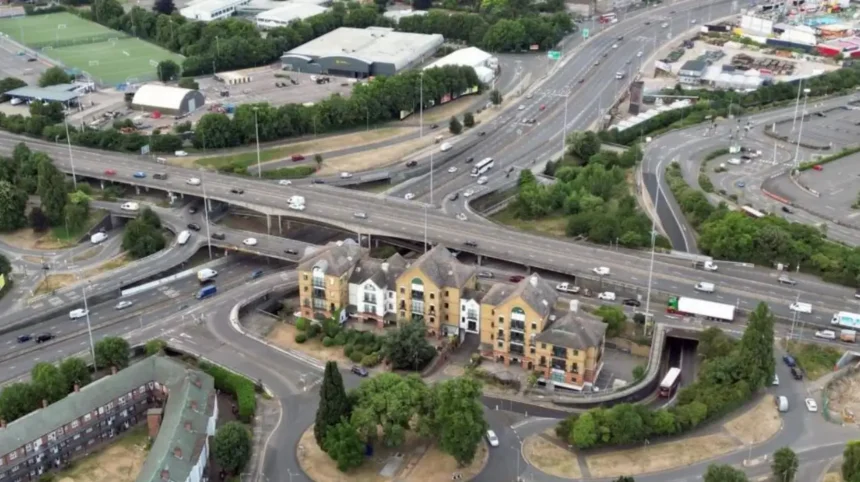
As reported by Ayokunle Oluwalana of My London, the critical arterial route carries the A41 Hendon Way directly over the A406 North Circular Road and handles a substantial portion of north London’s daily traffic volume. Engineering inspections conducted by Transport for London in October 2022 revealed underlying structural deterioration, including exposed steel reinforcements and sections of delaminating concrete. These findings necessitated the immediate imposition of an emergency 7.5-tonne weight restriction to maintain safe operation.
As outlined in official coverage by Times Series, the £10.8 million funding allocation provided by the Department for Transport (DfT) enables engineering teams to execute comprehensive strengthening measures. The structural renewal scheme involves reinforcing the primary concrete elevated decks, replacing existing safety barriers across both the flyover and its approach ramps, and applying a high-grade waterproofing system across the structure to prevent future water ingress and corrosion.
How will traffic management and lane restrictions be operated?
As detailed by news reports in Express.co.uk, the project mandates a reduction of dual-carriageway capacity to a single lane in each direction on the A41 flyover through 2028. Transport for London confirmed that to support various construction stages, a combination of contraflow systems, temporary speed reductions, and selective overnight and weekend closures will be deployed. Signed diversion routes are scheduled to operate during full night-time closures.
As reported by Ham & High, TfL has implemented specific demand-management protocols and localized signal timing alterations across the Brent Cross Interchange—a three-level stacked roundabout connecting the A41, A406, and A5—to manage queuing vehicles. However, transport authorities explicitly advised that drivers should expect prolonged journey times affecting surrounding networks, including the A406 North Circular, A5 Edgware Road, and the A1. To protect commercial trade during the peak retail season, TfL confirmed a planned suspension of major roadworks from late November until early January, providing temporary relief for visitors to the nearby Brent Cross Shopping Centre.
What have transport officials stated regarding the renewal scheme?
As cited by press officer updates from Transport for London, Stuart Harvey, Chief Capital Officer at TfL, stated:
“The A41 Brent Cross Flyover is a vital piece of London’s road network, supporting tens of thousands of journeys every day. These works are essential to ensure it remains safe and reliable for the millions of journeys that depend on it”.
Harvey further noted regarding the operational friction:
“We recognize that the work will cause disruption, and we’d like to thank local communities and road users in advance for their patience”.
As highlighted in technical briefings by Transport for London, the completion of this two-year engineering initiative will allow the safety-critical 7.5-tonne weight restriction to be lifted permanently, restoring heavy goods vehicle (HGV) access and freight movement along the strategic corridor.
Background of the Brent Cross Interchange development
The Brent Cross Interchange holds historical significance as England’s first three-level stacked roundabout structure, originally opened to traffic in 1965 to facilitate key connections between central London, the North Circular Road, and the M1 motorway corridor. Over six decades of continuous heavy usage, combined with increasing vehicle weights and environmental exposure, resulted in progressive concrete spalling and corrosion of the internal steel reinforcement within the flyover’s superstructure.
The structural downgrade in October 2022 forced heavy freight traffic, commercial buses, and multi-axle logistics vehicles to divert onto the mid-level roundabout and local surface arterial routes. This traffic distribution heightened congestion at ground level, particularly near the Brent Cross Shopping Centre and surrounding residential corridors in Barnet and Brent. The current £10.8 million renovation forms Phase 1 of a broader multi-year infrastructure renewal strategy planned by TfL and local authorities to modernize the entire Brent Cross Interchange network, including future remediation of mid-level slip roads and supporting bridges.
Prediction: How this development will affect local road users, businesses, and freight operators
The two-year restriction of the A41 Brent Cross Flyover to a single lane will generate widespread impacts across several key demographics:
- Commuters and Local Private Motorists: Daily commuters travelling along the A41 Hendon Way corridor into central and north-west London will encounter increased travel times and queue tailbacks extending onto the A1 and A5 during peak hours. Local residents in Hendon, Golders Green, and Cricklewood are likely to observe elevated levels of traffic displacement onto residential side streets as navigation systems reroute vehicles around bottlenecks.
- Freight and Logistics Operators: While heavy goods vehicles over 7.5 tonnes are already restricted from using the flyover deck, the overall reduction in interchange capacity will delay surface-level freight operations connecting with the M1 motorway and A406 North Circular Road. Long-term, however, the successful completion of the structural strengthening will restore direct route access for logistics fleets, eliminating permanent diversion routes.
- Retailers and Commercial Enterprises: Surrounding commercial zones, predominantly the Brent Cross Shopping Centre and adjacent retail parks, face potential reductions in customer pass-by traffic during peak weekend trading hours. The scheduled winter moratorium on construction activity will temporarily preserve holiday retail access, but broader disruption across 2026–2028 may influence local supply chains and delivery schedules.