Key Points
- Barnet Conservative Proposal: Conservative councillors in the London Borough of Barnet are planning to formally propose a new twinning agreement with the Israeli city of Haifa.
- Hackney Decision: The proposal comes as a direct counter-response to neighboring Hackney Council’s vote in July 2026 to begin severing its own 58-year twinning relationship with Haifa.
- Impact on Jewish Community: Proponents argue that terminating the historic relationship sends a damaging message to Jewish Londoners during a period of rising antisemitism.
- Green Administration Pledges: Hackney’s Green administration, which won 42 of 57 seats in May 2026, voted to end the arrangement in principle to fulfill a manifesto commitment regarding human rights and international law.
- Chamber Backlash: Opponents within local government and major communal bodies accused the Green-led administration of failing to consult Jewish councillors and predetermining its review.
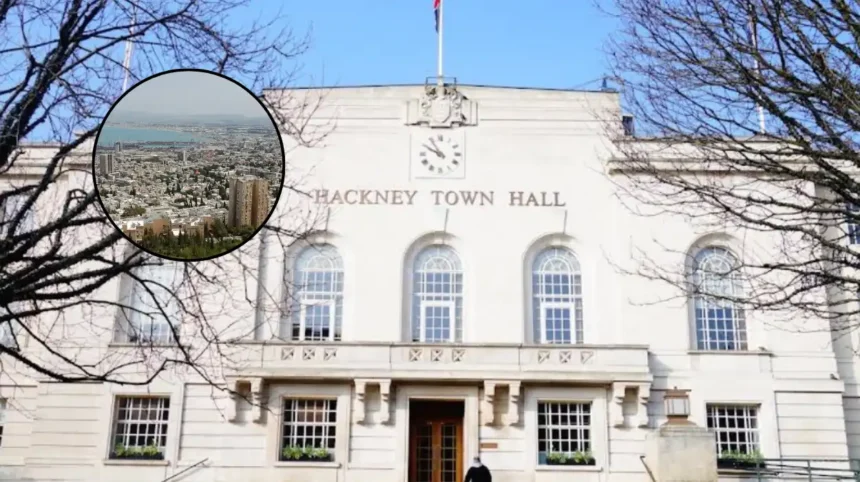
Barnet (North London News) October 6, 2026 — Conservative councillors in the London Borough of Barnet are set to introduce a motion proposing an official municipal twinning partnership with the Israeli city of Haifa. The policy move comes in opposition to a recent decision by the Green Party-led administration in neighboring Hackney Council to initiate the termination of its own 58-year civic bond with the same municipality.
What triggered the row over the Haifa twinning agreement?
The controversy began following local elections in May 2026, which saw the Green Party secure a majority in Hackney with 42 out of 57 council seats. During a full council debate in July 2026, Hackney’s Green administration voted in principle to end the borough’s 1968 twinning link with Haifa.
As reported by Hackney Citizen, Green Councillor Mathys stated during the chamber proceedings that it was the administration’s “responsibility as a Green-led council to ensure that our institutional relationships are consistent with our values and commitment to human rights, international law, justice and international solidarity”. Mathys added that the step was directly delivering on a manifesto pledge to end the arrangement “at its earliest convenience”.
The move prompted sharp criticism from elected representatives and national community organizations. During the debate, elected members highlighted that the original agreement had fostered long-standing medical exchanges between Homerton University Hospital in Hackney and Rambam Medical Centre in Haifa.
As documented by Jewish News, Conservative Councillor Simche Steinberger directly addressed the chamber, criticizing the lack of local engagement:
“To be honest, if I was Haifa, I’d be ashamed to twin with Hackney in such a current situation. It’s a disgrace, and it’s not asked for… You’ve not spoken to any of the six Jewish councillors about it. Nothing at all, nothing whatsoever”.
In response to the administration’s trajectory, Conservative representatives in Barnet—home to the largest Jewish population of any local authority area in the United Kingdom—announced their intention to step in by establishing an official link with Haifa. Writing for The Jewish Chronicle, author Raffy Lachter reported that Barnet’s Conservative councillors view Hackney’s decision as a move that “sends the wrong message to Jewish Londoners at a time of sharply rising antisemitism”.
How did council members and communal bodies react to the vote?
The debate inside the Hackney council chamber exposed deep political and civic divisions over the role of local councils in international affairs.
As reported by Jewish News, a Green councillor argued in favor of ending the relationship on human rights grounds, stating to the chamber:
“If the Jewish people of Britain want to fight rising antisemitism, the first thing they must do is condemn the genocide in Palestine. And it is for this reason that I will be voting in favour of these recommendations”.
Conversely, other members questioned the practical purpose of severing a historic municipal partnership. As reported by Jewish News, Labour councillors raised concerns over community cohesion, with one stating:
“We are all elected here on a mandate, and to be clear, we have a mandate to serve people, whether they voted for us or not. Twinning is about local communities having a civil partnership… It’s how we strengthen the communities. It’s how we build and come together. I’m perplexed by this proposal because it doesn’t seem to strengthen those communities”.
Outside the chamber, major Jewish leadership organizations issued statements condemning the Green administration’s decision. The Board of Deputies of British Jews, the London Jewish Forum, and associated community representatives accused the council of predetermining the outcome of its own internal review process.
As reported by the Jewish Telegraphic Agency, Board of Deputies President Phil Rosenberg publicly stated following the vote:
“Tonight, the Hackney Green Party showed its ignorance and bigotry,”
describing the motion as “the prioritization of spite over sense”.
Background of the particular development
Municipal twinning agreements in the United Kingdom traditionally originated after the Second World War as civic measures to encourage international exchange, cultural links, and professional collaboration between local authorities. The partnership between the London Borough of Hackney and the Israeli port city of Haifa was formally established in 1968. Over the subsequent five decades, the connection operated primarily through civil society links, educational visits, and cooperation between local health bodies, notably professional exchanges between Homerton University Hospital and Haifa’s Rambam Medical Centre.
Haifa is widely recognized within Israel as a center for co-existence, with an ethnically and religiously diverse population comprising Jewish, Muslim, Christian, and Bahá’í residents, governed by a municipal council that includes Arab, Green, and progressive political parties.
In July 2026, following political gains by the Green Party in London local government, Hackney Council voted to approve five procedural recommendations regarding its international links. These included agreeing “in principle” to terminate the 1968 Haifa agreement, establishing a cross-party working group to review all five of the borough’s twinning arrangements, conducting an equality impact assessment, and authorizing the Mayor of Hackney to write to the Mayor of Haifa to seek the municipality’s official views. The working group is scheduled to present its final report to full council in January 2027 following a public consultation period.
Prediction: How this development can affect Jewish Londoners and local authorities
The step by Barnet Conservative councillors to offer a twinning agreement to Haifa, combined with Hackney’s ongoing process to sever ties, is likely to have several tangible impacts across local government and community relations in London:
- Heightened Political Polarization in Local Government: Foreign policy debates are increasingly influencing town hall proceedings across London boroughs. As councils split along party lines regarding international agreements, municipal decisions may increasingly reflect national or international geopolitical stances rather than traditional local civic services.
- Impact on Community Relations and Security Sentiments: For Jewish residents in North and East London—particularly in areas like Stamford Hill and Barnet—the potential severance of ties by one borough alongside a adoption by another highlights contrasting approaches to community reassurance. The debate may increase scrutiny on how local councils engage with minority communities during periods of international conflict.
- Disruption of Civic and Medical Exchanges: If Hackney’s decision is formally finalized following its review in 2027, practical professional networks—such as clinical knowledge-sharing between Homerton Hospital and Israeli medical centers—will cease under Hackney’s framework. Conversely, if Barnet successfully adopts the agreement, those bilateral channels and cultural exchange networks could be repurposed within Barnet local authority institutions.