Key Points
- Record-breaking hot weather and a lack of rain have dried out many ponds and streams in and around High Barnet.
- Hadley Green and Hadley Common have both been hit hard by the drought.
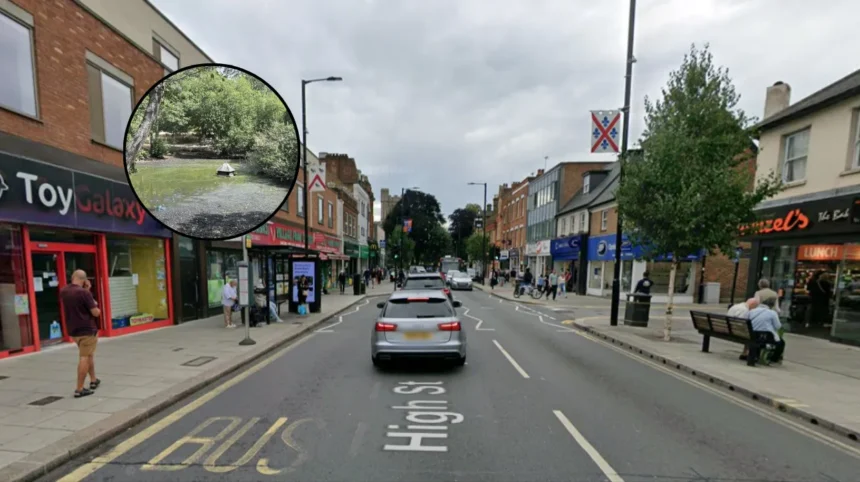
- At the duck pond where Hadley Green meets Barnet High Street, exposed mud and only a small patch of slimy water remain.
- Feeding ducks at the pond is now discouraged, with a notice warning that uneaten food encourages vermin.
- Brewery Pond at the northern end of Hadley Green, near Dury Road, is still holding water and continuing to provide a refuge for ducks, other birds and wildlife.
High Barnet (North London News) August 4, 2026 — Record-breaking hot weather and a lack of rain have taken a heavy toll on ponds and streams in Chipping Barnet, with prolonged dry conditions leaving many local water features severely depleted.
Hadley Green and Hadley Common have both been badly affected by the drought. At the duck pond where Hadley Green meets Barnet High Street, water levels have fallen dramatically, leaving exposed mud and only a small patch of stagnant, slimy water.
What has happened to the duck pond?
The duck pond has long been a popular spot where local families and children feed ducks, but that activity is now discouraged. A notice at the site advises visitors not to feed the birds because uneaten food can attract vermin.
The warning reflects efforts to manage the area during the drought, addressing both environmental conditions and public hygiene concerns as water levels remain exceptionally low.
Which pond is still holding water?
Brewery Pond, located at the northern end of Hadley Green near Dury Road, remains in better condition than the duck pond. Although water levels have also fallen there, it continues to provide an important refuge for ducks, other birds and local wildlife.
The contrast between the two ponds shows that the drought has affected different water bodies to varying degrees, with some continuing to support wildlife despite the prolonged dry spell.
Why are the ponds and streams drying out?
The main causes are prolonged hot weather and below-average rainfall. Together, these conditions have caused water levels to drop significantly across ponds and streams that normally form part of Chipping Barnet’s green landscape.
The dry conditions are part of a wider period of unusually warm weather affecting local green spaces rather than an isolated issue at a single location.
What does this mean for local wildlife and visitors?
Lower water levels reduce the availability of habitat for birds and other wildlife that depend on ponds and streams. While Brewery Pond continues to provide some shelter, the loss of water elsewhere limits suitable refuge for many species.
For residents and visitors, the impact is immediately visible, with familiar ponds replaced by exposed mud and shallow pools. The advice against feeding birds also reflects efforts to protect both wildlife and the surrounding environment during the drought.
Background of the development
Hadley Green and Hadley Common are well-known open spaces in and around High Barnet, with their ponds forming an important part of the local landscape. The current dry conditions highlight how quickly these natural features can change during extended periods of hot weather and limited rainfall.
The duck pond at Hadley Green has long been associated with generations of local families feeding ducks. Its current condition demonstrates how even long-established community landmarks can be affected by short-term weather extremes.
Explore More Barnet News
Four Spanish Men Sentenced for Tube Graffiti at High Barnet 2026
Silk Stream Expansion Approved by Barnet Council in West Hendon 2026
What could happen next?
If dry weather continues, more ponds and streams across Chipping Barnet may remain at unusually low levels, reducing their value as wildlife habitats and altering the appearance of local green spaces.
If rainfall returns, water levels are likely to recover gradually, although the current conditions already demonstrate the significant impact prolonged dry weather has had on the area’s natural environment.