Key Points
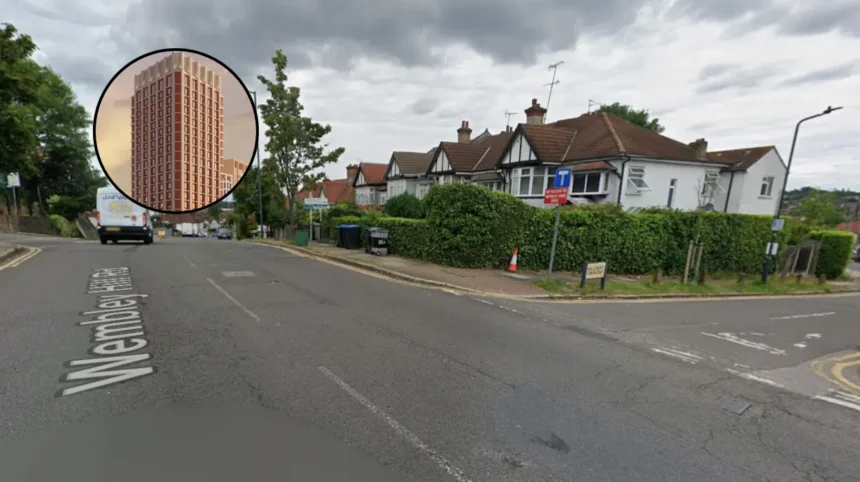
- New Development Proposal: Plans have been lodged to demolish existing residential homes at 127–129 Wembley Hill Road and replace them with a six-storey block of flats.
- Proximity to Iconic Venue: The proposed corner plot sits in a highly prominent location near Wembley Stadium, potentially shifting the local skyline and architectural scale.
- Planning Status: The application sets out a brand-new layout, scale, and design for the site, and it will now face full planning scrutiny by local council authorities.
- Community and Visual Impact: If approved, the taller six-storey height will replace low-rise housing, introducing denser residential living to the Wembley Hill area.
Wembley (North London News) June 13, 2026 — A major urban redevelopment application has been officially lodged to construct a six-storey residential block of flats at 127–129 Wembley Hill Road, a prominent corner plot situated close to Wembley Stadium. According to the initial planning documentation submitted to local authorities, the ambitious proposal seeks full permission to demolish the existing low-rise residential properties currently occupying the site to make way for a significantly taller, high-density residential building. The application outlines a comprehensive overhaul of the site’s existing scale, structural layout, and modern architectural design, marking another potential shift in the rapidly evolving urban landscape surrounding the international stadium district.
The application has now entered the formal validation and consultation phase, meaning the scheme will be subject to rigorous planning scrutiny by municipal officers, local stakeholders, and neighbors before any physical work can begin.
What Do the Official Plans Reveal About the Wembley Hill Road Proposal?
As detailed within the public access planning files submitted to Brent Council, the project planners aim to maximize the structural potential of the corner plot at 127–129 Wembley Hill Road. The proposed building features a stepped design rising up to six storeys, which is intended to transition between the more intensive commercial-residential zones nearer to the stadium and the suburban housing further up Wembley Hill Road.
The layout specifies a mix of multi-bedroom flats designed to meet local housing targets, alongside integrated cycle storage, refuse facilities, and landscaped communal areas.
Architects involved in the project design note in the design and access statement that the building utilizes modern materials intended to complement the surrounding brickwork while establishing a clear contemporary identity on the street corner.
The development site currently accommodates traditional residential housing. The transition from these existing units to a larger six-storey block represents a significant densification of the immediate plot.
Local planning officers will be tasked with assessing whether the proposed height and footprint constitute an overdevelopment of the site or a necessary contribution to the borough’s housing supply.
How Will the Local Authority Scrutinise the Project?
The submission of the planning application triggers a statutory consultation period during which various statutory consultees—including highways departments, environmental health officers, and local water authorities—will submit formal representations. Because the site is located on a prominent thoroughfare close to Wembley Stadium, traffic management and parking provisions will undergo intense evaluation.
According to standard Brent Council planning protocols, the scheme must align with the borough’s overarching Local Plan, which stipulates strict criteria for sustainable design, affordable housing quotas, and architectural compatibility.
Case officers will evaluate the daylight and sunlight impact on neighboring properties, potential overlooking issues, and the overall acoustic insulation of the proposed flats, given the proximity to major transport links and event-day traffic.
Members of the public residing within the immediate vicinity are also being notified, allowing residents to submit letters of support or objection regarding the scale, aesthetic, and density of the six-storey block.
Background of the Particular Development
The proposed redevelopment at 127–129 Wembley Hill Road comes against the backdrop of more than a decade of intense, multi-billion-pound regeneration across the wider Wembley area.
Historically characterized by industrial estates, low-rise commercial warehouses, and suburban housing tracts, the masterplan surrounding Wembley Stadium has progressively shifted toward high-density, high-rise urban living.
The London Borough of Brent has consistently been identified as an area under immense pressure to deliver new housing units under the London Plan.
Large-scale developers like Quintain have fundamentally rewritten the skyline around Wembley Park with high-rise build-to-rent schemes, retail hubs, and cultural quarters. This intense development pressure has gradually begun to ripple outward from the immediate stadium precinct into surrounding secondary thoroughfares like Wembley Hill Road.
Plots that previously held single-family homes or small, low-density multi-family structures are increasingly viewed by land buyers and speculative developers as prime opportunities for intensification.
The corner plot nature of 127–129 Wembley Hill Road makes it particularly attractive for a taller building, as corner sites are traditionally utilized by urban planners to anchor streetscapes and accommodate greater height than mid-terrace plots.
Prediction: How This Development Can Affect Local Residents and Property Owners
If this six-storey residential block receives final planning approval, it is highly likely to accelerate a trend of incremental densification along Wembley Hill Road, directly impacting local property owners, immediate neighbors, and daily commuters.
For residents living in the immediate vicinity of 127–129 Wembley Hill Road, the transition from low-rise housing to a six-storey block will visually alter the local streetscape. Neighboring properties may experience changes in natural light levels and increased localized activity.
On a broader scale, an approval here establishes a strong planning precedent. Property owners of neighboring plots may find the value of their land altered by the potential for high-density redevelopment, potentially prompting future assembly of land parcels by developers looking to replicate the six-storey model along the road.
Impact on Infrastructure and Public Services
The introduction of multiple new households onto this specific corner will place minor but cumulative demands on local infrastructure. While the development is expected to advocate for a “car-free” or low-parking framework in line with London planning policies, local public transport networks—including nearby Wembley Stadium and Wembley Park stations—will see marginally higher daily footfall.
Furthermore, nearby GP surgeries, schools, and utility networks will need to absorb the incremental population increase, a factor that Brent Council will weigh against the borough-wide benefit of securing additional housing stock.