Key Points
- Residents and local politicians in Fitzrovia and the Warren Street area have condemned Transport for London (TfL) over years of persistent Tube noise and ground-borne vibrations.
- The noise emissions, identified as originating primarily from the Victoria line, are reported to reach peak levels of 50 to 51 decibels (dB) inside local homes, shaking bed frames and severely disrupting sleep.
- City Hall politician Anne Clarke highlighted that noise levels inside properties are worsening and significantly exceed health and transport safety guidelines.
- TfL’s 2012 guidance classifies ground-borne noise over 40 dB LAFmax as “significant” and advises target limits of 35 dB for new railway lines, whilst World Health Organisation (WHO) standards recommend continuous overnight noise exposure in bedrooms remain below 30 dB LAeq.
- Residents, including local resident Alex, report that train pass-bys occur every 1 to 2 minutes during peak hours, creating constant noise spikes that persist into the early hours during Night Tube operations.
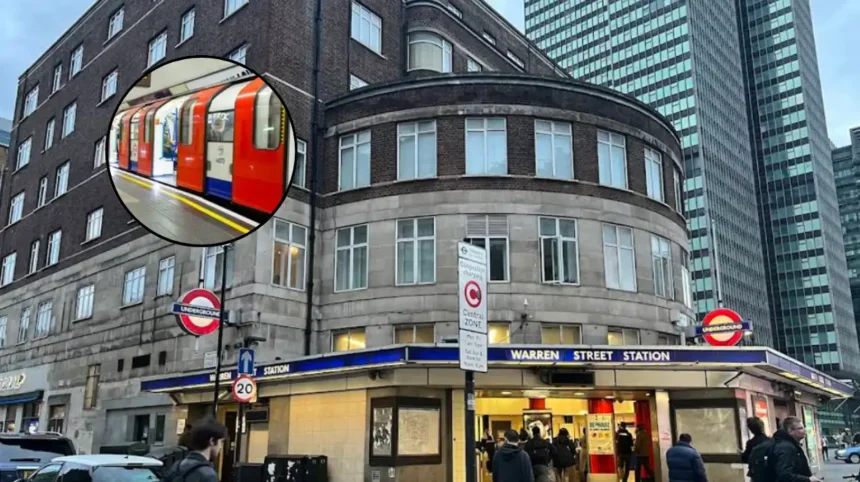
Fitzrovia (North London News) September 23, 2026 — Residents and local political representatives living on the border of Camden and Westminster have issued strong criticisms against Transport for London (TfL) regarding unresolved and “disruptive” underground railway noise that has affected the area for several years. According to local complaints, continuous low-frequency sounds and ground-borne vibrations originating from the Victoria line in the Warren Street and Fitzrovia area have caused structural shaking within residential properties, disturbed sleep in the early hours of the morning, and created ongoing disruptions during Night Tube operational hours. Although both the Northern line and Victoria line intersect at Warren Street station in Fitzrovia, technical assessments and resident reports confirm that the Victoria line is the primary source of the disruptive noise emissions.
- Key Points
- What is causing the severe Warren Street Tube noise and bed-shaking vibrations?
- How do the measured noise levels compare to official TfL and WHO guidelines?
- What is the background of TfL ground-borne Tube noise across London?
- What is the prediction for how this ongoing development will affect local residents and TfL?
What is causing the severe Warren Street Tube noise and bed-shaking vibrations?
As reported by local residents and public representatives, the disturbance stems from heavy wheel-rail interface friction and structural vibration transmission along the Victoria line deep below ground level. As trains pass through the subterranean tunnels, acoustic energy travels through the surrounding soil and bedrock into the foundations of residential structures above.
Local resident Alex stated that sound measurements recorded inside Warren Street properties consistently register between 50 and 51 dB as trains pass every 1 to 2 minutes during peak operational hours. According to resident accounts, these frequent noise spikes remain constant throughout the day and continue into the night, causing severe, repeated sleep disruption for households positioned directly above the tunnel alignment.
How do the measured noise levels compare to official TfL and WHO guidelines?
As highlighted by London Assembly Member Anne Clarke, affected residents have raised extensive frustrations regarding the problem, which they report is progressively worsening. Measurements inside affected residential dwellings have regularly exceeded 50 dB, representing a significant breach of published health and transport threshold standards.
According to Transport for London’s official guidance documentation from 2012, ground-borne noise generated from a newly laid underground railway line is formally categorized as “significant” if peak train pass-by noise ($dB\ L_{AFmax}$) exceeds 40 dB. The same 2012 TfL policy specifies that “reasonable endeavours” must be taken by engineers to meet a more stringent operational ceiling of 35 dB within residential properties.
Furthermore, residents have drawn attention to international public health benchmarks. As outlined in the World Health Organisation’s (WHO) night noise guidelines for Europe, continuous overnight noise exposure ($dB\ L_{Aeq}$) inside bedrooms should strictly remain below 30 dB to prevent adverse health effects, cardiovascular strain, and chronic sleep disturbance. The 50 to 51 dB levels documented in Warren Street homes sit well above both the WHO recommendations and TfL’s internal targets.
What is the background of TfL ground-borne Tube noise across London?
Ground-borne noise and subterranean vibration issues have long presented technical challenges for London Underground’s deep-level tube lines, particularly following track maintenance, rail grinding, or changes to track fastenings and rail pad installations.
Historically, lines running through central London—including the Victoria, Northern, Jubilee, and Central lines—have generated sporadic acoustic complaints in areas where track geometry, ground conditions, and Victorian-era building foundations interact. Transport for London has previously deployed mitigation strategies across various sections of the network, including rail lubrication, the insertion of resilient track fastenings, rail grinding to smooth out microscopic corrugations, and the installation of under-sleeper pads. However, residents on the Camden and Westminster border maintain that mitigation efforts applied to the Victoria line around Warren Street have thus far failed to lower noise levels to acceptable, healthy limits.
What is the prediction for how this ongoing development will affect local residents and TfL?
The continued escalation of recorded noise levels and sustained political involvement from City Hall representatives indicate that public pressure on Transport for London will intensify.
For the local audience—specifically residents, homeowners, and tenants in the Fitzrovia and Warren Street corridor—unmitigated noise levels of 50 dB during night hours risk causing prolonged health issues associated with chronic sleep deprivation, including elevated stress, fatigue, and potential impacts on long-term cognitive and cardiovascular wellness. Additionally, unresolved structural vibrations may negatively affect local residential property desirability and rental valuations along the affected surface streets.
For Transport for London and local authorities, this dispute is likely to mandate dedicated acoustic engineering investigations, night-time track inspections, and potential speed restrictions or capital investment in advanced vibration-damping track technology along the Warren Street stretch of the Victoria line to avoid formal legal or regulatory intervention under environmental noise nuisance frameworks.