Key Points
- Record Penalties Recorded: Tottenham Court Road in Camden topped the capital as the most fined thoroughfare, generating 59,329 Penalty Charge Notices (PCNs).
- Multimillion-Pound Revenue: Fines issued on Tottenham Court Road alone generated approximately £4.1 million from motorists.
- Westminster Leads Borough Collection: Westminster City Council made more overall revenue from PCNs than any other local authority in London, bringing in over £37 million from 645,261 notices in 2025/2026.
- Comprehensive Capital Breakdown: New research analysing nearly 500,000 PCNs across London highlighted North Worple Way in Richmond upon Thames (43,861 PCNs) and Oldfield Lane South in Greenford (31,252 PCNs) as the second and third most enforcement-heavy locations.
- Regulatory Landscape: Higher-level moving traffic and bus lane contraventions across London boroughs carry standard charges of up to £160, discounted by 50% if settled within 14 days.
North London (North London News) September 25, 2026 — Official figures revealed through a fresh analysis of capital transport enforcement data have identified London’s most heavily penalized roads, with a single West End corridor issuing almost 60,000 Penalty Charge Notices (PCNs) to motorists over a 12-month period.
Which London Roads Generated the Highest Number of Penalty Charge Notices?
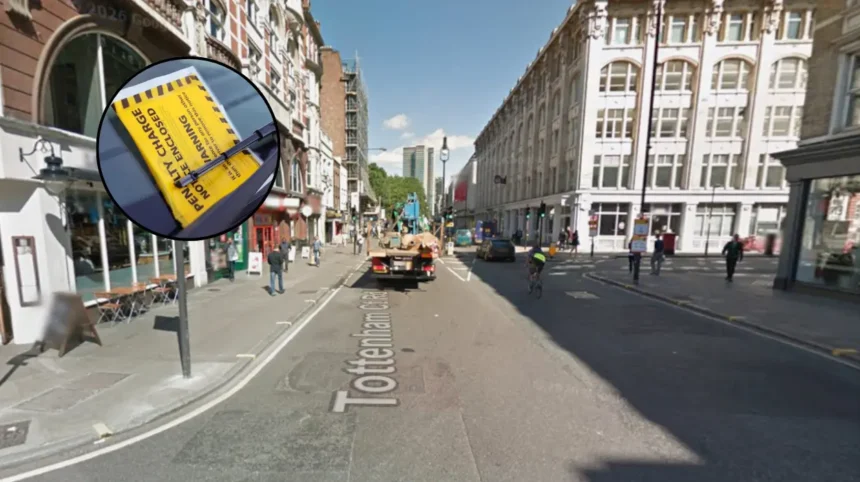
According to reporting by Holly Brencher of London Now and This Is Local London, new research conducted by NetVoucherCodes examining close to 500,000 penalty records found that Tottenham Court Road, situated within the London Borough of Camden, recorded more driving penalties than any other thoroughfare in the capital. The busy West End shopping and transport artery generated 59,329 individual PCNs, accumulating approximately £4.1 million in driver fines.
As noted by Brencher in her detailed report, traffic restrictions along Tottenham Court Road are particularly strict, featuring extensive camera-enforced restrictions that prohibit private motor vehicles on designated stretches between 8:00 am and 7:00 pm from Monday to Saturday, limiting access primarily to buses, cycles, and licensed taxis.
The figures compiled by NetVoucherCodes highlighted the 15 most fined roads and locations across London:
- Tottenham Court Road, Camden – 59,329 PCNs (Approx. £4.1 million generated)
- North Worple Way, Richmond upon Thames – 43,861 PCNs (Approx. £361,000 generated)
- Oldfield Lane South, Greenford, Ealing – 31,252 PCNs (Approx. £2.2 million generated)
- Albert Bridge (North Side), Kensington and Chelsea – 30,798 PCNs (Approx. £2.3 million generated)
- Station Parade, Barking and Dagenham – 28,857 PCNs (Approx. £1.8 million generated)
- High Street North, Newham – 27,227 PCNs
- Bull Lane, Enfield – 25,215 PCNs (Approx. £1 million generated)
- Abbey Road junction with High Path, Merton – 22,881 PCNs
- Maze Hill SE10 / Tom Smith Close SE10, Greenwich – 21,810 PCNs (Approx. £1.4 million generated)
- Ilford Lane, Redbridge – 20,971 PCNs (Approx. £1.1 million generated)
- Rye Lane, Southwark – 20,122 PCNs
- Camrose Avenue, Harrow – 19,889 PCNs
- Lansdowne Drive (Junction Trederwen Road – Eastbound), Hackney – 18,905 PCNs
- Tilling Road, Barnet – 16,173 PCNs
- Hazelbank Road, Lewisham – 13,665 PCNs
How Much Revenue Did Individual London Boroughs Receive From Motorists?
As reported by Holly Brencher of London Now, Westminster City Council emerged as the single highest-earning local authority in Greater London regarding motorist penalties. Council records show that Westminster generated more than £37 million in revenue during the 2025/2026 period alone, driven by a total of 645,261 notices served.
The secondary sites highlighted in the dataset displayed significant localized fine patterns:
- North Worple Way: Recorded 43,861 PCNs, producing £361,000. Brencher highlighted that this location operates as a restricted enforcement point on an otherwise quiet residential road, catching unpermitted drivers passing through.
- Oldfield Lane South: Accumulated 31,252 penalties bringing in roughly £2.2 million. The controls are designed around active school-street safety measures and temporary waiting restrictions.
- Albert Bridge (North Side): Produced 30,798 penalties worth £2.3 million prior to its closure to motor traffic following structural damage assessments.
- Station Parade (Barking): Recorded 28,857 PCNs yielding £1.8 million, driven by camera enforcement outside Barking Station to preserve bus and pedestrian flow.
- Bull Lane (Enfield): Recorded 25,215 PCNs bringing in roughly £1 million. Enforcement includes a bus gate and motor vehicle prohibitions near North Middlesex University Hospital.
- Maze Hill / Tom Smith Close (Greenwich): Generated 21,810 penalties bringing in £1.4 million via low-traffic neighborhood camera filters near Maze Hill Station.
- Ilford Lane (Redbridge): Issued 20,971 PCNs generating £1.1 million, reflecting strict loading, waiting, and movement enforcement along a high-density commercial corridor.
What is the Background of This Traffic Enforcement Development?
The substantial revenue generated across London roads comes in the wake of systemic adjustments made to traffic fine structures across the capital.
In April 2025, London councils officially raised parking and traffic PCN bands for the first time since 2011, following formal approval from the Transport and Environment Committee of London Councils and the Mayor of London. Under this policy update, moving traffic violations (including illegal turns, driving in bus gates, or violating low-traffic filters) were standardized at Band A rates of £160 (reduced to £80 if settled within a 14-day window).
Representative statements from London Councils highlighted that penalty charges had remained frozen for over a decade while non-compliance rates increased by roughly 70% between 2010 and 2024. Local authorities maintained that financial penalties do not enter general purpose funds but are strictly ring-fenced under statutory law to be reinvested into transport infrastructure, road maintenance, and subsidized travel schemes such as the Freedom Pass for elderly and disabled residents.
Explore More Camden News
Reed Watts London Lighthouse Church Refurbishment, Camden 2026
Camden Council Demands NHS Report Over Dementia Support Delays Camden 2026
What is the Future Prediction and Impact on London Motorists?
This continued rise in automated, camera-enforced PCN issuances is expected to significantly impact commuters, commercial transport operators, and local delivery drivers across Greater London.
Financial and Operational Impact on Drivers
- Heightened Costs for Transport Workers: Delivery couriers, freight drivers, and ride-hailing operators navigating central London routes face a growing risk of financial penalties. A single unintentional entry into a bus gate, such as Tottenham Court Road, results in an immediate £160 charge, severely affecting daily operating margins.
- Greater Reliance on Satellite Navigation Updates: A significant proportion of PCN appeals stems from outdated sat-nav mapping that fails to reflect real-time council traffic orders or school street hours. Driver reliance on technology will likely necessitate rapid software updates to avoid repeat violations along newly restricted residential routes like North Worple Way or Maze Hill.
- Escalation of Appeals at London Tribunals: As fine amounts remain at higher baseline rates, a larger percentage of motorists are predicted to submit formal representations and contest notices through the independent London Tribunals, citing issues such as obscured signage, unclear road markings, or timing discrepancies.
- Shift Toward Public and Active Transport: As local councils continue to enforce low-traffic neighborhoods, bus corridors, and school zones, private car journeys within inner London boroughs are anticipated to drop further, prompting commuters to transition toward bus, tube, and cycling networks to bypass enforcement zones.