Key Points
- Stance Reversal: Green Party councillors sitting on the North London Waste Authority (NLWA) now support the controversial Edmonton EcoPark incinerator scheme, despite opposing the project ahead of the May local elections.
- Financial Risk: The board’s controlling Green members stated that they inherited a “poisoned chalice” from the previous Labour administration and faced a choice between building the incinerator “or bankruptcy”.
- Contract Renegotiation: Under its new Green leadership, the NLWA has renegotiated its contract with main builder Acciona to reduce taxpayer costs and introduce stricter oversight.
- Timeline Delays: Delayed by Brexit, high interest rates, and the war in Ukraine, the new facility is delayed beyond its original 2027 opening target. The current facility, built in 1971, will remain active until 2030.
- Local Opposition: Community groups including ‘Stop the Edmonton Incinerator Now’ continue to oppose the scheme over concerns regarding waste demand and air quality.
Edmonton (North London News) November 6, 2026 – Green Party councillors serving on the North London Waste Authority (NLWA) have confirmed they will proceed with the construction of a controversial £1 billion incinerator in Edmonton, stating that political mismanagement by the previous Labour-led administration has left the regional body with no viable alternative to avoid bankruptcy.
- Key Points
- Why are North London Green councillors proceeding with the Edmonton incinerator?
- How has the NLWA board altered the project contract under new leadership?
- Why has the Edmonton EcoPark project faced delays and community resistance?
- Background of the Edmonton Incinerator Development
- Prediction: How Will This Decision Affect North London Residents and Taxpayers?
Why are North London Green councillors proceeding with the Edmonton incinerator?
Prior to their victories in the local elections, Green candidates across the capital pledged to examine every potential avenue to cancel the major energy-from-waste facility under development at Edmonton Eco Park. However, following their taking control of the authority, the newly appointed board members issued a joint statement revealing that contractual realities and financial commitments left them unable to halt the project.
As reported by Sebastian Mann, Local Democracy Reporter, the controlling seven Green members of the board released a collective statement explaining that while they remain “instinctively opposed” to the incineration of waste, they could not ignore the practical consequences of cancellation.
In their joint declaration, the Green board members stated:
“Since being elected as new board members, we have inherited a poisoned chalice in the Edmonton incinerator project. We committed to exploring every alternative avenue, and we have done that. We have found that political mismanagement by the previous Labour-controlled board has left us with no better options. It is simply between this or bankruptcy.”
The board members added:
“We will not shy away from the reality of the project in front of us. And we are determined to ensure that transparency and accountability are at the heart of all decisions going forward.”
How has the NLWA board altered the project contract under new leadership?
To mitigate the financial impact of the scheme on local authorities, the NLWA leadership confirmed that it has engaged in fresh negotiations regarding the existing procurement terms.
In their formal statement, the Green leadership detailed:
“The authority, under Green leadership, has renegotiated a better contract [with contractor Acciona] that reduces the taxpayer burden. We have also introduced a set of checks and balances to avoid a return to the disorder which has characterised this project to date.”
The board further outlined its long-term strategy for municipal rubbish, writing:
“We do this as we look at transformative, cross-borough approaches to increase recycling and food waste options, to drive better environmental outcomes and reduce costs. We further call on national government support to help us get there.”
The decision aligns with previous warnings issued by executive officers regarding the financial liabilities associated with terminating the developer contracts. As reported by MyLondon, NLWA chief Jacob Cable, who serves as a senior Hackney councillor, previously explained that it was “clear” that scrapping the scheme would prove “devastating both financially for the seven constituent boroughs”.
Why has the Edmonton EcoPark project faced delays and community resistance?
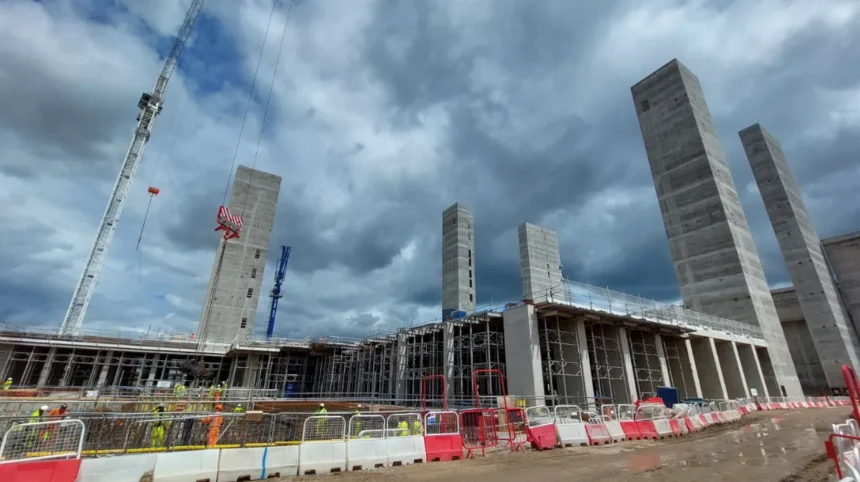
The development of the replacement energy-from-waste facility has suffered structural delays since its initial approval in 2017. Construction began in 2022 with an original operational target date of 2027. However, the timeline has been pushed back due to macro-economic pressures, supply chain disruptions from Brexit, high interest rates, and the ongoing war in Ukraine. Consequently, the original incineration plant—first commissioned in 1971—is expected to remain operational until at least 2030.
The multi-million-pound scheme has faced sustained pushback from grassroots community organisations, including ‘Stop the Edmonton Incinerator Now’. Campaigners argue that building high-capacity incineration infrastructure incentivises higher levels of municipal waste creation and raises concerns over particulate emissions in surrounding neighbourhoods.
The project was defended by the previous NLWA administration. As reported by Local Democracy Reporter Sebastian Mann, former NLWA chair and Waltham Forest Labour councillor Clyde Loakes assured local communities that the replacement plant would comply strictly with national environmental regulations and serve as an “exemplar” for modern waste infrastructure.
Responding to public criticism last year, Cllr Loakes stated that abandoning the redevelopment plans would represent the “worst possible outcome” for the population served by the authority. He added that failing to finish the facility would prove “detrimental” to residents by denying them “a safe, clean and low-carbon solution for managing their waste.”
The technical design for the plant incorporates advanced filtration technologies. The facility is set to use selective catalytic reduction—a chemical process that converts nitrogen oxide into harmless water and diatomic nitrogen—alongside a combined dry and wet scrubber mechanism to trap airborne particulates.
Background of the Edmonton Incinerator Development
The North London Waste Authority is the statutory body responsible for managing the municipal waste collected across seven London boroughs: Barnet, Camden, Enfield, Hackney, Haringey, Islington, and Waltham Forest. Serving a population of over two million residents, the authority relies heavily on the Edmonton EcoPark facility located in the London Borough of Enfield.
The original Edmonton plant, commissioned in 1971, has reached the end of its operational lifespan, triggering plans for its comprehensive replacement under the North London Heat and Power Project (NLHPP). Granted development consent by the UK Government in 2017, the £1.2 billion project encompasses a new energy-from-waste facility, a resource recovery center, and educational spaces.
Political control of the NLWA rested with the Labour Party for decades, during which the core procurement and construction contracts with international engineering firm Acciona were negotiated and executed. Following local electoral shifts that expanded Green Party representation across northern London, Green councillors assumed key leadership positions on the board. The inherited legal obligations, termination penalties, and sunk costs associated with the multi-year construction process created significant financial constraints for the incoming administration, prompting the eventual decision to proceed with the modified scheme.
Prediction: How Will This Decision Affect North London Residents and Taxpayers?
The confirmation that the Edmonton incinerator project will proceed under renegotiated terms carries immediate financial, environmental, and political implications for the two million residents living across the seven constituent boroughs.
Fiscal Impact on Local Taxpayers
By avoiding the immediate collapse or cancellation of the scheme, the constituent borough councils will dodge catastrophic legal and contractual penalties that could have forced regional authorities into financial insolvency. The renegotiated terms with contractor Acciona aim to contain cost overruns, providing greater predictability for municipal council tax rates. However, because the total expenditure remains above £1 billion, local authorities will still need to service substantial long-term debt through council tax revenue and waste management levies over the coming decades.
Environmental and Public Health Consequences
For local communities in Enfield and surrounding areas, the decision means industrial operations at Edmonton EcoPark will continue past 2030. While the addition of selective catalytic reduction and scrubbers aims to lower nitrogen oxide and particulate emissions compared to the 1971 plant, air quality advocates and resident groups are likely to maintain active scrutiny. The ongoing presence of high-capacity incineration infrastructure may also create a structural dependency on residual waste generation, potentially complicating local borough efforts to hit ambitious recycling and municipal waste reduction targets over the next 10 to 15 years.