Key Points
- Trial Scope: Enfield Council has distributed new food waste collection tools to approximately 1,000 households across both kerbside properties and communal flat blocks.
- Core Objective: The pilot program aims to make food waste recycling simpler and more appealing to raise resident participation rates and divert organic waste from general rubbish bins ahead of nationwide Simpler Recycling legislation.
- Product Provision: Participating households received a five-litre ReBorn kitchen caddy with a neutral design alongside a roll of caddy liners and clear instructional guidance.
- Local Circular Economy: The trial establishes a localized recycling loop where plastic collected in Enfield is processed by Biffa and utilized by ReBorn to manufacture new household items in the United Kingdom.
- Evaluation Criteria: Enfield Council is measuring participation levels, food waste tonnages, communal bin fill rates, and resident feedback before and after the initiative to inform future collection strategies.
Enfield Council (North London News) November 3, 2026 – Enfield Council has officially introduced a specialized food waste recycling trial targeting approximately 1,000 households, seeking to assess whether improved kitchenware design combined with clear resident guidance can increase domestic recycling participation and divert organic material from general waste streams. Launched in September, the initiative distributes a five-litre domestic caddy manufactured by eco-design firm ReBorn, a roll of liner bags, and straightforward educational materials to residents living in both individual kerbside properties and multi-occupancy communal blocks. The project tests a localized circular economy framework in which plastic waste collected within the London Borough of Enfield is processed by waste management firm Biffa and subsequently used by ReBorn to manufacture durable domestic products within the United Kingdom.
- Key Points
- How Is Enfield Council Implementing the 1,000-Home Food Waste Pilot Scheme?
- How Does the Localized Circular Economy Model Function in Enfield?
- What Metrics Will Be Used to Evaluate the Success of the Trial?
- What Do Key Stakeholders Say About the Food Recycling Initiative?
- Background of the Particular Development
- Prediction: How This Development Can Affect Enfield Residents and UK Local Authorities
How Is Enfield Council Implementing the 1,000-Home Food Waste Pilot Scheme?
As detailed in official project documentation released by Enfield Council, the recycling trial spans approximately 600 kerbside houses and roughly 400 households located within both privately owned and council-managed flats and communal residential blocks.
For participating multi-occupancy communal sites that previously lacked dedicated food waste infrastructure, Enfield Council is introducing the requisite outdoor collection containers and updating logistical collection arrangements as part of the initial implementation phase.
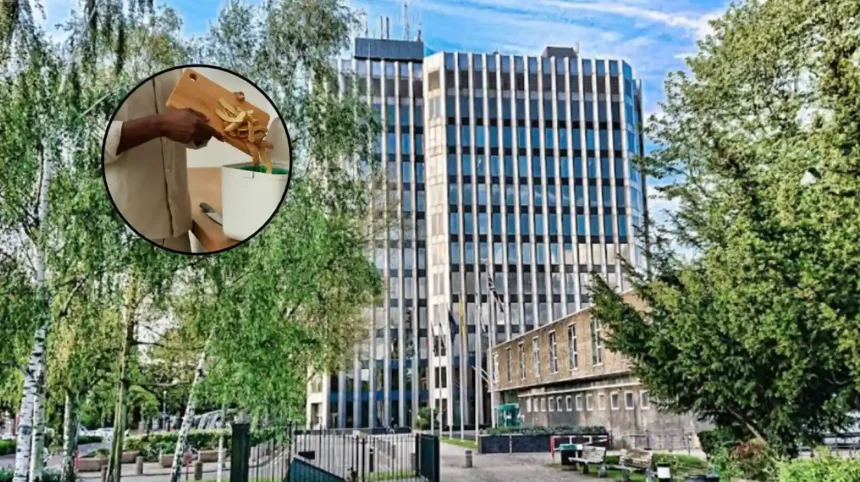
Each selected household receives a five-litre kitchen caddy engineered by ReBorn. The caddy features a neutral aesthetic designed to sit unobtrusively on domestic kitchen worktops, thereby keeping food waste disposal convenient during daily meal preparation. The physical hardware is accompanied by caddy liners and clear instructional literature to minimize operational friction for participating residents.
How Does the Localized Circular Economy Model Function in Enfield?
The strategic partnership between Enfield Council, Biffa, and ReBorn demonstrates a closed-loop recycling mechanism operating within the municipal boundary.
Under the established operational workflow:
- Domestic plastic waste collected from Enfield households is transported to recycling specialist Biffa for sorting and industrial processing.
- The resulting high-grade recycled plastic material is supplied to ReBorn, which manufactures household items entirely within the United Kingdom using 100 per cent recycled plastic content.
- Manufactured goods, such as the five-litre food waste caddies, are returned to Enfield residents for daily use.
This localized loop provides households with a visible demonstration of how municipal recycling collections transform domestic waste into functional consumer items.
What Metrics Will Be Used to Evaluate the Success of the Trial?
To determine the effectiveness of the updated caddies and instructional materials, Enfield Council is executing a comprehensive pre- and post-trial evaluation framework.
As reported by municipal communications, officers from the council’s recycling department are recording baseline figures prior to the intervention and monitoring ongoing changes across several key parameters:
- Resident Participation Rates: Tracking the percentage of target households actively separating organic waste.
- Tonnage Data: Measuring overall weight variations in collected food waste versus residual rubbish streams.
- Communal Bin Fill Levels: Monitoring volume shifts within shared waste containers at flat blocks.
- Qualitative Feedback: Gathering resident surveys to assess user satisfaction, behavioral obstacles, and daily compliance.
The quantitative and qualitative insights gathered during this pilot will inform future municipal waste management operations and assist in preparing local infrastructure for the broader statutory rollout of the UK Government’s national Simpler Recycling framework.
What Do Key Stakeholders Say About the Food Recycling Initiative?
As stated by Tim Read-Lamb, Waste Strategy and Recycling Manager at Enfield Council:
“This trial is about making the right choice easier. By giving residents a well-designed caddy and straightforward information, we want to understand what helps food waste recycling become an everyday habit. It is also a great example of the circular economy in action: materials collected for recycling can be processed and turned into useful products that come back to residents. We are proud that Enfield will be the first council to pilot this approach with ReBorn.”
Underscoring the national relevance of the design-led approach, Brian Walmsley, Founder and Chief Executive of ReBorn, stated:
“If better design can make recycling easier and more appealing, the potential for councils across the UK is huge. We’re excited to see what we can learn from Enfield.”
Background of the Particular Development
The food waste pilot in Enfield arrives amid widespread restructuring of municipal waste collection policies across England driven by the Department for Environment, Food & Rural Affairs (DEFRA) under its mandatory “Simpler Recycling” policy framework. Historically, household waste collection standards have varied significantly between local authorities, with many urban councils facing logistical challenges in providing separate organic waste collections for multi-occupancy housing blocks and high-density residential flats.
Organic waste decomposing in standard landfill sites generates methane—a potent greenhouse gas—while incurring significant landfill tax costs for local authorities. By implementing separate food waste streams, councils can divert organic matter to anaerobic digestion facilities, where it is converted into renewable biogas and agricultural soil improvers.
Enfield Council’s trial addresses two longstanding barriers to food waste separation: domestic aesthetic resistance (residents disliking unsightly or malodorous caddies on kitchen surfaces) and collection infrastructure deficits in communal living environments. By combining domestic product design with closed-loop UK manufacturing, the pilot tests a model aimed at boosting capture rates prior to nationwide statutory compliance deadlines.
Prediction: How This Development Can Affect Enfield Residents and UK Local Authorities
Impact on Local Residents
For residents within the Borough of Enfield, successful outcomes from this trial are expected to result in a permanent expansion of dedicated weekly food waste collections across all housing types, including previously underserved communal flat complexes. Improved domestic caddy design and regular provision of liners lower daily adoption barriers, helping households lower their residual waste volume. In the longer term, higher diversion rates reduce local authority expenditure on landfill taxes and incineration fees, preserving municipal budgets for essential public services.
Impact on UK Local Authorities and Waste Managers
For local councils and waste contractors across the United Kingdom, the empirical data gathered by Enfield Council will serve as an operational benchmark for design-led recycling strategies. If the integration of ergonomic, locally recycled caddies yields a measurable rise in capture rates, other municipal authorities are likely to adopt similar public-private circular supply chains. This approach enables councils to fulfill upcoming statutory Simpler Recycling obligations while simultaneously stimulating domestic UK recycling manufacturing markets.