Key Points
- Haringey Council Leader Mark Blake has criticised Prime Minister Andy Burnham and Housing Secretary Angela Rayner over the central government’s decision not to devolve powers for rent controls to local and regional authorities.
- The newly elected Green Party administration in Haringey argues that rent controls are essential for curbing spiralling temporary accommodation costs and regulating private landlords.
- The Green Party ended 55 years of Labour Party administration in Haringey during the May local elections, winning 28 seats to Labour’s 21, alongside 8 Liberal Democrats.
- Council Leader Mark Blake outlined plans to tackle Haringey’s severe financial deficit by bringing outsourced services back in-house to break the private sector’s grip on local public finances.
- To avoid a total financial collapse and a potential government commissioner takeover—which could lead to a “fire sale” of public assets—the council has adopted a three-year Financial Resilience Plan.
- Haringey Council has launched a new Private Renters’ Forum to collaborate directly with local residents, whilst demanding greater social value contributions from Tottenham Hotspur Football Club to aid the local community.
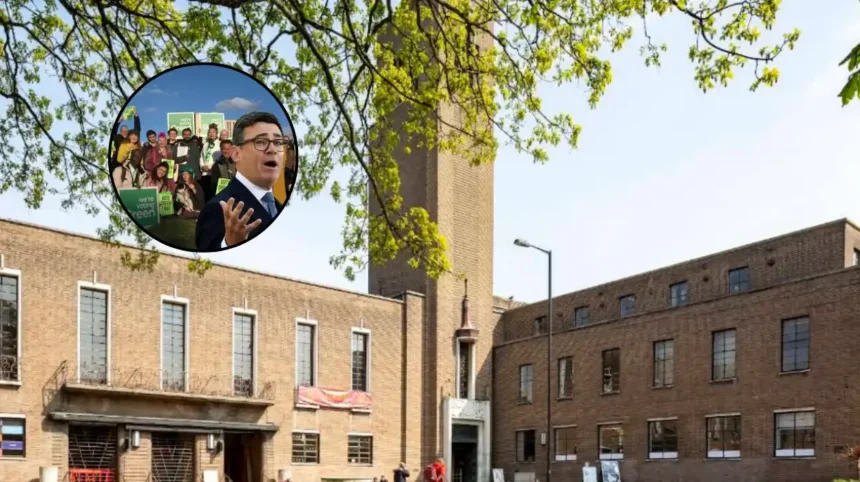
Haringey (North London News) August 15, 2026 – In a significant political intervention following May’s local election shifts, the newly appointed Green Party Leader of Haringey Council, Mark Blake, has voiced strong frustration at the central government led by Prime Minister Andy Burnham over its refusal to devolve rent control powers. As reported by the news outlet The Canary, Blake condemned the central administration after Housing Secretary Angela Rayner confirmed that decision-making on private sector rent caps would remain strictly centralized rather than being passed down to regional mayors and local authorities. The statement comes as Haringey Council struggles under severe financial pressures inherited from decades of previous administration, leaving the borough heavily dependent on emergency government funding to maintain statutory frontline services.
- Key Points
- Why has the Green council leader accused the government of a devolution failure?
- How did the Green Party secure power in Haringey Council?
- What steps are being taken to end private sector reliance and manage financial deficits?
- How does Haringey plan to avoid emergency commissioner intervention?
- What local community initiatives and housing policies are being introduced?
- What lies ahead for Haringey’s public services and municipal jobs?
- Background of the rent control and devolution debate
- Prediction: How will this political standoff affect local residents and tenants?
Why has the Green council leader accused the government of a devolution failure?
According to reporting by The Canary, Council Leader Mark Blake expressed sharp disappointment with the central government’s policy stance on housing regulation, arguing that it directly contradicts Prime Minister Andy Burnham’s explicit commitments to regional empowerment.
Blake noted that Housing Secretary Angela Rayner’s decision to retain central control over private sector rents undermines the core narrative of the administration. As reported by the publication, Blake stated:
“It seemed to me to be going against what was being said that ‘Andy Burnham is going to devolve a lot of power to mayors to make those decisions at a city level, at a regional level’. That’s what should happen, and [the announcement] seemed to be totally contrary to that.”
Blake further explained that having the authority to enforce local rent caps would have offered immediate relief to the local authority’s budget, particularly regarding the escalating costs associated with housing families in private temporary accommodation. He stressed that local powers are vital to managing local crises, adding:
“That would have helped us in terms of controlling temporary accommodation costs with private landlords… So I hope they’ll reconsider that.”
Highlighting international precedents, Blake pointed out that London remains a global anomaly by withholding rent stabilization mechanisms. He argued:
“London as a major city is a bit of an outlier, because most major cities across the world have rent controls. New York has rent controls. Madrid, Amsterdam, Paris – they all have some form of rent control. So for me, it’s not whether [we should say] ‘yes or no’ to rent controls – it’s really what system you’re going to bring in that’s going to suit your circumstances. And they should have been devolving that power down to make that happen.”
Critiquing the core ideology of the current central leadership, Blake reiterated that the failure to hand over these powers reinforces centralisation rather than solving it:
“It goes against the grain of everything Burnham said. He said: ‘I’m gonna be the devolution prime minister, guys. I’m the guy who’s gonna devolve power to these mayors, they’re gonna make the decisions locally.’ And it goes totally in the face of that… He’s made the analysis in terms of the problem, or a big aspect of the problem, in terms of centralised power. But one of the first announcements of his new secretary of state is basically just to reinforce the status quo.”
How did the Green Party secure power in Haringey Council?
The political landscape in Haringey underwent a dramatic realignment during the May local elections when the Green Party successfully broke a 55-year streak of Labour Party control. The election resulted in the Greens taking 28 council seats, Labour securing 21, and the Liberal Democrats holding 8 seats.
As detailed by political analysts covering the region, the shift in voter sentiment reflected widespread public dissatisfaction with Labour’s historical governance, communication failures, and the perceived absence of local MP David Lammy.
Prior to the local elections, Blake spoke with media outlets regarding the structural problems facing the borough. He highlighted the borough’s dire financial position, the urgent demand for affordable social housing, and the direct link between budget deficits and the widespread outsourcing of essential municipal services to private firms.
What steps are being taken to end private sector reliance and manage financial deficits?
In his current role as Council Leader, Blake emphasised that a core policy objective of the Green administration is “breaking the stranglehold” that external private contractors maintain over public services. According to reporting by The Canary, Blake warned against the risks of an unchecked private market in local governance:
“We can’t just be reliant on the private sector. Because if you do that, it becomes a rigged market and they will just hike the prices up. So we need to get more in-house services, more options, whether they’re run by the voluntary sector, whether they’re run within the council.”
Addressing the municipal housing crisis, Blake acknowledged that while Haringey currently manages one of the largest homebuilding programmes in both London and the wider country, the scale remains inadequate due to past inaction:
“The problem is it’s not enough, because we’ve built so little over the previous decades.”
He noted that accelerating development requires a substantial boost in capital resources:
“We need more injection of resources to enable us to do that.”
Haringey remains one of numerous UK local authorities operating with substantial financial deficits and relying on Exceptional Financial Support (EFS) to borrow emergency funding from central government. Blake criticized the terms of this financial lifeline, noting that the required interest repayments create an unsustainable burden on local councils:
“What’s very apparent to us is that this process is quite punitive. It doesn’t really give a way out for the council, any sort of debt recovery process.”
Despite these fiscal limitations, Blake affirmed that the council must prioritize its legally mandated responsibilities to vulnerable residents, characterizing them as
“serious responsibilities, life-affirming, life-saving responsibilities.”
He asserted:
“The delivery of those services is mainly being done by private actors, private agencies, landlords – and they’re making a lot of money. So our political call is that we need to regulate those markets effectively, which hasn’t been happening.”
How does Haringey plan to avoid emergency commissioner intervention?
Official documentation published on the Haringey Council portal acknowledges that the local authority is traversing
“one of the most challenging financial periods in the borough’s history.”
Blake warned that failing to stabilise the budget could result in central government commissioners taking control of local operations, an outcome that typically triggers radical austerity measures.
“One of the classic situations… with authorities that have gone into commissioners running the council is around asset sales, so you will definitely get a fire sale of key council assets.”
To prevent this scenario, the administration has implemented a mandatory “three-year Financial Resilience Plan.” This policy framework aims to eliminate reliance on temporary emergency borrowing and safeguard public property from liquidation.
Blake stated that the Green administration intends to adopt higher standards of public transparency compared to previous Labour leaderships. He stressed the necessity of community involvement in confronting the financial crisis:
“We’ve got to engage with the community, get people to understand the problem, get them to write to their MPs, and crucially, I think get the Labour Party to realise that bankrupting local authorities isn’t gonna be a vote winner… I think it’ll be for their own benefit if they come to the right conclusions.”
He added:
“We’re very keen to get out in the community and talk to people, and talk to people in a more structured way… So I’m looking to try and elevate our game, particularly working with local communities, but also service user groups… We’re very keen to be far more transparent in terms of how we’re taking decisions.”
What local community initiatives and housing policies are being introduced?
As part of its strategy to improve local community involvement, the council recently launched a consultation on private tenants’ rights. Green Cabinet Member for Housing Tammy Hymas explained that the establishment of a new Private Renters’ Forum forms a key pillar of this strategy, intended to gather evidence on problematic landlords and protect vulnerable tenants from exploitation.
Official statements on the council website note that the forum will function as a collaborative space where residents directly participate in organizing and directing local policy discussions.
Additionally, the council is prioritizing faster repair turnarounds for existing social housing stock and reducing turnaround times for empty municipal properties.
The council is also seeking greater contributions from major commercial institutions in the borough. With the Tottenham Hotspur Stadium situated within one of London’s most economically deprived wards, Blake is pressing the football club for expanded social value commitments.
Given that previous administrations granted permission for the stadium to host up to 30 non-sporting major events annually, Blake is seeking a direct financial contribution from the organization toward a newly proposed local community endowment fund.
What lies ahead for Haringey’s public services and municipal jobs?
Addressing the systemic challenges facing the borough, Council Leader Mark Blake openly acknowledged the structural constraints inherited from 55 years of uninterrupted Labour administration.
While expressing hope that central government funding and market regulations will eventually materialize to support mass council-house construction, he acknowledged the limits of local government authority:
“A lot of these things that we’re working around are systemic, and we do need government intervention… That’s out of our power.”
Because the Green Party holds a plurality (28 seats) rather than an absolute majority on the council, passing upcoming annual budgets will require legislative support from opposition parties. Nevertheless, Blake maintained that defending essential public infrastructure remains non-negotiable:
“We’re gonna fight to defend frontline services. Obviously, we want to fight to defend jobs. We want to make the end user experience better.”
Explore More Haringey Council News
Why Haringey Council Backs Direct Support for Windrush Families Haringey 2026
Simon Levy Guilty of Double Murder and Rape | Tottenham 2026
Background of the rent control and devolution debate
The debate over rent controls and municipal devolution in the United Kingdom has intensified significantly amid rising living costs and escalating private rental prices across urban centres.
Historically, central government policy has resisted mandatory rent caps, arguing that capping rents discourages private investment in the housing market, shrinks the supply of available rental units, and deteriorates building maintenance standards over time.
Conversely, local authorities in high-cost metro areas, particularly within Greater London, have consistently argued that unchecked market rents drive working-class families into poverty and force local councils to spend disproportionate amounts of their public budgets on temporary accommodation arrangements for displaced families.
The policy tension between local leaders and Whitehall reflects broader questions around regional autonomy. While recent administrative narratives have emphasized delegating decision-making powers down to regional metro mayors and municipal councils under the banner of “devolution,” central taxation, spending limits, and housing market regulations remain heavily concentrated within central government departments.
Consequently, local council leaders frequently find themselves legally responsible for providing essential social welfare and housing safety nets while lacking the regulatory tools or financial independence required to address the root drivers of local market pressures.
Prediction: How will this political standoff affect local residents and tenants?
The refusal of central government to devolve rent control powers, coupled with Haringey Council’s strict financial constraints, will directly impact local residents, private renters, and municipal service users across the borough in several distinct ways:
- Private Renters: Without local rent caps or temporary price stabilization mechanisms, private tenants in Haringey will remain exposed to market-driven rent increases. This ongoing exposure is likely to maintain high rates of residential displacement, push more lower-income households toward financial vulnerability, and increase reliance on borough housing assistance options.
- Council Taxpayers and Service Users: Haringey’s three-year Financial Resilience Plan will necessitate strict budgetary discipline to avoid insolvency. While the administration has pledged to protect frontline jobs and essential services, the cost of servicing Exceptional Financial Support loans means that discretionary spending on non-statutory community projects, local park maintenance, or leisure facilities may face tighter constraints.
- Local Community and Voluntary Groups: The council’s strategic shift toward bringing outsourced services back in-house and collaborating with voluntary sector providers could lead to improved localized service delivery. However, the transition away from established private contractors may cause short-term operational friction as internal capacities are rebuilt.
- Residents in Economically Deprived Wards: If the council successfully secures new social value commitments and endowment funding from commercial entities such as Tottenham Hotspur Football Club, local wards surrounding the stadium could see targeted investments in youth services, community infrastructure, and employment support schemes.