Key Points
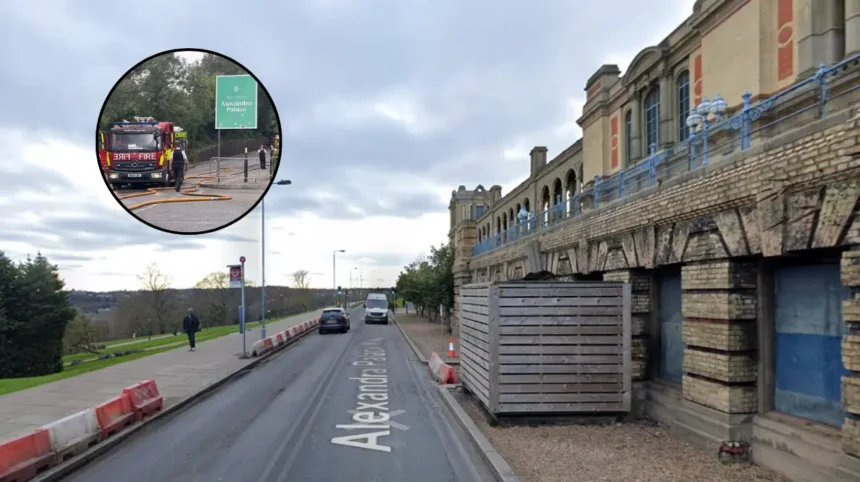
- Incident Location: A wildfire broke out near Alexandra Palace Way in Wood Green, North London.
- Scale of Blaze: Approximately half an acre of compost and garden waste went up in flames.
- Emergency Response: Six fire engines and around 40 firefighters were dispatched to battle the blaze.
- Specialist Equipment: Fire crews deployed a Terrain Support Vehicle carrying roughly 475 litres (nearly half a tonne) of water alongside misting lance technology and backpack blowers.
- Duration: Firefighters spent over 12 hours battling the flames and damping down remaining hot spots before bringing the incident under control at 2:57 pm on Thursday, July 23.
- Casualties & Cause: No injuries were reported, and the cause of the fire remains under investigation.
- Transport Disruptions: Alexandra Palace Way was closed in both directions between A1201 Park Road and Bedford Road, causing local traffic diversions and forcing the London Bus W3 onto an alternative route.
Wood Green (North London News) July 24, 2026 – Fire crews were forced to deploy nearly half a tonne of water to extinguish a sustained grass fire near Alexandra Palace, which took firefighters over 12 hours to fully bring under control. Emergency services responded to the scene at Alexandra Palace Way in Wood Green after approximately half an acre of compost and garden waste caught fire. Despite the prolonged operation, London Fire Brigade officers confirmed that no casualties or injuries occurred. Local roadways remained blocked while crews conducted dampening-down operations, prompting traffic diversions across North London.
- Key Points
- What Happened During the Wildfire Near Alexandra Palace?
- How Did Emergency Services Respond to the Incident in Wood Green?
- What Equipment Was Used by Firefighters to Extinguish the Blaze?
- How Has the Fire Affected Local Traffic and Transport Infrastructure?
- What Is the Background of This Particular Development?
- How Will This Development Impact Local Residents, Commuters, and Emergency Services?
What Happened During the Wildfire Near Alexandra Palace?
As reported by Rafi Mauro-Benady of MyLondon, the London Fire Brigade (LFB) was initially alerted to a blaze involving roughly half an acre of compost and garden waste off Alexandra Palace Way in the early hours of Thursday, July 23.
The fire broke out in open ground, where dry vegetation allowed the flames to spread rapidly across the compost accumulation.
According to Joseph Reaidi of the Ham & High, the Brigade’s Control Room registered approximately 20 individual emergency calls from members of the public as smoke became visible across Wood Green and surrounding North London neighbourhoods.
Fire crews maintained a continuous presence at the scene from the time of arrival until the main blaze was officially declared under control at 2:57 pm. However, personnel remained on site well into the afternoon to damp down remaining hot spots and prevent any potential reignition.
How Did Emergency Services Respond to the Incident in Wood Green?
As detailed by reporting staff at MyLondon, the London Fire Brigade deployed a total of six fire engines accompanied by approximately 40 firefighters to contain the fire ground. Upon arrival, crews identified that the fire was concentrated within a dense mass of garden waste and compost.
To effectively combat the spread across open terrain, the Brigade dispatched one of its specialised Terrain Support Vehicles (TSVs).
As documented in official London Fire Brigade statements, these specialised off-road vehicles carry approximately 475 litres—nearly half a tonne—of water, allowing firefighters to transport essential suppression gear directly onto rough or unpaved ground where standard fire engines cannot easily navigate.
In an official public safety advisory released during the incident, a spokesperson for the London Fire Brigade stated:
“During periods of dry and sustained extreme heat, the chance of wildfires spreading rapidly is high. The Brigade is ready and prepared to respond to all types of incidents, but we urge everyone to play their part to prevent incidents, such as wildfires, which can be time-consuming to resolve and have devastating impacts on livelihoods, occurring in the first place.”
The spokesperson added guidance regarding outdoor safety during dry conditions:
“If you’re planning to enjoy the weather over the coming days either in a park or other open spaces, please don’t take a disposable BBQ with you. They pose a significant fire risk as the heat can be retained for many hours, even after a barbecue has been put out. It’s also important to make sure that smoking materials are discarded of properly and either dispose of your rubbish in the appropriate bins or take it home with you if none are available.”
What Equipment Was Used by Firefighters to Extinguish the Blaze?
To manage open-ground wildfires effectively without exhausting localized water mains, the London Fire Brigade utilizes specialized off-road technology.
As reported by Kelly Williams of the Daily Star, the Terrain Support Vehicle deployed to Wood Green was equipped with misting lance technology, backpack blowers, beaters, and ear defenders.
The misting lance system allows firefighters to pump water continuously while driving across open grass, maximizing water efficiency by dispersing high-pressure mist deep into smouldering compost layers rather than spraying surface water alone. The cause of the fire remains under formal investigation by the London Fire Brigade.
How Has the Fire Affected Local Traffic and Transport Infrastructure?
The incident caused noticeable disruptions to North London road networks. According to traffic monitoring service INRIX, which classified the event as a “serious fire,” local authorities implemented immediate road closures to facilitate emergency access.
Alexandra Palace Way was closed in both directions between the A1201 Park Road at Muswell Hill and Bedford Road near Alexandra Palace Station.
Transport for London (TfL) confirmed that the London Bus route W3 was placed on diversion, bypassing affected stops along Alexandra Palace Way while firefighters worked on damping down operations.
What Is the Background of This Particular Development?
Wildfires and grass fires in urban parks and green spaces across Greater London have become an increasingly frequent operational challenge for the London Fire Brigade during dry periods.
Open grounds such as Alexandra Park, Hampstead Heath, and Lee Valley contain extensive areas of dry vegetation, leaf litter, and organic compost heaps that can retain heat internally for extended periods.
Compost fires, in particular, present unique tactical difficulties for firefighters. Unlike surface grass fires that burn off quickly, compost heaps undergo slow, anaerobic decomposition that generates internal heat.
When exposed to dry ambient weather and oxygen, these heaps can smoulder undetected deep below the surface before breaking out into open flame.
Extinguishing a compost fire requires turning over the organic material while applying significant volumes of water or misting agents to cool the core—explaining why operations near Alexandra Palace extended over a 12-hour duration.
In response to elevated seasonal risks, the London Fire Brigade introduced Terrain Support Vehicles to its fleet to enhance off-road response capabilities, ensuring firefighters can reach remote parklands without stalling heavy apparatus on uneven terrain.
How Will This Development Impact Local Residents, Commuters, and Emergency Services?
This wildfire development carries immediate and medium-term impacts for several key groups across North London:
Residents living adjacent to Alexandra Park and Wood Green face temporary localized air quality reductions due to prolonged smoke drift from smouldering compost.
Park visitors will encounter restricted access around the affected half-acre zone while environmental officers assess the ground conditions. Furthermore, strict local enforcement against disposable barbecues and open flames in public parks is likely to intensify across the borough of Haringey.
Motorists traversing between Muswell Hill and Wood Green face ongoing delays around Park Road and Bedford Road during residual dampening operations.
Users of the W3 bus route should anticipate temporary schedule adjustments and alternative routing until Alexandra Palace Way is fully reopened by highways authorities.
The deployment of 40 firefighters, six engines, and specialist terrain equipment for over 12 hours represents a significant drawdown of emergency resources for North London.
As dry weather conditions persist, fire services may reallocate off-road units to high-risk parklands across the capital, accompanied by heightened public messaging regarding outdoor fire prevention.