
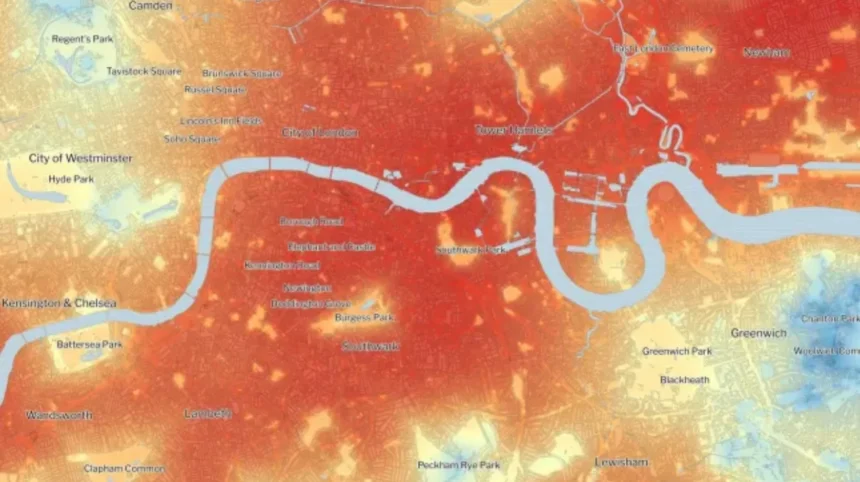
Summer has not even officially begun, and already London is baking. But while rising temperatures affect the whole capital, research shows that North London‘s inner boroughs, Islington, Hackney, and Haringey in particular, are bearing a disproportionate share of the burden, caught in the grip of what scientists call the urban heat island effect.
The urban heat island effect, or UHI, is the result of cities absorbing and trapping heat in ways that the countryside simply does not. Concrete, tarmac, and brick absorb heat during the day and release it slowly at night, meaning London’s urban centre can be up to 10°C warmer than rural areas surrounding the capital. Research by global engineering firm Arup found that London’s urban core has the joint-fourth most extreme urban heat island hotspot of any major city in the world, with temperatures running 4.5°C hotter than rural surroundings.
For North London residents, those numbers are not abstract. Boroughs including Islington and Hackney show the greatest heat risk for schools in the entire capital. Thousands of children in these boroughs are attending classes in buildings not designed for extreme heat, with no air conditioning and windows that trap warmth rather than release it. There is also a significant hotspot in the north of Enfield, attributed to high socioeconomic vulnerability and higher property vulnerability for schools in the area.
The problem runs deeper than just schools. Research published in 2025 found that young children, ethnic minorities, particularly Asian and Black populations, and lower-income groups experience surface temperatures up to 4°C hotter than wealthier communities in London. North London’s inner boroughs, which have significantly higher proportions of these communities than outer London, are therefore among the most acutely exposed. The same research found a potential 6 to 9 per cent decline in pedestrian movement in the most heat-exposed streets, which can further limit mobility and deepen social inequalities in already disadvantaged areas.
The health implications are stark. The Climate Change Committee has projected that heat-related deaths may triple by 2050 without further adaptation action, while around one fifth of UK homes are already overheating in summer. Central London boroughs with a greater proportion of flats which includes large parts of Islington, Hackney and inner Haringey face a higher risk of overheating than outer boroughs with more houses and gardens.
The British Geological Society has also highlighted soil shrinkage caused by extreme heat as an escalating structural problem in northern and central London boroughs, making building foundations increasingly vulnerable to subsidence as temperatures rise. The issue is not simply one of comfort. It threatens the fabric of North London’s streets and housing stock.
Solutions exist but require investment. Green roofs, urban tree planting, reflective pavements and shaded public spaces have all been shown to reduce localised temperatures significantly. Arup has already worked with several London boroughs including Waltham Forest and Newham to develop bespoke climate action plans for schools but North London’s most affected boroughs are still waiting for comparable intervention at scale.