Key Points
- Unite has scheduled up to 10 further strike days through mid-October 2026 if no agreement is reached.
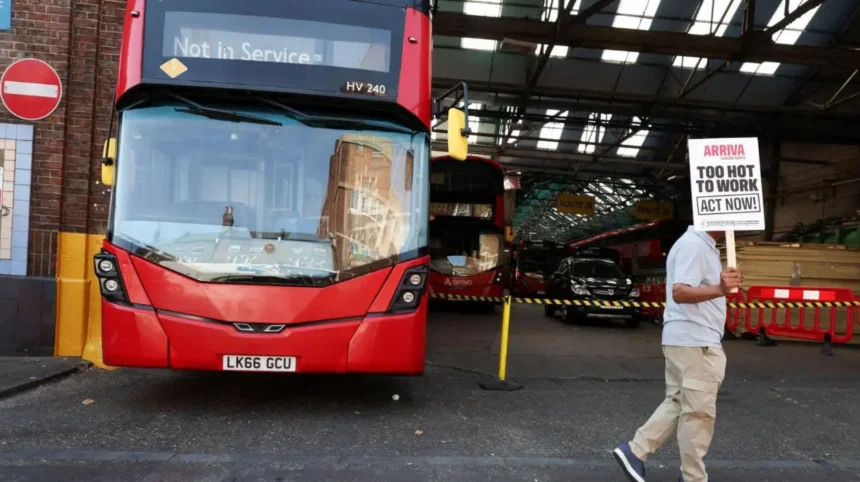
- About 1,500 Arriva North London bus drivers began a four-day strike on Tuesday, 25 August 2026, over high temperatures inside driver cabs.
- Drivers say cab temperatures can reach 40°C during heatwaves, causing heatstroke, dehydration, fatigue and near-miss incidents while driving.
- The dispute centres on Arriva’s use of basic air-cooling systems rather than air conditioning. Unite says the systems reduce temperatures by only two to three degrees.
- Unite members rejected a revised offer from Arriva before resuming the strike, saying it did not address working conditions.
- The strike covers eight depots across North London and Essex, affecting more than 40 routes, including night buses and Superloop services.
North London (North London News) August 25, 2026 — Transport across North London and Essex faces severe disruption this week as approximately 1,500 bus drivers employed by Arriva North London walk off the job in a four-day strike. As reported by Teena Jose of Eastern Eye, the industrial action, organized by trade union Unite, stems from long-standing grievances regarding “unbearable” driver compartment temperatures that allegedly peak above 40°C during summer heatwaves.
- Key Points
- What is driving 1,500 London bus drivers to walk out over extreme heat?
- Why did bus drivers reject Arriva’s latest operational offer?
- How is Arriva North London responding to the union’s allegations?
- Which routes and transportation networks are impacted by the walkout?
- Background of the particular development
- Prediction: How this development can affect commuters, transport authorities, and bus operators
What is driving 1,500 London bus drivers to walk out over extreme heat?
The walkout follows months of mounting friction between bus staff and Arriva management over safety conditions inside driver cabs. As covered by ITV News London, drivers have repeatedly raised concerns that temperatures within their enclosed driver boxes reach up to 40°C, leading to heat exhaustion, severe dehydration, and extreme fatigue.
As detailed in an official press release published by Unite the Union, staff have reported alarming near-miss accidents on the road directly linked to heat-induced drowsiness and reduced concentration. The dispute comes amidst the UK experiencing its fifth heatwave of the summer, with Kew Gardens recording local temperatures of 38.1°C earlier in August 2026.
As reported by Unite the Union, the main operational issue is that most Arriva North London buses are fitted with basic “air-cooling” units rather than proper, integrated air conditioning. The union states these air-cooling units lower cab temperatures by only two or three degrees Celsius, which offers minimal relief when ambient temperatures soar.
As reported by Counterfire, striking drivers at the Wood Green depot expressed that working in such stifling compartments poses direct hazards to staff health and public safety.
Why did bus drivers reject Arriva’s latest operational offer?
Industrial action was initially paused prior to mid-August to allow both sides to hold talks. However, as reported by Teena Jose of Eastern Eye, union members overwhelmingly voted to reject the company’s newest proposal, concluding that the concessions offered were insufficient to resolve the thermal conditions inside driver cabs.
As reported by ITV News London, Unite General Secretary Sharon Graham stated:
“London bus drivers do a vital job, but are putting themselves at risk due to these appalling conditions. Arriva can fully afford to make meaningful changes our members can accept. Until that happens, strike action will continue and our members at Arriva North London will continue to have the full backing of Unite”.
In an additional statement published by Unite the Union, Sharon Graham noted:
“Time and time again drivers have complained to Arriva North London about working in dangerous conditions but the company has failed to act which is completely unacceptable. A profitable company such as Arriva could easily invest in improving conditions for its drivers and protecting the general public but is instead prioritising greed”.
Unite further pointed to financial data from mid-2025 showing Arriva reported a pre-tax profit of €156 million alongside an operating profit of €127 million, arguing the firm possesses sufficient resources to retrofit its active London fleet.
Explore more Local North London News
Former Islington Gazette Editor Tony Allcock Dies Aged 78 Islington 2026
Parkland Walk Disused Railway Trail Transformed in North London 2026
How is Arriva North London responding to the union’s allegations?
Arriva North London maintains that employee health and safety remain paramount. As reported by Teena Jose of Eastern Eye, a spokesperson for Arriva stated that the firm had:
“…already reached agreement with Unite officials on every demand,” and was working to evaluate remaining concerns at garages that voted to strike.
The spokesperson emphasized that staff and customer wellbeing “will always be our highest priority,” noting that immediate heat-mitigation measures—such as extra welfare checks and distribution of hydration supplies—had been implemented across the summer. Furthermore, Arriva noted it is actively engaged in an extreme weather task force established by Transport for London (TfL) alongside other regional bus operators, making “meaningful progress” toward fleet-wide air-conditioning upgrades.
Which routes and transportation networks are impacted by the walkout?
The four-day walkout directly affects eight key bus garages across North London and Essex:
- Barking
- Edmonton
- Enfield
- Grays
- Palmers Green
- Stamford Hill
- Tottenham
- Wood Green
As reported by The Independent, over 40 outer-borough and inner-city routes are disrupted, including key night bus lines and TfL’s high-frequency Superloop network. The disruption coincides with planned closures on the London Underground’s Piccadilly line, compounding commuter delays across Northern and Eastern corridors. Transport for London has formally apologized to passengers for the inconvenience, advising commuters to check service statuses before traveling.
As reported by Unite the Union, if the impasse remains unresolved, up to ten additional strike days will take place intermittently through mid-October 2026.
Background of the particular development
The dispute over bus cab conditions is part of an ongoing debate regarding London’s public transport infrastructure and its resilience against changing weather patterns.
Over the past decade, successive summer heatwaves have repeatedly exposed the limitations of aging rolling stock across the capital’s transport network. While modern double-decker vehicles and newly introduced electric buses come equipped with integrated climate control systems, a substantial portion of London’s contracted diesel and hybrid bus fleet continues to rely on traditional ventilation or air-cooling mechanics. Air cooling draws in ambient air and passes it through water-soaked pads, a process that loses efficiency when surrounding humidity is high or ambient temperatures exceed 30°C.
Transport for London sets regulatory frameworks for bus service agreements, but operational maintenance and fleet specifications are managed by private franchise holders, including Arriva, Go-Ahead, Stagecoach, and Metroline. Trade unions, including Unite and the RMT, have repeatedly called on TfL to mandate maximum working temperatures for public transit workers, similar to regulations applied to hazardous indoor environments.
The current action represents one of the first major organized walkouts in the UK specifically centered on climate-induced workplace hazards, establishing a precedent for how labor unions address extreme heat conditions in mobile workplace settings.
Prediction: How this development can affect commuters, transport authorities, and bus operators
The ongoing dispute between Arriva North London and Unite is poised to have short- and long-term ramifications for commuters, transport authorities, and private operators across Greater London.
Impact on Commuters and the Public
In the short term, commuters across North London and Essex face continued transit friction through late summer and early autumn 2026. Reduced bus coverage will increase passenger reliance on alternative transport, leading to heightened congestion on parallel Tube, Overground, and national rail lines. Outer-London suburban areas that lack direct rail access will experience the highest levels of travel disruption. In the long term, if trade unions successfully secure strict cab temperature thresholds, passengers may benefit from safer bus journeys driven by less fatigued, more alert drivers, reducing the risk of heat-related traffic incidents.
Impact on Transport Authorities (TfL) and Policy
For Transport for London, this strike action accelerates the need to update franchise contract guidelines. TfL will likely face mounting pressure from regional government bodies and union leaders to institute mandatory, fleet-wide air-conditioning specifications for all future bus procurement contracts. This may require TfL to allocate additional capital expenditure toward fleet modernization or offer subsidies to private operators to accelerate the decommissioning of older, air-cooled vehicles.
Impact on Bus Operators and Industrial Relations
For private operators like Arriva North London, the dispute presents financial and operational challenges. Sustained industrial action risks penalty fines under TfL performance-monitored contracts due to missed service mileage. Furthermore, this strike sets a contractual precedent across the UK transit sector. If Unite secures major retrofit commitments from Arriva, rival transport contractors across Greater London and regional urban centers will likely face identical demands from their workforces, accelerating capital expenditure timelines for fleet retrofitting nationwide.