
Children in London have experienced improved lung growth following reductions in air pollution after the introduction of the Ultra Low Emission Zone (ULEZ) in 2019, a new study has found.
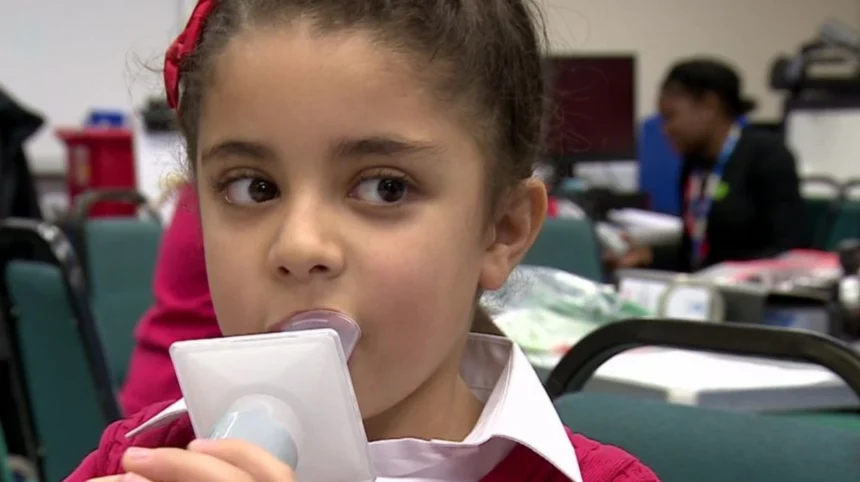
The study ran from 2018-2022 and was led by researchers at Queen Mary University of London. It included more than 3,400 children aged between six and nine from London and Luton, with those from Luton acting as a comparison group. The researchers regularly measured the children’s lungs size and function and asked them to undertake tasks such as blowing out candles and running as fast as possible without losing their breath.
Before the introduction of ULEZ, researchers found that children in London had significantly smaller lungs than children in Luton. Yet, over the course of the study, London children’s lung growth improved, becoming comparable with children in Luton.
Researchers also noted that the proportion of children with a ‘clinically impaired lung function’ fell from 14% to 9% in London, compared with a reduction of 9% to 7% in Luton.
After looking at the data, researchers concluded that the fall in nitrogen dioxide (NO2) exposure following the implementation of ULEZ in 2019 was strongly linked to these improvements.
The findings could have significant implications for children’s long-term health, as the evidence suggests that some of the damage to lung development due to exposure to air pollution may not be permanent. This study is also important as it is the first evidence that shows how the introduction of clean air zones could benefit children’s development.
Since the introduction of ULEZ in 2019, roadside NO2 concentrations have fallen by 54% in Central London, 29% in Inner London and 24% in Outer London, according to a report from 2025. The same report also found that NO2 exposure is highest in more ‘deprived communities.’
Reductions have also been recorded in North London. Evidence from the House of Lords Environment and Climate Change Committee in 2024 found that the average annual NO2 concentrations fell in Camden by 45.4% between 2018 and 2024.
This decrease has been welcomed by people such as Tom Parkes, Air Quality Programme Manager at London Borough of Camden, who said that ‘the ultra-low emission zone has … delivered transformational improvement in air quality.’
For many Londoners, the introduction and subsequent expansion of ULEZ has been controversial. A major criticism is that drivers of vehicles that are not ULEZ-compliant are currently charged £12.50 a day, which critics have argued would make London ‘unaffordable’ for some.
However, Professor Ian Mudway, Associate Professor in the School of Public Health at Imperial College London, and a joint senior author of the study said that ‘Air pollution if a global issue’ and that ‘if we want to improve the lives of children living in high-traffic urban environments, we need bold and ambitious measures.’
Rosamund Adoo-Kissi-Debrah, whose daughter Ella became the first person in the UK to have air pollution listed as a cause of death said, ‘London children shouldn’t be the only ones who are breathing clean air’, highlighting how important research like this is to reduce children’s exposure to air pollution.