
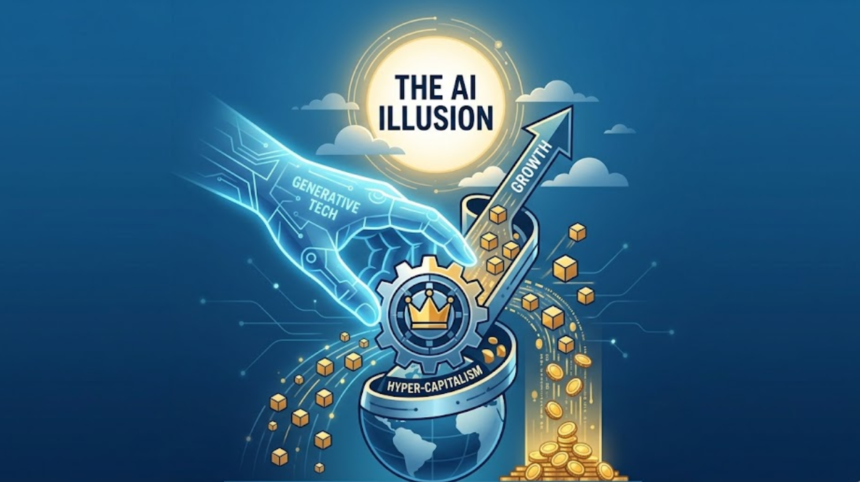
We are living in an era where the boundary between society and the market has not just blurred; it has been entirely erased. Even in a mixed economy like the UK traditionally defined by a balance of free enterprise and the welfare state unfettered capitalism is achieving a quiet, total dominance. Wherever we look, every societal challenge, human struggle, or cultural shift is rapidly repackaged as an economic problem to be solved by the very corporations that helped create it.
Big business continues to colonise the average human mind, steering our collective consciousness for corporate gain. Today, this manipulation is magnified exponentially by the advent of artificial intelligence. While AI is frequently championed as the ultimate tool for human liberation, a closer inspection reveals a more unsettling reality: it is becoming the ultimate weapon for hyper-capitalist exploitation.
The Deepfake Epidemic and Societal Trauma
While AI certainly holds the potential to streamline work and benefit society, its collateral damage is already proving devastating. We are witnessing the normalisation of profound social harm, most visibly through the explosion of deepfake technology.
Without robust regulatory frameworks or aggressive law enforcement, the creation and distribution of harmful AI generated content is spiralling from bad to worse. Deepfake pornography is being weaponised to harass, blackmail, and degrade, causing immense psychological distress. The trauma is highly visible across the UK and the US, and it is spreading globally. Young people are disproportionately bearing the brunt of this digital violence, their lives upended by a technology that moved faster than the law ever could.
The Banking Paradox: Fraud and Redundancies
In the financial sector, AI is creating a malicious, cyclical headache of supply and demand. We are witnessing the industrialisation of deception. The UK alongside the global banking industry is currently engaged in a technological cold war against AI-driven fraud, and it is a battle where the combatants are entirely non human.
Historically, financial fraud was somewhat artisanal; a convincing scam required time, human effort, and coordination. Today, generative AI has transformed fraud into a high-volume, lowcost enterprise. Criminals now utilise “crime-as-a-service” toolkits available on the dark web, deploying agentic AI to run thousands of adaptive, highly personalised scams in parallel. From hyper realistic voice cloning that mimics a panicked relative, to synthetic identities capable of bypassing banking verification systems, the volume and sophistication of attacks are surging.
This has triggered a vicious arms race. On one side of the ledger, major high-street banks are aggressively cutting thousands of human jobs in customer service and compliance, citing the “efficiencies” of AI. They champion automated KYC (Know Your Customer) systems and chatbots that process data at a fraction of the cost of a human workforce. Yet, in a glaring paradox, these same institutions are haemorrhaging the money they allegedly saved, forced to invest billions in defensive AI, behavioural biometrics, and complex cybersecurity to combat the sophisticated fraud their own technological pivot has enabled.
Democracy for Sale
Perhaps the most chilling application of AI lies in the political arena. If we look back at the Cambridge Analytica scandal during the Brexit referendum, we saw how personal data could be weaponised to manipulate voter behaviour. Today, that looks like child’s play.
We are entering a landscape of algorithmic propaganda. Social media is flooded with fabricated narratives, deepfake videos of political figures, and hyper-targeted disinformation campaigns designed to fracture public consensus. Powerful corporate and political elites are leveraging these tools for their own gain, steering society towards instability while the public is too exhausted, distracted, or overworked to look at the wider frame.
Big tech and powerful business interests are not building these tools to liberate the working class; they are building them to monopolise attention, influence elections, and maximise profit.
The Academic Arms Race
Nowhere is this shift more alarming than within the education sector. Universities, once the bedrock of critical thought, are increasingly operating as high volume corporate entities. The genuine motive of teaching the desire to nurture intellect and challenge assumptions is being suffocated by metrics.
A surprising inversion has taken root in modern higher education: students are now consistently outflanking their institutions in the everyday use of generative AI. When it comes to navigating these tools and defining the new boundaries of academic integrity, university students are frequently a step ahead of some of the academics and administrators tasked with policing them.
While AI-native learners seamlessly integrate these models to conceptualise and structure their work, university bureaucracies often remain trapped in a panicked, reactive cycle. Rather than proactively redesigning assessments to evaluate genuine critical thought, institutions tend to swing between two damaging extremes. They either rely on flawed AI detection software that unfairly penalises vulnerable students, or they default to inflating grades and awarding unmerited high marks to mask their own pedagogical shortcomings. Ultimately, universities cannot uphold true academic integrity when the gatekeepers understand the technology less intimately than the students sitting in their lecture halls.
The modern higher education sector suffers from a profound cognitive bias at the highest levels of management. Senior leaders systematically reward and promote academics who treat students as mere customers, processing them like robotic units on an educational assembly line. Genuine, transformative teaching has been largely stripped from the calculus of academic career progression. Instead, professional advancement is increasingly dictated by a relentless, uncritical mix of publications in ‘status quo’ journals, alongside a pervasive institutional snobbery that automatically assigns greater worth to staff and students simply because they hail from so-called elite universities.
This deeply flawed, metric-driven approach to decision-making is inflicting severe structural damage upon the academy. By incentivising superficial prestige over genuine pedagogical care, university leadership is actively hollowing out the institution from within. If we allow this commodification to continue unchecked, the foundational pillars of the university the pursuit of genuine knowledge, critical thought, and intellectual wisdom will be permanently relegated to the history books.
Meanwhile, the quality lecturer the educator whose primary aim is to teach, mark fairly, and cultivate genuine critical thinkers is left behind. Education is no longer about intellectual development; it is about output, optimisation, and algorithmic efficiency.
The Erosion of the Mind
The cumulative effect of this new reality is devastating for the next generation. We are already seeing the warning signs: a sharp decline in critical thinking skills, soaring rates of mental illness, and a pervasive sense of digital fatigue.
To deny that AI has utility would be foolish. It can handle repetitive tasks with unprecedented speed and assist in genuine medical and scientific breakthroughs. However, we cannot afford to be naive. The capitalist machinery will inevitably misuse these tools for social and political dominance unless we intervene.
A Paradigm Shift: Reclaiming Humanity in the Generative Era
The pedagogical and administrative frameworks of the 20th century are fundamentally obsolete in 2026. The traditional metrics by which we govern our institutions, manage our workplaces, and educate our youth are collapsing under the weight of generative technology. The old ways of thinking are not merely outdated; they are dangerously out of context.
Nowhere is this paradigm shift more urgent than in our universities and workplaces. We can no longer afford to teach students to act as rote processors of information. Instead, we must actively cultivate professionals whether in finance, accounting, or the wider economy who possess the ethical grounding and intellectual agility to interrogate AI, rather than blindly submit to its outputs. At a time when young people are entering a precarious labour market defined by structural shifts and persistent graduate wage stagnation, education must urgently pivot from producing compliant, algorithmic workers to forging resilient, critical thinkers.
If we are to survive the generative era with our humanity intact, we cannot treat technology as an isolated, inevitable force. We urgently need to adopt a more careful, deeply critical approach to the tools we consume and, crucially, to the economic system that drives their development. We must demand that digital transformation is secured to genuine sustainability and corporate social responsibility, rather than unchecked, automated profit.
Ultimately, technology should serve society, not conquer it. To ensure this, we must strip away the illusion of AI as a neutral entity and confront the hyper-capitalist engine behind it. Our day to-day lives, our democratic institutions, and the very integrity of human thought depend on it.