
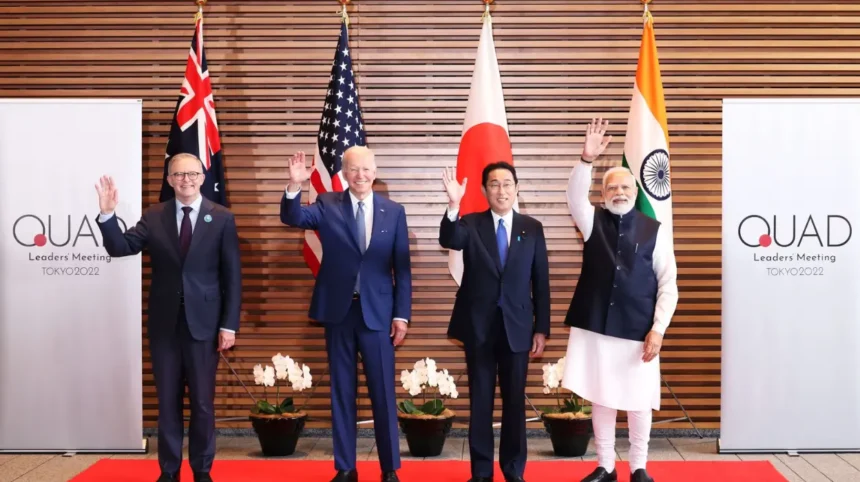
The Quadrilateral Security Dialogue (Quad), comprising Australia, India, Japan and the United States, has evolved into a multifaceted forum addressing a wide range of regional issues beyond traditional security concerns. The question now arises: does this dialogue remain helpful to India, or is it merely window dressing in the lexicon of the often-quoted notion of “strategic autonomy”?
At the Wilmington, Delaware, summit held in 2024, the Quad showcased initiatives ranging from healthcare and cybersecurity to infrastructure development and emerging technologies. The approach was ambitious only in name. Some argue that, for India, the Quad offers an opportunity to engage in regional cooperation with the United States and its Asian allies without the constraints of formal military alliances. While the forum maintains that it is not directed against any particular country, it implicitly serves as a counterbalance to China’s growing assertiveness in the Indo-Pacific. Importantly, however, the Quad’s nuanced approach may not be creating sufficient diplomatic space for India to manage its complex relationship with China.
The Indo-Pacific region has become the epicentre of global geopolitical contestation with the emergence of multilateral mechanisms such as the Quad. India is often considered the “weakest link” in the grouping. It is the weakest link because it has little in common with Australia, Japan or the United States from the standpoint of geopolitical proximity or historical experience. Nor do these countries share with India a history of extending a helping hand during India’s freedom struggle, during the India-China war of 1962, the India-Pakistan wars, or more recent conflicts and tensions involving India and Pakistan.
Since its inception, the Quad has been driven by three overriding objectives: containing China, enhancing maritime security, and promoting infrastructure development.The primary driving force behind the Quad has been the containment of China, or what is sometimes described as “balancing China”, either implicitly or explicitly.
Since the formation of the Quad, China’s growing economic and geopolitical power has overshadowed the strategic calculations of Japan, Australia and India. For Australia, balancing its strategic outreach towards China has become imperative. India seeks to counterbalance China while maintaining its proclaimed strategic autonomy. Japan’s interests in the South China Sea and its support for Taiwan are major strategic concerns, encouraging it to remain active in the Quad. The United States considers the Quad crucial to its Indo-Pacific strategy for maintaining regional leadership.
The Quad’s New Initiatives
At the recent meeting of Quad foreign ministers in May 2026, several initiatives were discussed:
- Quad Critical Minerals Initiative: A $20 billion initiative intended to coordinate investments in mining, processing and recycling in order to strengthen global supply chains.
- Indo-Pacific Maritime Surveillance Collaboration Initiative: This focuses on the Indian Ocean Region and seeks to enhance real-time information sharing and maritime awareness by combining the surveillance capabilities of member countries.
- Quad Initiative on Indo-Pacific Energy Security: This initiative seeks to identify areas of cooperation in technology, management, policy, international market analysis and emergency-response exercises in order to ensure open and stable energy markets and diversified supply chains.
- Indo-Pacific Connectivity: This seeks to ensure connectivity to all Pacific Islands Forum countries through undersea cables and to advance port infrastructure in Fiji under the Quad Ports of the Future Partnership.
Besides these initiatives, the meeting also reaffirmed commitments to the United Nations Convention on the Law of the Sea (UNCLOS). US Secretary of State Marco Rubio described the outcomes of the ministerial meeting as “real achievements and real accomplishments.” However, the ambitious catalogue of new initiatives is neither sufficiently tangible nor necessarily achievable. Announcing initiatives is one thing; implementing and achieving them in concrete terms is quite another.
The Quad suffers from an institutional memory problem. It has no permanent secretariat, no treaty framework and no standing implementation body capable of ensuring continuity across political cycles. US imperialism under Trump has cast its iron grip over the members of the Quad, and, like Trump, other leaders increasingly appear to follow a principle of opportunism. To make matters worse, the grouping has a poor track record of sustaining its focus after communiqués are signed and the flags are packed away. The Quad Cancer Moonshot initiative of 2024, the Quad Vaccine Partnership of 2022, and the Space Cooperation initiative of 2021, to name a few, illustrate how initiatives can fade from political attention once the announcements are over. The uncertainty surrounding the annual leaders’ meeting has further undermined the Quad’s political visibility.
The divergent strategic priorities and structural asymmetries among its members have resulted in core limitations and shifting vulnerabilities. There is a local anecdote about two lovers who light lamps in a temple to have their dreams fulfilled. One lover asks the other, “I was lighting the lamp for you, but whom did you light the lamp for?” The members of the Quad similarly remain suspicious of one another with regard to their respective relationships with China.
Why Should India Leave?
India should recognise that the Quad is essentially a US anti-China manoeuvre created and sustained by Washington for its own strategic interests. Trump uses India as part of the broader effort to contain China, including by perpetuating tensions along India’s borders. Washington has hardly encouraged independent decision-making by India in resolving its border disputes with China. Even during the US-Israel war on Iran, the United States reportedly relied on Pakistan as an intermediary rather than India, thereby further marginalising India’s diplomatic position.
Second, India and China together account for around 40 percent of the world’s population and represent enormous markets. This should provide sufficient justification for strengthening bilateral relations and economic cooperation without allowing Washington to determine the terms of the relationship or prioritise American interests.
Third, both Asian powers are major leaders of the Global South and possess the potential to expand trade and investment in their own currencies rather than relying predominantly on the US dollar.
Fourth, the United States is facing a relative decline in its global economic and political dominance and is increasingly struggling to sustain its hegemony. This provides an opportunity for China and India to contribute to a more multipolar global order by working with countries such as Iran and Russia. Such cooperation could help reduce dependence on unilateral sanctions and trade tariffs imposed by the United States.
India’s economic future lies in strengthening its engagement with the Shanghai Cooperation Organisation (SCO), BRICS and the United Nations. India’s security lies in strengthening the UN and working through independent multilateral forums such as BRICS and the SCO, rather than tying its fate to Western security blocs. The global economic centre of gravity has, of late, been shifting towards the Global South. Professor Jeffrey Sachs has argued that, within the next 25 years, India and China could become the world’s largest economies. To maximise this potential, India should champion independent multilateral frameworks rather than betting its strategic future on Western imperial security blocs. But the fundamental question remains: will India muster the political courage to do so under the present political dispensation?
The views expressed in this article are the author’s own and do not necessarily reflect (North London News) editorial policy.