
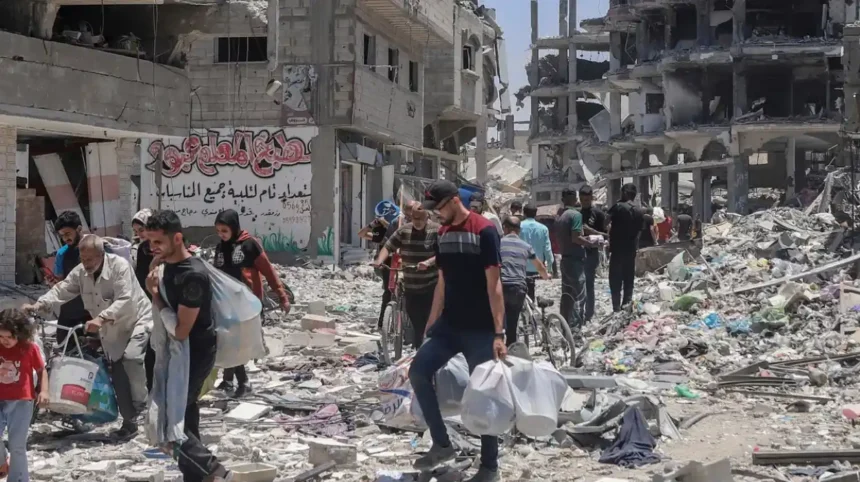
The extensive recovery of human remains from beneath the rubble of demolished buildings in Gaza has prompted the UN High Commissioner for Human Rights, Volker Türk, to warn that these discoveries have unearthed potential war crimes committed by the Israeli armed forces. He has demanded immediate international access for forensic investigators to examine the sites. The UN Security Council has identified and condemned six grave violations against children in times of war: the killing and maiming of children; the recruitment and use of children by armed forces and armed groups; attacks on schools or hospitals; rape and other grave sexual violence; the abduction of children; and the denial of humanitarian access for children. International humanitarian law requires armed forces and armed groups to take measures to protect civilians, including children, who are especially vulnerable during wartime.
Türk has said that the extensive human remains—mostly of children and women, discovered almost three years after their homes were heavily bombed by Israeli forces—underscore serious concerns over compliance with international law and the possibility that grave violations, including war crimes, may have been committed. The High Commissioner further said:
“The remains of what appears to be entire families are now being unearthed at locations that were pulverized by Israeli attacks. It is heart-breaking that the loved ones of those missing for so long are only now having their worst fears confirmed.” He added,
“I worry the remains recovered so far may only be the tip of the iceberg. Much of Gaza has been flattened by Israeli bombing or demolition and clearing by heavy machinery and explosives. Today, many areas in Gaza where the Israeli military is deployed continue to be levelled by bulldozers with no respect for the dead under the rubble.”
Türk suggested that evidence of violations is critical and that the demolished sites should be preserved lest all evidence be lost through the levelling activities of Israeli forces. He called for international investigations to be allowed into all parts of Gaza to assist in gathering evidence. Surprisingly, Israeli forces deny these charges and refuse entry to heavy machinery for removing the rubble. Reports from the Palestinian Civil Defence present startling statistics about dead bodies and other human remains. According to these reports, more than 630 bodies have been recovered across Gaza between November 2025 and September 2026, with the total number of missing under the rubble estimated at 8,000. It is imperative to document the victims, preserve forensic evidence and biological samples, record their burial locations, and notify their family members.
The Civil Defence report also stated that between 27 June and 27 August, 233 of 407 bodies believed to be trapped under 20 destroyed buildings—mostly in Gaza City—had been recovered. The figure of 233 includes 74 children and 106 women. In September 2026, Palestinian Civil Defence teams reportedly recovered 96 bodies and human remains at a single site in Az Zeitoun, south-east of Gaza City, allegedly struck in November 2023. Of these, 58 were children and 23 were women. Most were recovered using bare hands. These findings are a stark reminder of the gravity and breadth of the destruction.
The agony of the bereaved family members is compounded by prolonged suffering and misery brought by years of not knowing. They have a right to know the fate of their kith and kin—a right that does not end with identification or a dignified burial. They deserve to know the full truth, which the Israeli military refuses to disclose.The UN Human Rights Office, in its 2024 report, highlighted the use of heavy bombs of up to 2,000 pounds between 9 October and 2 December 2023 on residential buildings, schools, refugee camps, and markets, killing over 200 people. The report pointed out that those strikes may have violated the fundamental tenets of international humanitarian law. The law stipulates that warring parties must abide by the principles of distinction, proportionality, and precaution during attacks.
The High Commissioner, Volker Türk, is reported to have said:
“On a number of occasions, I have expressed grave concern that Israel’s choice of methods and means of conducting hostilities, including through the extensive use of explosive weapons with wide-area effects in densely populated areas, failed to ensure that they effectively distinguish between civilians and fighters.”
Reuters reported that neither the Israeli Prime Minister’s office nor its foreign ministry responded to requests for comment. Israel has repeatedly denied the allegations and said it acted in accordance with international law while fighting Hamas militants in Gaza. According to the UN report, Israel’s assault on Gaza has generated 61 million tonnes of wreckage and debris, which could take seven years to clear. A US-brokered ceasefire brought an end to the full-scale war in October 2025 but has miserably failed to halt Israeli strikes on the pretext of violating the truce.
Volker Türk is apprehensive that the remains uncovered so far are “only the tip of the iceberg,” as large parts of Gaza have been flattened by Israeli bombing or later demolition and clearance operations. He also accused Israel of continuing to level some areas of Gaza where its forces are deployed, with bulldozers operating “with no respect for the dead under the rubble.” Ajit Sunghay, head of the UN rights office for the Occupied Palestinian Territory, stated in a Geneva press briefing that “the collective impact of Israel’s conduct is making any systematic, large-scale search, recovery, and identification work nearly impossible.” Surprisingly, Israel’s COGAT military agency, which controls access to Gaza, has brazenly justified long-held restrictions on items it claims could be used for a “terrorist build-up.” Israel goes to great lengths to assert that Hamas uses Gaza’s civilians as human shields in densely populated areas—an accusation Hamas denies.
Unfortunately, the nature of violence has changed. Today’s violence is not the old kind of brutality. It is abstract and, to a certain degree, captured and relayed in numbers. In a way, these numbers tend to turn violence into an impersonal affair. Nonetheless, violence affects the language of body counts. In a deep and fundamental way, the numbers under the rubble tell us something about the people who died and the way they died. It is not a mere act of counting. It is a way of communicating the genocidal brutality subjected to selective erasure. The world must wake up to fight this erasure. Elie Wiesel’s words—
“We must always take sides. Neutrality helps the oppressor, never the victim. Silence encourages the tormentor, never the tormented”
bear more relevance than ever before.