
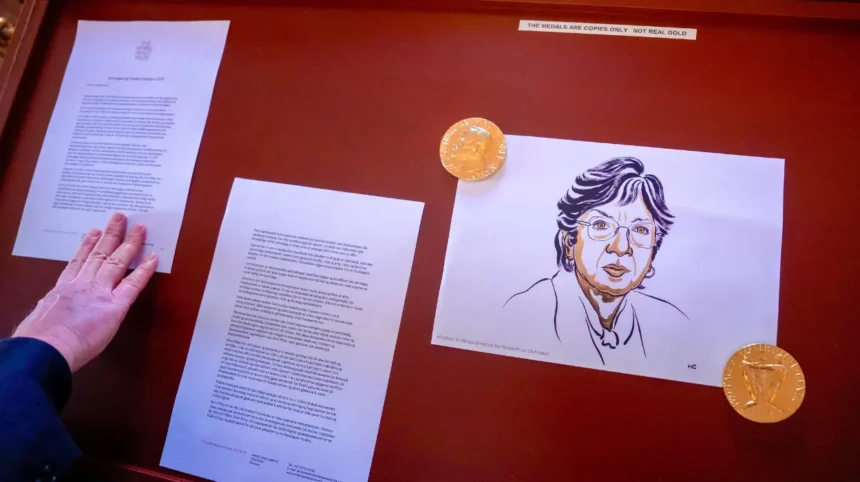
The 2026 Nobel Peace Prize awarded to Navi Pillay has once again unsettled the Zionist regime of Mr Benjamin Netanyahu and diverted international attention, even as the international community affirms its belief that genocide is occurring in Gaza and the West Bank during an election month. In its citation, the Norwegian Nobel Committee described Pillay as instrumental in ensuring that war crimes, crimes against humanity, and genocide are prosecuted. It called her one of the most respected international jurists of our time.
Israeli opprobrium was predictable. Danny Danon, Israel’s ambassador to the UN, told The New York Times that honouring Pillay “would not only damage the credibility of the Nobel Committee, but also tarnish the legacy of the distinguished laureates who have received this honour throughout history.” Although the Committee did not explicitly mention Gaza in its statement, its chairman, Jorgen Watne Frydnes, told reporters that Pillay’s work on the UN Commission was “an important part of the reasoning why she received the prize.”
The award came amid escalating US hostility to international accountability. As reported by The New York Times News Service and the Associated Press, soon after the announcement the Trump administration imposed sweeping new sanctions on the International Criminal Court. The administration says the ICC has become politicized and has unfairly and illegally prosecuted Americans and Israelis on war-crime charges. On October 9, 2026, Secretary of State Marco Rubio announced in a video address:
“We will ban transactions with the rogue Court, cutting off their resources and crippling its ability to operate against us. The United States and the American people are not subject to the jurisdiction of this fake ICC.”
These reactions recall Erich Fromm’s account of the colonizer’s negative, possessive attitude:
“The necrophilous person can relate to an object—a flower or a person—only if he possesses it; hence a threat to his possession is a threat to himself; if he loses possession, he loses contact with the world… He loves control, and in the act of controlling he kills life.”
Netanyahu’s Zionist regime, backed by US imperialism, grants itself impunity for crimes against humanity committed against the people of Gaza because it cruelly controls every aspect of their daily lives. It imposes its laws on them without their consent. Life under Israeli occupation means sacrificing part of one’s being—one’s soul and spirit—while resisting the erasure of Gazans.
Israel is facing deeper isolation in the theatre of public opinion at home and abroad. A survey of ten European countries, including Spain, France, and Sweden, found that large majorities held a negative opinion of Netanyahu’s Israel. According to the Pew Research Centre, negative views rose especially after the start of the US-Israeli war on Iran, which unleashed a new crisis in West Asia and a global economic shock. In Poland, negative views jumped 8 points to 70 percent; in Italy they increased by 9 points to 75 percent; and in Germany they also rose by 9 points to 73 percent. The British government also announced sweeping sanctions on trade with illegal Israeli settlements and condemned “ethnic cleansing” in the West Bank by state-backed “settler terrorists.” Netanyahu’s dismissal of critics as “moral cowards” at the UN General Assembly has further alienated Israel.
Two recent episodes have also weakened Netanyahu politically. The first was the miraculous survival of Israeli passengers on a Flydubai flight after an attempted hijacking, thwarted only by the smart action of Indian captain Smith Machchhar and the passengers on board. The incident hurt Netanyahu because his administration had failed to properly vet the antecedents of the Omani pilot, who had flown to Israel beforehand. The second is the October 27 election, which he knows will be a referendum on his handling of Israel’s security situation since October 7, 2023. In the Flydubai case, he tried to spread the narrative that he alone is the savior of Israel surrounded by enemies everywhere. But it backfired.
His political tactic is to go on the offensive at the slightest hint of criticism of Israel’s policies—whether at the UN General Assembly, by attacking New York mayor Mamdani, or by painting Navi Pillay, the Nobel Peace laureate, as a hater of Israel. In doing so, he tries to fuse his image with that of the State of Israel: criticizing him would mean criticizing Israel. But this old political trick probably will not work in his favor this time.
Divisions within Israeli politics are unbridgeable. Corruption charges against him, the failure to establish a state commission of inquiry into the October 7 failures, long-pending judicial reforms, mandatory conscription for the ultra-Orthodox Haredi, and, above all, the high cost of living are high stakes against Bibi.
Israel’s relationship with Trump is now the most delicate issue. Israel’s wars in Gaza, the West Bank, Lebanon, Iran, and Syria have in the meantime estranged Netanyahu from both the political left and right in the United States. MAGA supporters are questioning the Trump administration’s support for Tel Aviv. Netanyahu’s recent experience in New York, where Trump avoided meeting him, is a case in point. Trump is mercurial and may at any time pull back and allow regional allies such as Saudi Arabia, the UAE, and Qatar to play a bigger role. He is using the Abraham Accords not only as a template for Arab-Israeli relations but potentially as a balance against Israel in West Asia.
The 2026 Nobel Peace Prize, apart from sending an unmistakable message to politicians that they have a legal obligation to protect human rights and refrain from war, has, in a way, brought oppressed people into the world’s consciousness. This is not because of who their adversary is, but because of their solidarity and their own political force.