
Students and youth are often dismissed by geriatric people as apolitical, depoliticised, lazy, immoral, unconcerned, and materialistic—too busy with their own lives, glued to digital platforms and social media. Acting on such perceptions, the ruling classes have taken India’s young for granted. Thus, education—from school to higher education—remains low on the priority list, suffering from minimal investment and a glaring lack of political commitment to expanding science-based, secular teaching and learning environment in the country.
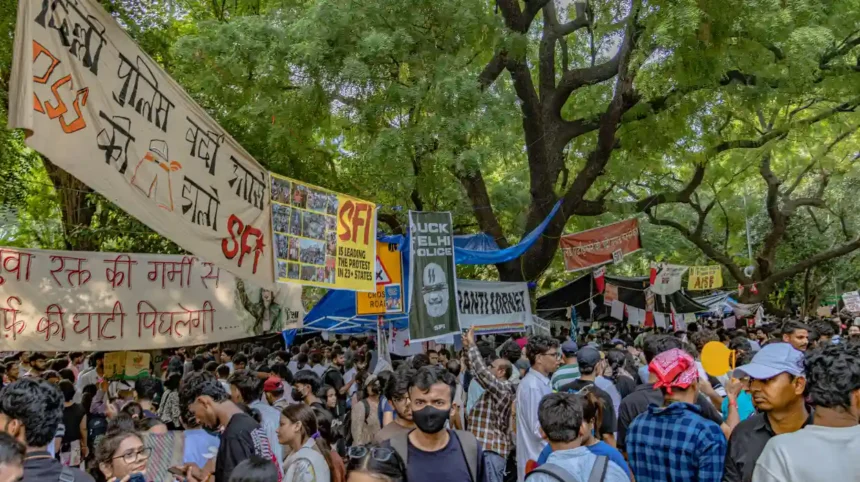
The ongoing student-led movement, however, bursts these myths. The very youth and students who formed the soul of the anti-colonial struggle are now leading the nation again, this time by questioning Hindutva fascists and their electoral machinery, which survives solely on fraudulent propaganda devoid of substance in any field. Having betrayed the freedom struggle by siding with the British, these forces now betray Indians by aligning with corporate capitalism. Students and youth are ruthlessly exposing this Hindutva hypocrisy.
This movement is not merely demanding political accountability to ensure integrity and transparency in educational systems; it is also pushing for radical reforms so that Indian education truly serves the needs of society. Its nature, character, and features are fundamentally different from any post-colonial social and political movements, making this current wave unique in contemporary India. It resurrects the ethos and legacies of the freedom struggle, bringing them directly into modern political praxis and mobilisation of people to question power that governs them.
First, the movement stands on moral and political clarity—questioning the government in power through concrete issues and offering alternatives in the form of tangible policy changes. It is unequivocally political yet transcends party lines and ideological dictates. It upholds national interests without descending into parochialism, teaching us that Indian youth are eternal idealists: their loyalty cannot be purchased, nor their integrity questioned when it comes to committing to social, political, cultural, and economic transformation. Unlike the India Against Corruption movement, this one has no room for political expediency.
Second, it demonstrates an absolute commitment to secular values—not merely as a political practice but as the very core of street mobilisation of masses. The message is unambiguous: political parties and Hindutva forces must stop dividing people by religion, caste, or community lines. Indian students and youth envision an inclusive, pluralistic, and secular India as their default setting, and they have managed to mobilise across all walks of life without the slightest bias.
Third, the movement seamlessly blends physical protests with digital outreach, connecting streets to homes, children to parents, and students to teachers. Solidarity marches have erupted across India and in major cities worldwide. Never before have street protests permeated Indian households the way this movement has. While leadership exists, the rigid hierarchy of traditional parties is dead here; horizontal networks, egalitarian camaraderie, and simple language—punctuated by witty memes—have carried the agitation into every educational institution and living room. The revolution is literarily televised.
Fourth, it remains non-violent, creative, and radically courageous, anchored in the conviction of students and youth for equality, justice, freedom, fairness, and moral standing in public life. Despite ruthless state crackdowns, they have stayed utterly non-violent, embodying the very qualities inherited from the freedom struggle’s legacy of youthful sacrifice for the greater good of Indian society.
This student and youth resurgence has given much-needed oxygen to a shell-shocked Indian opposition, pulling it out of electoral defeats and back toward representing people’s interests. There is no longer any place for political and other wise expediency. The movement delivers a clear warning to all political parties: the patience of students and youth is not a weakness, and political inaction will no longer be tolerated in silence. The Indian Constitution continues to guide this struggle for deepening of Indian democracy and citizenship rights in the country.
In this way, the student movement serves as a moral compass—something that mainstream parties and the current Hindutva lunatics sorely lack. Its uncompromising idealism warns those in power to change direction before their days are numbered. Political change is now in the Indian air, thanks to the country’s youth. The students have transformed into teachers, schooling the older generation on the future they demand. Rejecting caste-based, patriarchal, and gender-feudal hierarchies, as well as every form of crony capitalism that has ruined their prospects, this movement is a masterclass in restoring liberal, democratic, secular, and constitutional politics. There is no place for authoritarianism here. The message is loud and clear on the streets of India.
In essence, this movement is different because it does not ask for power; it asks for accountability. It does not seek shortcuts; it builds bridges across every divide. It does not wait for permission; it writes its own future—loud, clear, and unstoppable on the streets of India. Street protest politics is the oxygen of Indian democracy.
The views expressed in this article are the author’s own and do not necessarily reflect (North London News) editorial policy.