Key Points
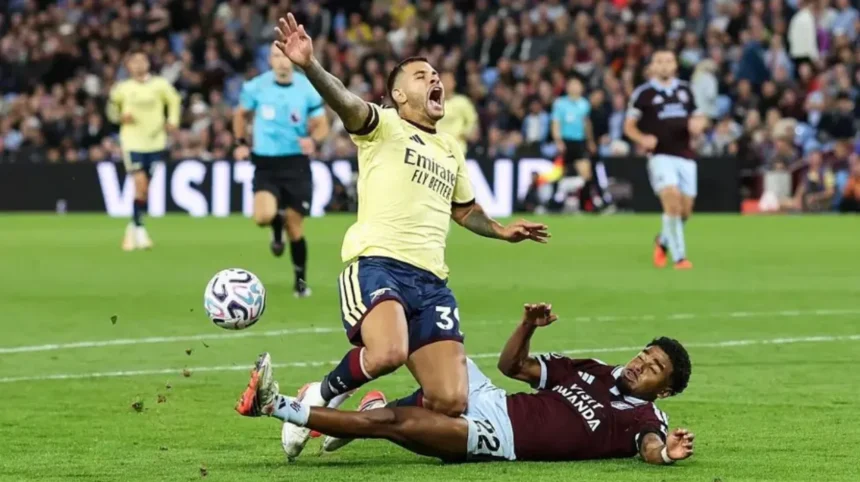
- A Premier League Key Match Incident (KMI) panel reached an unanimous decision (5-0) that Arsenal were not awarded a penalty correctly in their 1-0 victory over Aston Villa at Villa Park.
- The key incident happened when Aston Villa defender Ian Maatsen lunged into a tackle on Arsenal midfielder Bruno Guimarães inside the penalty box at stoppage time.
- It was decided that referee Jarred Gillett had made a mistake on the field when he did not award a penalty, and the Video Assistant Referee (VAR), James Bell, also failed to spot an obvious error.
- It was pointed out that Maatsen’s challenge was described as “reckless,” came into contact with the player’s standing leg without touching the ball, and that Maatsen deserved a second yellow card leading to a sending off of the Belgian full-back.
- However, despite Arsenal missing a penalty, Mikel Arteta’s team won three points with Bukayo Saka’s goal in the second half.
London, (North London News), September 9, 2026 — Arsenal’s narrow 1-0 triumph over Aston Villa earlier in the campaign has faced renewed scrutiny after official league bodies confirmed a major officiating oversight. The Premier League’s independent Key Match Incidents (KMI) Panel concluded that the north London side should have been awarded a late penalty following a challenge on Bruno Guimarães by Aston Villa defender Ian Maatsen.
What did the Premier League Key Match Incidents Panel find regarding the Aston Villa and Arsenal match?
The independent KMI panel—comprising three former players or coaches alongside representatives from the Premier League and Professional Game Match Officials Limited (PGMOL)—reviewed the flashpoint from the fixture at Villa Park. According to Football.London senior football writer Stephen Killen, the panel voted unanimously 5-0 that the failure to award a spot-kick constituted a clear and on-field error.
As detailed in the official findings reported by Stephen Killen of Football.London, the panel stated: “The panel felt that a penalty should have been awarded on-field for Maatsen’s reckless challenge on Guimaraes. Clear contact was made on the attacker’s standing leg and Maatsen made no contact with the ball.” Furthermore, the panel noted that because the tackle was deemed reckless, it met the criteria for a second caution, which would have resulted in Maatsen being sent off.
Explore More Arsenal FC News
Arsenal Prioritise Squad Culture in Bruno Guimarães Transfer North London 2026
Arsenal Offered Chance to Sign Striker Mohamed Kader Meite London 2026
Why did VAR fail to intervene during the incident?
The decision not to award a penalty during real-time play raised significant questions regarding the deployment of video technology. The on-field referee, Jarred Gillett, wave away appeals, while VAR official James Bell opted against recommending an on-field review.
Writing for The Mirror, sports analysts pointed out that the non-intervention stemmed from the Premier League’s tactical shift this season toward a higher threshold for VAR engagement, aiming to reduce subjective interruptions and focus solely on anomalies deemed extreme. However, the KMI panel emphasized that this specific instance crossed the line into a missed intervention, classifying it as the sole uncorrected VAR oversight from that particular round of fixtures.
How did players and managers react to the officiating controversies?
In the aftermath of the fixture, Arsenal talisman Bukayo Saka addressed reporters regarding the physical nature of the contest and officiating decisions that went against his side. As reported by Football.London, Bukayo Saka stated:
“Very very tough game. It’s not easy coming here, we knew that, and they made it hard for us so it feels great to come out with the win.”
Bukayo Saka further noted:
“One goal is normally enough for us because we’re so solid at the back. Once we got the first, we could have got the second. We had two penalty shouts that didn’t go our way.”
While Arsenal ultimately claimed the three points courtesy of Bukayo Saka’s clinical goal, the retrospective verdict from the KMI panel has intensified discussions regarding consistency in elite refereeing standards and the practical application of the video review protocol across the division.
Background of the particular development
The establishment of the Key Match Incidents (KMI) Panel by the Premier League was designed to bring transparency, accountability, and independent evaluation to controversial refereeing decisions throughout the domestic football calendar. Composed of former professional players, coaches, and governance experts, the panel meets regularly to review major match-changing incidents—specifically focusing on goals, penalty decisions, red cards, and VAR interventions. While the panel’s rulings do not alter past match scores or league standings, they serve as an official benchmark for evaluating referee performance, shaping future interpretations of the laws of the game, and addressing growing concerns among clubs regarding consistency in officiating standards.
This official admission by the Premier League KMI panel is expected to heavily influence the broader discourse surrounding officiating thresholds and VAR intervention limits for clubs, managers, and players alike. For Arsenal, while the missed penalty did not ultimately prevent them from securing victory in this instance, the ruling validates managerial frustrations regarding protection for key players in high-intensity duels. For the wider footballing audience, including match officials and PGMOL leadership, heightened scrutiny following this verdict will likely prompt a subtle recalibration of how aggressively VAR intervenes on late-match challenges, potentially leading to increased stoppage-time reviews and stricter disciplinary actions in subsequent fixtures.