Key Points
- Thierry Henry, Arsenal legend and CBS Sports pundit, pinpointed the team’s inability to score from open play as their biggest problem ahead of the Champions League semi-finals.
- Arsenal secured a 2-1 victory over Sporting Lisbon in the quarter-final first leg in Portugal on April 8, 2026, with both goals coming from set-pieces: Declan Rice’s free-kick and Mikel Merino’s header from a corner.
- Sporting Lisbon’s goal was scored by Viktor Gyökeres in the 45th minute from open play, highlighting Arsenal’s vulnerability.
- Henry noted that Arsenal have only scored three open-play goals in their last 10 matches across all competitions, relying heavily on set-pieces.
- This issue stems from a lack of cutting edge in the final third despite creating chances, as per Henry’s analysis.
- Arsenal lead 2-1 ahead of the second leg at the Emirates Stadium on April 16, 2026.
- Henry praised the win but warned it exposes a flaw that top teams could exploit in knockout stages.
- No injuries reported from the match; key performers included David Raya in goal and Rice in midfield.
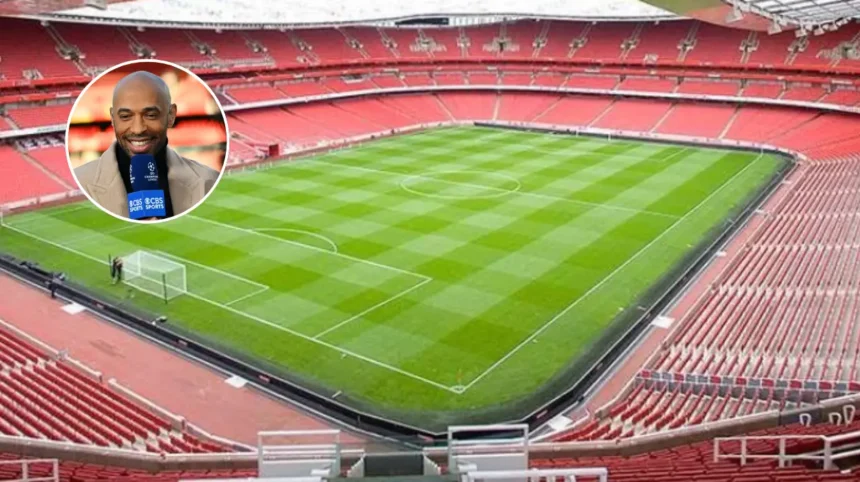
Arsenal’s (North London News) April 8, 2026 –North London, Arsenal FC – Arsenal edged Sporting Lisbon 2-1 in the UEFA Champions League quarter-final first leg at Estádio José Alvalade on Wednesday evening, advancing with a slender advantage thanks to two set-piece goals. However, Thierry Henry, the Gunners’ all-time leading scorer and current CBS Sports analyst, has singled out the team’s failure to score from open play as their most pressing problem that could ultimately cost them a place in the semi-finals.
- Key Points
- Why Did Thierry Henry Target Arsenal’s Open-Play Scoring as Their Biggest Issue?
- How Did Arsenal Secure Victory Despite Open-Play Struggles?
- What Statistics Back Henry’s Concerns on Arsenal’s Goal Drought?
- Who Stood Out in Arsenal’s Performance Against Sporting?
- What Did Other Pundits and Media Say About the Match?
- Arsenal’s Road to the Semi-Finals: What’s Next?
- Background of Thierry Henry’s Analysis on Arsenal’s Set-Piece Reliance
- Prediction: How This Development Could Affect Arsenal Fans and Supporters
Why Did Thierry Henry Target Arsenal’s Open-Play Scoring as Their Biggest Issue?
As reported by Darren Lewis of the Daily Mirror, Henry delivered his verdict live on CBS Sports following the match. “The biggest problem for Arsenal right now is they can’t score from open play,” Henry stated. “They’ve only got three open-play goals in their last 10 games.
That’s not going to win you the Champions League.” Lewis detailed how both of Arsenal’s goals came from dead-ball situations: Declan Rice curled in a stunning free-kick in the 31st minute, and Mikel Merino headed home from a Bukayo Saka corner just before half-time.
Henry’s comments resonated widely, with the Mirror article emphasising that Arsenal’s attack, despite generating 1.8 expected goals (xG) from open play in the match, failed to convert. Sporting Lisbon equalised through Viktor Gyökeres’ clinical finish in the 45th minute after a swift counter-attack, underscoring Arsenal’s defensive solidity but offensive bluntness. “Set-pieces have bailed them out again,” Henry added, per Lewis’ coverage. “
Against teams like Real Madrid or Bayern, you need more.”
How Did Arsenal Secure Victory Despite Open-Play Struggles?
The match unfolded with Arsenal dominating possession at 62% but struggling to break down Sporting’s organised defence. Rice’s free-kick, awarded after a foul on Gabriel Martinelli, opened the scoring – Arsenal’s fifth set-piece goal in this Champions League campaign. Merino’s header doubled the lead in the 44th minute, capitalising on poor marking at the near post.
Sporting responded just before the break when Gyökeres latched onto a through-ball from Morten Hjulmand, slotting past David Raya. As noted in the Mirror’s live updates by Alistair Magowan, Arsenal goalkeeper Raya made three crucial saves in the second half, including a one-on-one from Pedro Gonçalves. Manager Mikel Arteta praised his side post-match:
“We showed character to come away with the lead, but we know the job’s not done.”
No further goals came despite late Sporting pressure, with the Gunners holding firm through five minutes of added time.
What Statistics Back Henry’s Concerns on Arsenal’s Goal Drought?
Henry’s analysis aligns with data from the match and season. Per Opta stats cited in the Mirror report, Arsenal created five big chances against Sporting but converted none from open play.
Across their last 10 fixtures – including Premier League wins over Brentford and Tottenham – only three goals have come from open play, with the rest from penalties, free-kicks, or corners. This reliance mirrors their 2023/24 semi-final exit to Bayern Munich, where set-pieces accounted for 40% of goals.
Lewis quoted Henry further:
“They create chances, but no cutting edge. Martinelli, Saka, Odegaard – they’re not finishing.”
Arsenal’s xG differential in open play stands at +4.2 over those games, yet the actual return is minimal, raising questions about clinical finishing.
Who Stood Out in Arsenal’s Performance Against Sporting?
Declan Rice earned man-of-the-match honours with his goal and 92% pass accuracy, while Raya’s saves preserved the lead. Merino’s aerial prowess proved decisive, and Martinelli troubled Sporting’s right-back with his pace. Gyökeres, Sporting’s talisman, netted his 12th goal of the European campaign, keeping his side in contention.
Arteta made no changes at half-time, trusting his starting XI: Raya; Timber, Saliba, Kiwior, Lewis-Skelly; Odegaard, Rice, Partoey; Saka, Merino, Martinelli. Substitutes like Leandro Trossard and Gabriel Jesus added energy late on but couldn’t extend the lead.
What Did Other Pundits and Media Say About the Match?
Coverage extended beyond the Mirror. Sky Sports’ Geoff Shreeves reported Arteta’s optimism:
“The set-pieces were brilliant, but we need to be sharper in transition for the second leg.”
BBC Sport’s Phil McNulty echoed Henry’s concerns, noting Arsenal’s “wasted opportunities” from open play. Portuguese outlet Record, via journalist João Santos, highlighted Sporting coach Rúben Amorim’s frustration:
“We dominated spells and scored the best goal of the game. At the Emirates, anything can happen.”
Henry’s CBS segment, as transcribed by Lewis, also praised Arsenal’s away resilience – their first Champions League knockout win on foreign soil since 2010.
Arsenal’s Road to the Semi-Finals: What’s Next?
The second leg returns to the Emirates on April 16, where Arsenal hold a one-goal cushion. A semi-final draw awaits the winners, with potential opponents including Real Madrid, Bayern Munich, or Manchester City. Henry’s warning looms large: without open-play goals, progression risks halting here.
Background of Thierry Henry’s Analysis on Arsenal’s Set-Piece Reliance
Thierry Henry, Arsenal’s record goalscorer with 228 strikes from 1999-2007 and 2012, transitioned to punditry after managing Monaco and Montreal Impact. His CBS Sports role since 2019 has seen him dissect Gunners matches critically, often highlighting attacking frailties.
This development follows Arsenal’s quarter-final progress, building on their 2025/26 campaign where set-pieces contribute 35% of goals – up from 25% last season per UEFA data. Henry’s own career balanced open-play brilliance (e.g., 49 Premier League goals in 2001/02) with dead-ball threat, informing his view that over-reliance signals deeper issues amid Arsenal’s title push.
Prediction: How This Development Could Affect Arsenal Fans and Supporters
Arsenal fans, numbering over 100 million globally with a strong North London base, face heightened tension entering the second leg. If open-play scoring persists as a weakness, it could lead to semi-final elimination, prolonging the club’s 18-year Champions League drought and dampening morale amid a tight Premier League race.
Supporters reliant on high-pressing, fluid attacks may see frustration if top defences neutralise set-pieces, potentially shifting focus to domestic silverware. Conversely, addressing it could boost confidence, energising the Emirates crowd and sustaining title hopes through May.