Key Points
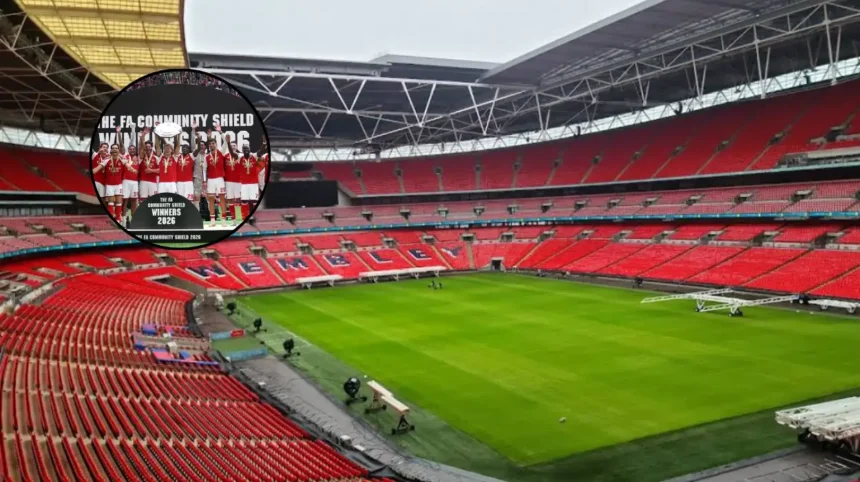
- Arsenal secured the 2026 FA Community Shield with a dominant 3-0 victory over Manchester City at Wembley Stadium.
- Captain Martin Ødegaard delivered a standout performance, culminating in a clinical second-half goal to seal the win.
- The result serves as a significant psychological statement for Mikel Arteta’s squad ahead of the 2026/27 Premier League campaign.
- Ødegaard displayed elite composure, effectively wrong-footing Manchester City goalkeeper Gianluigi Donnarumma for his goal.
- Analysts suggest this performance signals that the Norwegian midfielder may be entering the most influential season of his career to date.
Arsenal (North London News) August 18, 2026 — Arsenal signalled their intent for the upcoming 2026/27 campaign by dismantling Manchester City 3-0 in the FA Community Shield, with captain Martin Ødegaard at the heart of a commanding display. The Norwegian international dictated the tempo of the match from midfield, capping his afternoon with a composed finish that extended Arsenal’s lead shortly after the interval, effectively ending the contest as a competitive fixture.
- Key Points
- How did Martin Ødegaard influence the Community Shield victory?
- What does this performance mean for Arsenal’s 2026/27 ambitions?
- Are there concerns for Manchester City after the 3-0 defeat?
- Background: The evolution of the Arsenal-Manchester City rivalry
- Prediction: How will this development affect the Premier League title race?
How did Martin Ødegaard influence the Community Shield victory?
While the Community Shield is often dismissed as a glorified exhibition, the nature of Arsenal’s victory over their perennial title rivals suggested a shift in momentum. From the opening whistle, Ødegaard operated as the primary architect for the North London side. His ability to find pockets of space between Manchester City’s defensive lines disrupted the rhythm of the opposition, allowing Arsenal to transition from defence to attack with clinical precision.
The defining moment arrived three minutes into the second half. Following a fluid team movement that bypassed the Manchester City press, the ball fell to Ødegaard inside the penalty area. Under pressure from defenders and facing goalkeeper Gianluigi Donnarumma, the captain displayed remarkable composure, feinting to shoot before slotting the ball into the corner of the net. This third goal served as a microcosm of Arsenal’s current tactical identity: patient, intelligent, and lethal when the opportunity arises.
What does this performance mean for Arsenal’s 2026/27 ambitions?
The victory provides more than just a ceremonial trophy; it serves as a litmus test for the squad’s readiness to challenge for major honours. For Mikel Arteta, the primary takeaway from the match was the cohesion shown by his midfield unit. Ødegaard, serving as the link between the deeper-lying playmakers and the forward line, appeared physically refreshed and tactically sharper than in previous campaigns.
Observers noted that Ødegaard’s movement off the ball was equally as important as his technical contribution. By dragging Manchester City markers out of position, he created the necessary space for his teammates to exploit. This level of peripheral awareness has become a hallmark of his captaincy, yet the added clinical edge in front of goal—demonstrated by his strike against Donnarumma—suggests he is evolving into a more decisive attacking threat.
Are there concerns for Manchester City after the 3-0 defeat?
Conversely, the match highlighted defensive vulnerabilities for Manchester City. Gianluigi Donnarumma, despite making several high-profile saves during the opening stages of the first half, was left exposed by a high defensive line that struggled to cope with Arsenal’s rapid counter-attacks. The absence of tactical compactness allowed Ødegaard and his supporting cast—notably the wingers—to isolate defenders in one-on-one situations.
Manchester City manager Pep Guardiola, speaking post-match, acknowledged the disparity in sharpness between the two sides. While he insisted that the result would not define the season, he conceded that his side failed to manage the transitions effectively. For the Citizens, the challenge will be re-establishing defensive stability before the Premier League season begins next weekend, particularly against teams that mirror Arsenal’s high-pressing intensity.
Background: The evolution of the Arsenal-Manchester City rivalry
The rivalry between Arsenal and Manchester City has defined the Premier League landscape over the last three years. Following back-to-back title races that frequently went down to the final matchday, the clubs have developed a distinct tactical familiarity.
Arsenal’s strategy under Mikel Arteta has evolved from a reactive system to one that prioritises control and positional interchangeability. Martin Ødegaard has been the central figure in this transition since his permanent move from Real Madrid. Initially signed as a creative spark, the Norwegian has gradually assumed greater defensive responsibilities, evolving into a prototypical “box-to-box” playmaker.
The Community Shield has frequently served as a barometer for these two clubs. In previous seasons, these meetings have highlighted tactical adjustments; however, the 2026 edition was distinct for the psychological weight it carried. With both sides having made strategic squad investments during the summer transfer window, the match was viewed as the first genuine indicator of which tactical philosophy—Arteta’s structured fluidity or Guardiola’s possession-based dominance—would hold sway in the coming months.
Prediction: How will this development affect the Premier League title race?
For Arsenal supporters and the wider Premier League audience, this performance confirms that the Gunners have bridged the gap in maturity against the league’s perennial champions. If Ødegaard sustains this level of fitness and creative output, he is poised to be a contender for individual accolades, including the PFA Player of the Year.
For Manchester City, the defeat serves as a necessary reality check. Historical data suggests that teams often struggle with complacency following sustained periods of domestic dominance, and this result provides a clear mandate for tactical recalibration. For the neutral observer, the 2026/27 season appears set to be an even tighter contest than previous iterations. If Arsenal can translate this “statement victory” into consistent results against lower-ranked opposition, they have demonstrated the technical ceiling required to displace Manchester City at the top of the table. Conversely, should they fail to maintain this intensity, the pressure on the leadership group to prove their longevity will return immediately.