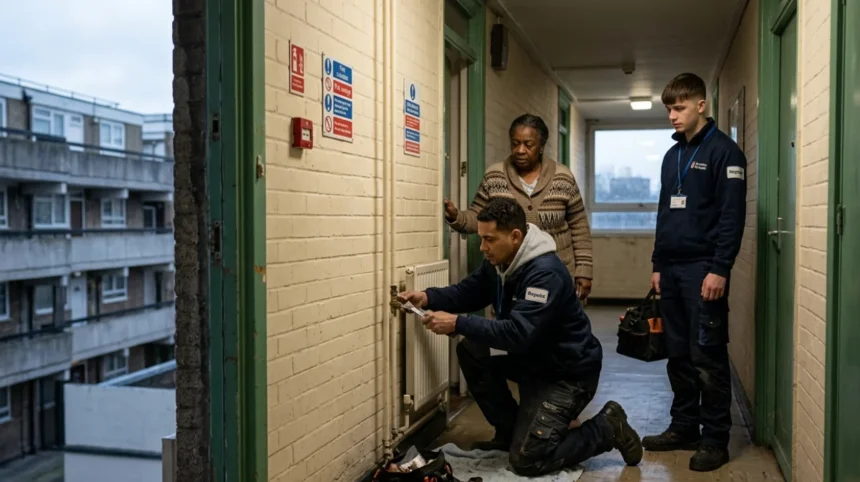
Council housing repairs in North London vary by urgency and borough policy. Emergency fixes occur within 24 hours, urgent within 7 days, routine within 28 days, and planned up to 80 days.
- What is council housing?
- What are the main types of council housing repairs?
- How do North London councils classify repair urgency?
- What counts as an emergency repair in council housing?
- How long do urgent repairs take in North London?
- What is the timescale for routine council repairs?
- How long do planned repairs last?
- How do repair times differ across North London boroughs?
- What factors delay council housing repairs?
- What is the impact of Awaab’s Law on repair times?
- How do tenants report repairs and track progress?
- What rights do tenants have if repairs exceed timescales?
- What statistics show the council’s repair performance in North London?
- How has the history of council repairs evolved?
- What future changes affect council repair timelines?
What is council housing?
Council housing consists of properties owned and managed by local authorities in the UK to provide affordable rental homes for eligible residents. North London boroughs like Haringey, Camden, Barnet, Islington, and Enfield maintain over 50,000 such units collectively. Tenants report repairs through council portals or phone lines for issues from leaks to structural damage.
Council housing originated post-World War II under the Housing Act 1949 to address slum clearances. North London councils expanded stock in the 1950s-1970s, building estates in areas like Tottenham and Highgate. Today, these properties include flats, houses, and high-rises managed under secure tenancies defined by the Housing Act 1985.
Repairs fall under landlord duties per Section 11 of the Landlord and Tenant Act 1985, covering structure, installations for water, gas, electricity, sanitation, and heating. Councils classify repairs into categories with set timescales published online.
Failure to repair breaches tenancy agreements and triggers legal remedies like the Decent Homes Standard, mandating all social housing meets fitness criteria by 2030.
What are the main types of council housing repairs?
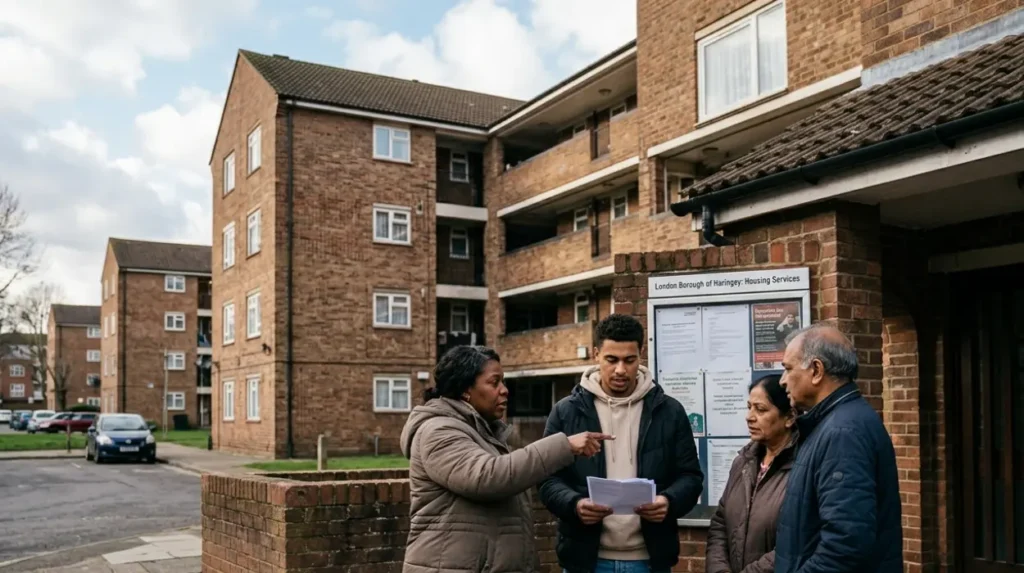
North London councils categorize repairs into five types: out-of-hours, emergency, urgent, routine, and planned. Out-of-hours respond in 4 hours, emergencies in 24 hours, urgent in 7 days, routine in 28 days, and planned in 80 days. Examples include burst pipes for emergencies and gutter fixes for routine.
Macro context stems from national guidelines under the GOV.UK framework, adapted locally. Haringey Council details these in their Repairs Timescales policy updated March 2025.
Out-of-hours repairs cover urgent issues after 4pm, such as burst pipes or lift breakdowns in single-lift buildings. Emergency repairs address risks to health or property, including total heating loss or leaking waste pipes. Urgent repairs prevent further damage, like minor leaks or blocked gutters. Routine repairs handle non-urgent fixes, such as loose handrails or partial electrical faults. Planned repairs involve major works like kitchen replacements requiring pre-inspection.
Examples: In Haringey, emergency includes no communal lighting; urgent covers extractor fan failure from March 2025. Camden prioritizes severe damp as emergency within 24 hours.
Implications include first-time fix targets of 85% in Islington for 2024/2025, reducing repeat visits.
How do North London councils classify repair urgency?
Councils use risk-based classification: emergency risk immediate harm (24 hours), urgent risk escalation (7 days), routine low risk (28 days). Haringey defines out-of-hours for after-hours emergencies (4 hours); Camden adds high-risk damp (24 hours). Policies align with Awaab’s Law, effective 2023.
Classification follows national standards from the Department for Levelling Up, Housing and Communities. Local variations reflect tenant feedback; Haringey co-produced theirs with residents.
Process: Tenants report via app, phone, or portal; assessors triage based on description. Photos aid prioritisation in Camden.
Details: Haringey emergencies include dangerous structures; urgent breaches in security. Barnet aims for a 4-hour emergency attendance.
Implications: Non-compliance risks, Ombudsman complaints; 94% emergency completion in Islington 2024/2025.
What counts as an emergency repair in council housing?
Emergency repairs receive response within 24 hours, including burst pipes, total heating loss, unusable sole toilet, or hazardous glazing. Haringey attends within 2-24 hours; Barnet makes safe in 4 hours. Damp and mould qualify under Awaab’s Law.
Emergencies pose immediate danger per the Housing Health and Safety Rating System. Awaab’s Law, from the Social Housing (Regulation) Act 2023, mandates action on damp/mould.
Subtopics: Structural risks like back-surging drains; service failures like no electricity. North London examples: Camden high-risk leaks in 24 hours.
Process: Operatives make safe first, complete later if complex. Out-of-hours extends to flooding.
Implications: Delays breach law; councils report 94-99% targets met.
How long do urgent repairs take in North London?
Urgent repairs will be completed within 7 calendar days in Haringey from March 2025, covering minor leaks or heating loss from May to September. Camden non-emergency in 35 days; Islington urgent in 24 hours. Examples: blocked drains, security breaches.
Urgent category prevents damage escalation, introduced in the Haringey overhaul.
Details: Haringey examples include defective cisterns and gutter blocks. Lambeth attends in 3 working days.
Macro flow: From report to appointment within priority window.
Implications: Faster than routine, reduces emergency escalations; performance tracked quarterly.
What is the timescale for routine council repairs?
Routine repairs are scheduled within 28 calendar days in Haringey, 20-35 days in Islington and Camden. Covers partial electrical faults, loose handrails, and minor tiling. MTVH aims for 28 days across North London.
Routine handles single-visit jobs post-triage. National benchmark sets 28 days max.
Examples: Non-flushing toilets (if not sole), extractor fans, door locks. Haringey books appointments to suit tenants.
Process: Coordinator sets date; first-time fix targeted at 85%.
Implications: Backlogs occur in high-demand; Enfield paused non-emergency services temporarily.
How long do planned repairs last?
Planned repairs are complete within 80 calendar days in Haringey, 90 days in Lambeth. Involves pre-inspection for kitchens, windows, and plastering. Updates every 20 days in Islington policies.
Planned suits multi-day or component-sourced jobs. Defined as non-urgent major works.
Examples: Bath replacements, external doors, fencing in North London estates.
Macro: Councils program into cycles for efficiency.
Implications: Tenants get weeks’ notice; disruption compensation if major.
How do repair times differ across North London boroughs?
Haringey: 24h emergency, 7d urgent, 28d routine; Camden: 24h emergency/damp, 35d others; Islington: 2h E02, 24h U24, 20d routine; Barnet: 4h emergency safe; Enfield prioritises emergencies.
Differences arise from local policies under national law. Haringey updated 2025 for urgents.
| Borough | Emergency | Urgent | Routine | Planned |
|---|---|---|---|---|
| Haringey | 2-24 hours | 7 days | 28 days | 80 days |
| Camden | 24 hours | – | 35 days | – |
| Islington | 2 hours | 24 hours | 20 days | – |
| Barnet | 4 hours safe | – | – | – |
| Lambeth | 24 hours | 3 days | 28 days | 90 days |
Implications: Tenants check borough sites; variations affect expectations.
What factors delay council housing repairs?
Delays stem from high demand, parts shortages, access issues, weather, or complexity. Enfield paused routine in 2024 due to costs; Islington hit 74% standard target 2024/2025 vs 90% goal.
Factors include backlog peaks post-pandemic and contractor capacity. Regulations like gas safety add time.
High-demand North London sees 10,500+ homes in Enfield alone.
Examples: Manufacturing delays for windows; surveying for damp.
Implications: Councils provide updates; legal action is possible after the timescales.
What is the impact of Awaab’s Law on repair times?
Awaab’s Law requires damp/mould response in set times: Camden 24h high-risk, Islington DAM24 washdown in 24h, DAM20 survey in 20 days. Enforces emergency treatment nationwide since 2023.
Law named after Awaab Ishak, who died in 2020 from mould. The Social Housing Act 2023 mandates enforcement.
Process: Diagnostic survey, interim fixes, full remediation.
Implications: Fines up to £30,000; improved Camden policy 2026.
How do tenants report repairs and track progress?
Tenants report online, phone, app, or WhatsApp; Camden uses photos for priority. Track via portal; Haringey books appointments. Islington targets 93% call answering.
Reporting channels operate 7 days in Camden. GOV.UK advises checking policies.
Details: MTVH 0203 535 3535 weekdays; Haringey portal for status.
Implications: First contact details issue; repeat logs escalate.
What rights do tenants have if repairs exceed timescales?
Tenants claim compensation via the Right to Repair scheme for qualifying emergencies. Ombudsman handles complaints post-timescale; rent reduction for disruption. Section 11 enforces basics.
Rights under the Housing Act 1985, 1996. Councils must warn weeks ahead of major works.
Process: Written complaint, then Housing Ombudsman.
Examples: Compensation for uninhabitable delays.
Implications: Successful claims average £500-£2000 for disrepair cases.
What statistics show the council’s repair performance in North London?
Islington 2024/2025: 94% emergencies, 94% urgents, 74% standards met. Haringey targets 99% emergencies. National social housing first-fix 80% average.
Data from council dashboards. The Islington table shows call answering 93.1%.
Examples: Camden’s new policy cuts times; Enfield’s emergency focus.
Implications: Transparency via annual reports; improvements ongoing.
How has the history of council repairs evolved?
Post-1949 Housing Act built stock; 1985 Act defined duties; 2000 Decent Homes set standards; 2023 Awaab’s Law sped damp fixes. North London modernized 2010s.
Evolution addressed crises: 1970s stock market crash, 2020s mould scandals.
Details: Right to Buy 1980 reduced ownership; repairs were centralised.
Implications: Future net-zero by 2050 adds upgrades.
What future changes affect council repair timelines?
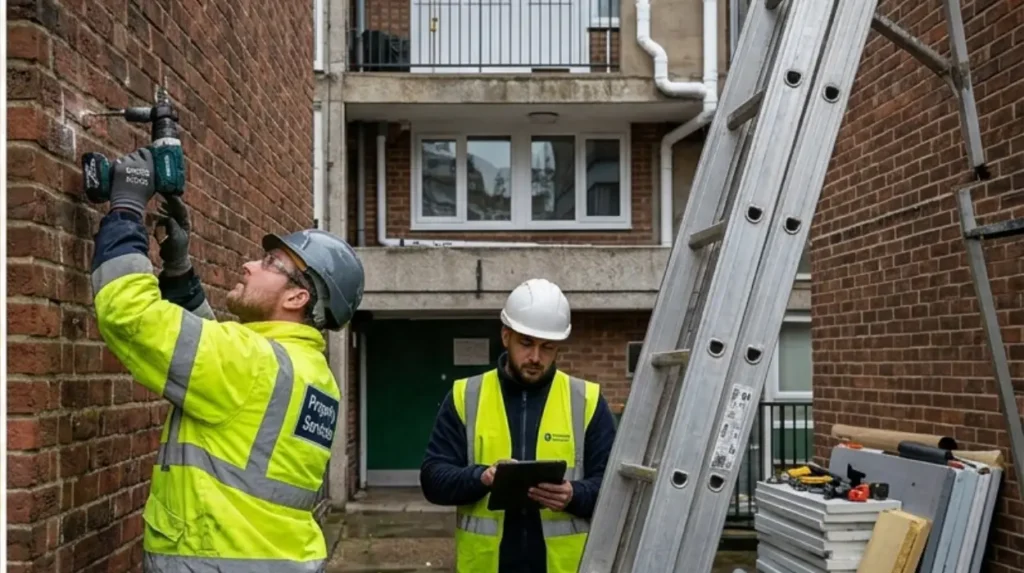
Digital portals expand; net-zero retrofits plan 90-day cycles; Awaab’s enforcement tightens. Haringey urgent category rolls out 2025; performance targets rise to 95%.
Changes from the Regulator of Social Housing. Budgets rise post-2024.
Examples: AI triage pilots; contractor hubs.
Implications: Faster routine via batching; tenant apps standard.
How long do council housing repairs take in North London?
Council housing repairs in North London usually depend on how serious the problem is. Emergency repairs are typically completed within 24 hours, urgent repairs within 7 days, routine repairs within 28 days, and planned major works within 80–90 days depending on the borough. Haringey, Camden, Islington, Barnet, and Lambeth all use slightly different repair targets.