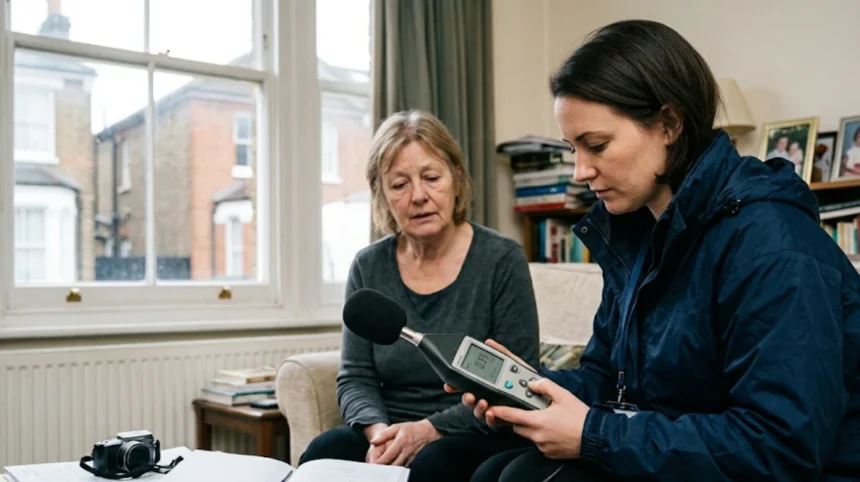
Local councils in North London handle persistent neighbour noise by investigating complaints under the Environmental Protection Act 1990, serving abatement notices that require noise to stop, and enforcing fines up to £5,000 for individuals or £20,000 for businesses when notices are ignored. Councils first require residents to log evidence through incident diaries, then deploy environmental health officers to measure noise levels inside the complainant’s property before taking formal enforcement action.
- What is statutory noise nuisance and when does neighbour noise become a legal problem?
- How do I report persistent neighbour noise to my North London council and what evidence do I need?
- What steps do councils take after receiving a noise complaint and how long does investigation take?
- What is an abatement notice and what happens if the noisy neighbour ignores it?
- How do councils use the Noise Act 1996 for night-time noise and what powers do officers have?
- What mediation services do councils offer and when should residents try mediation before formal complaints?
- What can councils do if the noisy neighbour is a tenant and how do they involve landlords?
- What legal action can residents take themselves through Magistrates Court under Section 82 if councils don’t act?
- How many noise complaints are recorded across England and Wales and does London dominate the statistics?
- What are the maximum fines for noise nuisance and how do penalties differ between domestic and commercial premises?
- What future changes might affect how councils handle neighbour noise and will new technology improve enforcement?
What is statutory noise nuisance and when does neighbour noise become a legal problem?
Statutory noise nuisance is legally defined as “excessive noise from a property that causes unreasonable interference with a person’s use or enjoyment of their home” under Section 79 of the Environmental Protection Act 1990, and it becomes a legal problem when the noise is persistent, unreasonable, and significantly impacts residential quality of life.
Statutory nuisance encompasses more than just loud music or parties. The Environmental Protection Act 1990 Section 79 explicitly lists “noise emissions from premises” as a statutory nuisance category that local authorities must investigate. This legal definition covers continuous noise from domestic activities, persistent dog barking, recurring loud television noise, regular early-morning construction work by neighbours, and repeated noisy parties that disrupt sleep.
The key distinction between ordinary neighbour noise and statutory nuisance lies in three factors: persistence, unreasonableness, and impact. Persistent noise occurs repeatedly over time rather than as a single isolated incident. Unreasonable noise exceeds what neighbours typically accept in shared residential environments. Significant impact means the noise substantially interferes with normal home activities like sleeping, working, or relaxing.
North London boroughs including Camden, Islington, Barnet, and Westminster handle thousands of noise complaints annually. Islington received 855 vehicle-related noise reports between 2022-2024, averaging 13 complaints per 10,000 residents—eleven times the UK average. Camden and Westminster also rank among London’s loudest boroughs with 7 and 7.5 complaints per 10,000 residents respectively.

How do I report persistent neighbour noise to my North London council and what evidence do I need?
To report persistent neighbour noise to your North London council, you must submit an online complaint through your borough’s official website providing the noise type, location, dates, current status, description, and contact details, while first maintaining a detailed incident diary logging at least 6 incidents on different days with times, dates, locations, and disturbance descriptions.
The reporting process follows specific steps across North London councils. First, residents attempt informal resolution by talking to the noisy neighbour directly. If this fails, councils require documented evidence before investigation begins. Camden Council requires residents to sign in or register for a Camden Account to report noise nuisances online, keeping all details confidential. Kensington and Chelsea accepts complaints via online forms with 30-minute callback promises and 1-hour officer visit targets.
Evidence collection is critical for council action. Residents must maintain incident diaries recording: the date, time, and location of each incident; detailed descriptions of what happened; how the noise affected them; and visual information about the noise source. Waltham Forest specifically requires logging six incidents on different days before raising a formal noise case. Hillingdon provides printable nuisance diary sheets capturing all required details.
The information needed for complaints includes: type of noise or nuisance; exact location; date problem first noticed; confirmation if noise is happening now; problem description; optional evidence; and contact details. For ongoing complaints, residents should have their 6-digit case reference number available.
Councils respond within specific timeframes. Camden acknowledges complaints within 5 working days and responds fully within 10 working days. Kensington and Chelsea aims to call within 30 minutes and visit within 1 hour, though summer demand may delay this. Waltham Forest operates Monday to Friday 8am-6pm and Saturday 8am-1pm, excluding Sundays and bank holidays.
What steps do councils take after receiving a noise complaint and how long does investigation take?
After receiving a noise complaint, councils contact complainants within 2 working days to confirm the noise is still happening, arrange property visits for environmental health officers to measure noise levels inside the home, assess impact severity, and determine if the noise constitutes statutory nuisance requiring formal action.
The investigation process follows a structured sequence. Once councils receive complaints, they may call complainants to verify the noise continues. If confirmed, councils contact residents to arrange in-person property visits. Officers visit to witness problems firsthand, assess impact inside properties, and measure actual noise levels. This on-site assessment is essential because councils cannot act on complaints alone—they must verify noise levels meet statutory nuisance thresholds.
Camden Council’s noise team operates specific hours: Monday to Thursday 8pm-2am, Friday 9pm-3am, Saturday 1pm-7pm and 9pm-3am, Sunday 10am-4pm and 8pm-2am, plus public holidays 10am-4pm and 8pm-2am. For online reporting issues, residents call 0207 974 4444 for call handlers to log details.
Investigation timelines vary by council capacity. Kensington and Chelsea promises officer visits within 60 minutes of initial calls, subject to summer service demand. After visits and assessments, officers advise what action will be taken based on witnessed evidence. The action taken depends entirely on what officers observe during investigations.
Council complaint procedures have maximum timelines. The Local Government and Social Care Ombudsman states complaints should complete all stages within 16 weeks maximum. Councils typically have no more than two complaint stages before residents can escalate to the ombudsman. Residents must complain to the ombudsman within 12 months of realizing council error.
Data shows enforcement action has dropped significantly since COVID peaks. England and Wales recorded 306,956 noise complaints between October 2024 and September 2025—around 840 per day—with London dominating statistics. Despite high complaint volumes, actual enforcement measures like fines and abatement notices have decreased markedly.
What is an abatement notice and what happens if the noisy neighbour ignores it?
An abatement notice is a formal legal document served by councils on persons making noise or nuisance that requires the activity to stop, demands steps to reduce noise through insulation or volume control, or restricts when nuisance activities can occur, and ignoring it results in fines up to £5,000 for individuals or £20,000 for businesses as it constitutes a criminal offence.
The abatement notice process follows strict legal requirements. Councils serve notices on noise makers after confirming statutory nuisance exists. Notices specify required actions: stopping the nuisance entirely, reducing noise through practical measures like insulation, or restricting activity times. The person named receives 21 days to challenge the notice in magistrates’ court.
Consequences for non-compliance are severe. Failure to comply with abatement notices constitutes a criminal offence. Individuals face fixed penalty notices up to £110 payable within 14 days to avoid prosecution. Without payment or if councils pursue legal action, prosecution results in fines up to £1,000 for individuals who don’t pay FPNs. Magistrates’ Court convictions carry maximum fines of £5,000 for individuals.
Businesses face substantially higher penalties. Companies convicted of contravening abatement notices face fines up to £20,000. This 20-fold difference reflects the greater impact commercial noise can have on residential areas.
Alternative enforcement includes fixed penalty notices as prosecution alternatives. Councils serve FPNs giving 14 days to pay penalties for both domestic and licensed premises. Paid FPNs prevent further action, but unpaid penalties after 28 days trigger prosecution through procurator fiscals offices in Scotland.
The challenge process protects notice recipients’ rights. Recipients have 21 days from notice date to appeal in magistrates’ court. Solicitor assistance is advisable during appeals. Only after the challenge period expires or appeals fail can councils enforce fines for continuing nuisance.
How do councils use the Noise Act 1996 for night-time noise and what powers do officers have?
Councils use the Noise Act 1996 to take swift action against excessive continuous night noise between 11pm and 7am by issuing on-the-spot warning notices, serving fixed penalty notices of £500, seizing noisy equipment like amplified music, and prosecuting in Magistrates Court where fines up to £5,000 apply for individuals.
The Noise Act 1996 applies specifically to night-time noise complaints. For investigation, complaints must occur between 11pm and 7am and relate to excessive noise from properties during that period. The power to investigate night noise is now available to all councils regardless of whether they adopted the Noise Act 1996 provisions.
Officers have multiple enforcement tools under the Act. They issue on-the-spot warning notices when suspecting licensed premises exceed permitted noise levels. If noise continues after warnings, councils exercise discretion to prosecute in Magistrates Court with £5,000 fines or serve £500 fixed penalty notices. Officers can confiscate equipment causing noise including amplified music devices.
The 2015 Deregulation Act amended the Noise Act 1996 to give councils discretion rather than mandatory response requirements. Local authorities now target particular noise sources, complaint types, seasons, or week nights between 11pm-7am as appropriate to local circumstances. This allows strategic resource allocation rather than responding to every night noise complaint.
Penalties differ for domestic versus commercial premises. Individuals face fines up to £5,000 where offences occur in or near residential areas. Businesses face up to £20,000 fines for similar offences. Equipment seizure powers extend to local authority officers applying for warrants to seize noise-causing equipment.
What mediation services do councils offer and when should residents try mediation before formal complaints?
Councils offer free neighbourhood mediation services where independent third parties listen to both resident and noise producer views to help reach agreements, and residents should always try talking to neighbours or using mediation before contacting councils because formal complaints require evidence that mediation often resolves without enforcement.
Mediation involves independent third parties facilitating dispute resolution. Mediators listen to complaints from both noise recipients and producers, helping both sides reach mutually acceptable agreements. This approach addresses underlying neighbour conflicts rather than just punishing noise behaviour.
Many North London councils fund mediation services for residents. Councils, housing associations, and community law centres provide free neighbourhood mediation access. Community Mediation Services resolve disputes between neighbours including anti-social behaviour issues, generally free for self-referrals or agency referrals through local authorities, community housing providers, or police. Mediation Bucks serves neighbouring areas with similar free community dispute resolution.
The recommended dispute resolution sequence starts with direct neighbour communication. Greater London Authority explicitly states talking to noisy neighbours is best first approach. If direct conversation fails, residents should consider mediation before formal complaints. GOV.UK guidance states residents should always try solving problems through talking or mediation before contacting councils.
Mediation benefits include avoiding formal enforcement processes, maintaining neighbour relationships, and creating sustainable long-term solutions. Unlike abatement notices that create adversarial dynamics, mediation builds cooperative agreements. Free council-funded services remove financial barriers preventing resolution.
Writing to neighbours after talking provides formal documentation. Oxford City Council recommends writing to neighbours explaining problems and asking them to stop noise nuisance, referencing conversations and outcomes. Keeping letter copies with sent dates creates evidence records if formal complaints become necessary.
Mediation works best for ongoing neighbour relationships where both parties want resolution. It’s less effective for cases involving deliberate antisocial behaviour or where neighbours refuse to participate. Councils typically suggest mediation when initial complaints show potential for cooperative resolution.
Explore More Help & Resources
What counts as anti-social behaviour in residential areas?
How to report noisy neighbours anonymously in UK?
What can councils do if the noisy neighbour is a tenant and how do they involve landlords?
When noisy neighbours are tenants, councils contact their landlords—private landlords require residents to find landlord contact details first, while council or housing association properties involve tenancy officers directly—because most tenancies prohibit disturbances giving landlords power to act, and councils can issue Community Protection Notices against landlords for tenant behaviour under the Deregulation Act 2015.
The tenant noise process differs based on landlord type. For private tenants, residents must first identify landlord contact details since these aren’t publicly available. Once identified, residents discuss problems with landlords who can enforce tenancy terms. For council or housing association properties, residents contact housing or tenancy officers directly without middlemen.
Most tenancies include disturbance prohibitions. Waltham Forest states most tenancies require residents not cause neighbour disturbances, giving landlords enforcement power. These clauses create legal grounds for landlords to address tenant noise through warnings, rent deductions, or tenancy termination.
The Deregulation Act 2015 expanded landlord accountability through Community Protection Notices (CPNs). CPNs stop persons aged 16+, businesses, or organisations from persistent antisocial behaviour unreasonable and detrimental to community quality of life. The Act treats conduct on or affecting premises a person owns, leases, occupies, controls, operates, or maintains as that person’s conduct.
This provision allows councils and police to issue CPNs against landlords for tenant or visitor behaviour at their properties. CPNs can require stopping noise activities or taking actions like clearing garden waste. Landlords failing CPN compliance commit criminal offences with £5,000 maximum fines upon conviction.
Anti-social behaviour definitions under the Housing Act 2004 include noise such as shouting, loud music, and noisy parties causing nuisance, annoyance, or distress to communities. This legal definition covers typical neighbour noise complaints and gives landlords clear grounds for tenant action.
Landlord involvement often resolves tenant noise faster than council enforcement. Landlords control tenancy continuation and can apply immediate pressure through rent consequences or termination threats. Councils typically contact landlords after initial tenant complaints fail, using landlord authority as intermediate enforcement before abatement notices.
What legal action can residents take themselves through Magistrates Court under Section 82 if councils don’t act?
Residents can take themselves to Magistrates Court under Section 82 of the Environmental Protection Act 1990 by giving at least 3 days written notice to noise makers of proceedings intention, visiting court reception to seek Section 82 orders, producing evidence showing complaint grounds, and bringing copies for court and defendants, where magistrates may issue summons and ultimately orders stopping noise if satisfied grounds exist.
Section 82 provides independent legal action rights when council enforcement fails or is insufficient. The process begins with mandatory 3-day written notice to noise makers before proceedings. This notice explains proceedings intention and gives最後 opportunity for voluntary resolution.
Court procedures require specific steps. Residents visit Magistrates Court offices explaining Section 82 order requests under Environmental Protection Act 1990. Reception staff explain processes and residents submit written evidence documenting complaint grounds. Evidence must demonstrate statutory nuisance exists through incident diaries, noise measurements, and impact documentation.
Documentation requirements include full written evidence records with copies for court and defendants (at least 3 copies). Wigglaw confirms Section 82 allows persons including companies to take statutory nuisance proceedings in their own right. This independent action right exists regardless of council involvement.
Magistrate decisions determine outcomes. If magistrates satisfied complaint grounds exist, they may issue summons serving defendants. Defendants attend hearings where magistrates determine order issuance是否 stopping noise. Orders issued under Section 82 legally require noise cessation with non-compliance consequences.
Section 82 complements but doesn’t replace council powers. Residents typically pursue Section 82 after council complaints fail, when councils decline action, or when residents want faster resolution than council processes provide. Independent action avoids council resource constraints and bureaucratic delays.
Evidence standards mirror council requirements. Residents must prove noise is persistent, unreasonable, and significantly impacts residential enjoyment. Incident diaries with 6+ incidents on different days, detailed timestamps, and impact descriptions form core evidence. Witness testimony from other affected neighbours strengthens cases.
How many noise complaints are recorded across England and Wales and does London dominate the statistics?
England and Wales recorded 306,956 noise complaints between October 2024 and September 2025—approximately 840 complaints per day—with London dominating statistics as the highest-complaint region, while enforcement action has dropped significantly despite high complaint volumes.
The complaint volume represents substantial daily pressure on councils. Around 850 complaints per day across England and Wales means councils handle constant noise dispute influx. This translates to roughly 35 complaints per hour nationally during operating hours, creating significant resource demands.
London’s dominance reflects population density and urban living challenges. High-density housing means neighbours share walls, floors, and ceilings, increasing noise transmission. Islington’s 855 vehicle-related reports (2022-2024) averaging 13 per 10,000 residents exceed UK averages eleven-fold. Westminster and Camden follow with 7.5 and 7 complaints per 10,000 residents respectively.
Complaint trends show post-COVID declines. Numbers dropped from 2021 pandemic peaks when lockdowns increased neighbour friction. The 306,000+ complaints in 2024/25 represent sharp decreases from pandemic-era highs. Despite declines, daily volumes remain substantial at 840 complaints.
Enforcement action decreases contradict complaint volumes. CIEH data shows enforcement dropping significantly despite 306,956 complaints. This gap suggests councils face resource constraints, evidence collection difficulties, or policy changes reducing enforcement priorities. Fewer abatement notices and fines mean many complaints receive no formal action.
Only 49 local authorities maintain noise abatement zones with just 81 zones total, of which only 2 are actively managed. This limited zone coverage means most councils rely on complaint-driven enforcement rather than proactive area monitoring. The 2 active zones represent minimal proactive noise management nationally.
North London boroughs face disproportionate pressures. Islington’s 13 complaints per 10,000 residents versus UK averages indicates urban density challenges. Camden’s 7 per 10,000 and Westminster’s 7.5 per 10,000 confirm North London as England’s noise complaint hotspot region.
What are the maximum fines for noise nuisance and how do penalties differ between domestic and commercial premises?
Maximum fines for noise nuisance reach £5,000 for individuals and £20,000 for businesses convicted in Magistrates Court, with fixed penalty notices of £500 for licensed premises and £110 for domestic premises as prosecution alternatives, and businesses face 4 times higher penalties due to greater noise impact on residential areas.
Penalty structures create tiered enforcement options. Fixed penalty notices offer prosecution alternatives: £110 for domestic premises payable within 14 days. £500 FPNs apply to licensed premises like pubs and bars exceeding permitted levels. Paid FPNs prevent further action, creating cost-effective resolution for minor offences.
Court conviction fines escalate significantly. Magistrates Court convictions impose £5,000 maximum fines for individuals failing abatement notices. Businesses face £20,000 maximums for contravening abatement notices in residential areas. The 4:1 ratio reflects commercial premises’ greater potential noise impact.
Penalty progression follows non-compliance timelines. Unpaid £110 domestic FPNs trigger prosecution with up to £1,000 fines if councils pursue legal action. Unpaid £500 licensed premises FPNs after 28 days initiate procurator fiscals office prosecution in Scotland. These escalations create financial pressure for immediate compliance.
Business penalties extend beyond fines. Equipment seizure powers allow officers to confiscate noise-causing machinery or amplified music. Warrant applications enable seizing persistent noise equipment. Business reputation damage from public convictions creates additional consequences beyond monetary penalties.
Individual penalty avoidance includes abatement notice challenges. Recipients have 21 days appealing in magistrates’ courts before fines apply. Solicitor assistance during appeals improves success rates. Successful appeals void notices and prevent all penalties.
Fixed penalty notice flexibility benefits councils. Discretion to issue FPNs versus prosecution allows resource-efficient minor offence handling. Councils choose approaches based on offence severity, compliance history, and resource availability. This flexibility optimizes enforcement impact across complaint volumes.
Penalty enforcement requires council resources. Prosecutions need evidence preparation, court time, and legal representation. FPN administration requires monitoring payments and pursuing defaults. Resource constraints explain enforcement drops despite 306,956 complaints. Higher penalties don’t guarantee higher enforcement without adequate staffing.

What future changes might affect how councils handle neighbour noise and will new technology improve enforcement?
Future changes affecting council noise handling include continued discretion under amended Noise Act 1996 allowing targeted enforcement on specific sources or seasons, potential expansion of actively managed noise abatement zones from current 2 zones, and technology improvements through noise monitoring apps and automated detection systems that could reduce evidence collection burdens while enforcement remains constrained by resource limitations.
The 2015 Deregulation Act amendments created council enforcement discretion. Authorities now target particular noise sources, complaint types, seasons, or week nights between 11pm-7am as locally appropriate. This flexibility allows strategic resource allocation but may reduce consistent enforcement across complaint types. Future policy changes could expand or restrict discretionary powers.
Noise abatement zone expansion remains unlikely given current constraints. Only 49 authorities maintain 81 zones with just 2 actively managed. Zone establishment requires noise measurement, register creation, and ongoing monitoring—resource-intensive processes. Expansion would require significant council funding increases or central government support.
Technology improvements could transform evidence collection. Noise monitoring apps enabling real-time recording might reduce diary sheet burdens. Automated detection systems identifying excessive noise levels could trigger automatic officer responses. However, technology adoption requires council investment and staff training, constrained by current budget limitations.
Digital complaint systems already exist across North London councils. Camden’s online reporting with Camden Account registration. Kensington and Chelsea’s 30-minute callback and 1-hour visit systems. Further digital improvements might include automated status updates, real-time officer tracking, and integrated evidence submission reducing administrative delays.
Enforcement resource constraints will persist without funding increases. The 840 daily complaints versus declining enforcement action indicates system strain. Councils face choices between expanding staff, reducing enforcement thresholds, or accepting complaint backlog growth. Central government noise pollution funding has not increased proportionally with complaint volumes.
Community mediation expansion offers alternative resolution pathways. Free council-funded services reduce formal enforcement needs. Future mediation growth could handle more disputes cooperatively rather than adversarially. Mediation success rates would determine whether councils invest more in facilitation versus enforcement.
Tenant landlord accountability under the Deregulation Act 2015 may strengthen. CPN issuance against landlords for tenant behaviour creates leverage points councils could expand. Future guidance clarifications might increase landlord enforcement frequency, reducing council direct action needs.
North London’s noise complaint dominance suggests continued regional pressure. Islington’s 11-times-average complaint rates indicate urban density challenges persisting regardless of policy changes. Population growth in Camden, Islington, and Westminster will likely maintain high complaint volumes requiring sustained council resources.