Key Points
- Metropolitan Police made 14 arrests after rival protesters clashed outside Edgware United Synagogue in north London on Sunday
- Arrests included five for violent disorder (including two for assault on emergency workers), one common assault, six for Section 4a Public Order Act offences (four racially/religiously aggravated), and one for Section 18 Public Order Act offences
- Protesters gathered after the Palestine Solidarity Campaign claimed a real estate event at the synagogue was advertising land sale in an “illegal Israeli settlement in the occupied West Bank”
- The Board of Deputies of British Jews stated organisers had “publicly refuted claims” that the event marketed real estate over the Green Line
- Footage showed angry confrontations between protesters waving Palestine flags and counter-protesters waving Israel flags, with police detaining demonstrators
- Adrian Cohen, acting president of the Board of Deputies, called for protests to be kept at “significant distance from places of worship” to prevent intimidation
- New measures under the Crime and Policing Act will give police new powers to impose conditions on protests near places of worship from the end of the month
- Metropolitan Police Commander Adam Slonecki acknowledged Jewish communities experiencing “heightened fear and concern” following two-and-a-half years of sustained protest and recent arsons/attacks
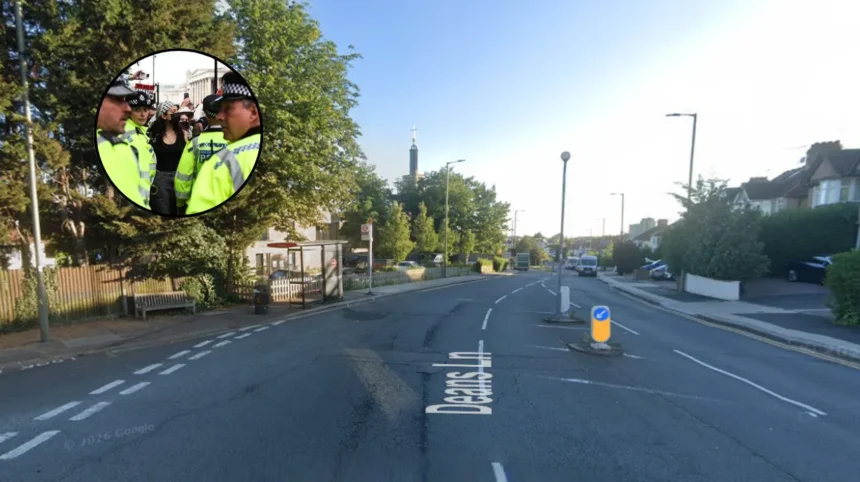
Edgware (North London News) June 15, 2026 – Rival protesters clashed outside Edgware United Synagogue in north London on Sunday, prompting Metropolitan Police to make 14 arrests during the demonstration, according to official police statements.
- Key Points
- What Exactly Happened During the Protest Outside Edgware United Synagogue?
- Why Did the Board of Deputies of British Jews Condemn the Demonstration?
- What Specific Offences Led to the 14 Arrests?
- How Will New Crime and Policing Act Measures Change Protest Restrictions Near Synagogues?
- What Did Metropolitan Police Commanders Say About Their Policing Strategy?
- Background on Recent Attacks Against Jewish Communities in London
- Prediction: Impact on Jewish Community Members and Protest Organisers
What Exactly Happened During the Protest Outside Edgware United Synagogue?
Footage shared on social media showed angry confrontations between rival groups, with protesters waving Palestine flags clashing against counter-protesters waving Israel flags, according to video evidence circulating online.
Police officers were seen detaining some demonstrators during the confrontations near the synagogue, which is located in an area with a large Jewish community.
Protesters gathered after the Palestine Solidarity Campaign and other groups claimed a real estate event at the synagogue was
“openly advertising the sale of land”
in an “illegal Israeli settlement in the occupied West Bank,” as reported by the Palestine Solidarity Campaign in their initial statement. However, the Board of Deputies of British Jews said the event’s organisers had
“publicly refuted claims that the event is marketing real estate over the Green Line”
– which refers to 1949 armistice demarcation lines established after the 1948 Arab-Israeli War separating Israel from the West Bank.
Why Did the Board of Deputies of British Jews Condemn the Demonstration?
The Board of Deputies of British Jews said it was “deeply disturbed” at the “wholly unjustified” demonstration, adding that MPs had
“inflamed tensions through partial and misleading commentary,”
according to the Board’s official statement released following the incident. In a statement, acting president of the Board of Deputies of British Jews Adrian Cohen said:
“The event organisers have publicly refuted claims that the event is marketing real estate over the Green Line.”
Cohen continued:
“It is very disappointing that MPs and other public figures have not acknowledged this and instead inflamed tensions through partial and misleading commentary. Protesting at a synagogue based on false pretences seems to be little more than an excuse to harass and intimidate members of the Jewish community,”
as reported by Adrian Cohen of the Board of Deputies of British Jews.
Protesters near the synagogue held a large sign saying “stop Israel’s illegal sale of stolen Palestinian land” at the demonstration, according to witness accounts and social media footage.
What Specific Offences Led to the 14 Arrests?
The Metropolitan Police said five arrests were for violent disorder including one person also arrested for assault on an emergency worker, one common assault arrest, and one other arrest for assault on an emergency worker, according to the official police breakdown of arrests.
There were six arrests for Section 4a Public Order Act offences, with four of those for racial or religiously aggravated matters, and one arrest for Section 18 Public Order Act offences, as detailed in the Metropolitan Police statement.
The force said those arrested had been taken into custody, confirming all 14 individuals were detained following the clashes.
How Will New Crime and Policing Act Measures Change Protest Restrictions Near Synagogues?
New measures under the Crime and Policing Act, called for by the Board and community partners, will from the end of the month give police new powers to impose conditions on protests near places of worship, according to Adrian Cohen’s statement.
“We are calling on the police to ensure such protests are kept a significant distance from places of worship to prevent intimidation to members of the Jewish community,”
Cohen added.
What Did Metropolitan Police Commanders Say About Their Policing Strategy?
Metropolitan Police Commander Adam Slonecki said: “We have liaised with the venue and the Community Security Trust and have deployed officers to prevent serious disruption and to deal with any offences, using the full range of powers available to us including imposing conditions under the Public Order Act,” as reported by Commander Adam Slonecki of the Metropolitan Police.
Slonecki continued:
“We are mindful that Jewish communities are experiencing heightened fear and concern following two-and-a-half years of sustained protest and, in recent months, a series of arsons and other attacks. There is a distinction between protesting in central London and protesting in the heart of communities where the potential to cause serious disruption and intimidation is greater and our policing plan reflects that,”
according to the Commander’s official statement.
Background on Recent Attacks Against Jewish Communities in London
The context surrounding this protest involves a broader pattern of rising antisemitism in the United Kingdom. As reported by The Guardian in April 2026, antisemitism has been rising in years since the 7 October attacks, including recent arson attacks at Jewish sites.
Recently, there has been a troubling rise in attempted arson incidents targeting Jewish institutions, with notable occurrences at two synagogues in London and a facility associated with the charitable organization Jewish Futures.
Additionally, on the early morning of March 23, 2026, four ambulances serving the Jewish community were set ablaze in north London, according to The Guardian’s investigation. On Thursday, the U.K.
government announced that the nation is confronting an antisemitism crisis, committing to enhance security measures for Jewish communities in light of a series of arson incidents and a double stabbing that have generated significant fear and outrage among Jewish citizens, as reported by NPR.
Since the onset of the Iran conflict on February 28, 2026, there have been multiple arson attacks targeting synagogues and other Jewish sites in London, as well as on adversaries of the Iranian government, according to NPR. Police have confirmed the arrest of 28 individuals in connection with these incidents, which fortunately did not result in injuries.
The chief rabbi of the U.K. expressed that British Jews are enduring
“a persistent campaign of violence and intimidation”
following an attempted arson at a London synagogue, marking yet another incident in a concerning series of attacks, as reported by AP News. The event, which resulted in minor damage to the Kenton United Synagogue on Saturday evening, is part of a troubling pattern of fires at Jewish-affiliated locations and an Iranian opposition media outlet, all of which are under investigation by counterterrorism authorities.
Senior policing leaders in the United Kingdom are signaling a more assertive response to antisemitic threats following a series of violent incidents targeting Jewish communities at home and abroad, according to HS Today.
The statement outlines immediate operational changes, including heightened patrols, expanded use of public order powers, and a firmer approach to protest-related language that police say now carries increased real-world risk.
Prediction: Impact on Jewish Community Members and Protest Organisers
This development will significantly affect the Jewish community in north London, particularly residents living near Edgware United Synagogue. As Commander Slonecki acknowledged, Jewish communities are experiencing
“heightened fear and concern following two-and-a-half years of sustained protest and, in recent months, a series of arsons and other attacks”.
The 14 arrests demonstrate police will actively intervene when protests escalate to violent disorder, which may provide some reassurance to community members worried about intimidation.
The new measures under the Crime and Policing Act, which will give police new powers to impose conditions on protests near places of worship from the end of the month, will fundamentally change how protests occur near synagogues.
Police forces will be allowed to consider the “cumulative impact” of repeated demonstrations in order to impose conditions on public processions and assemblies, according to government announcements.
This means protest organisers must now anticipate stricter route restrictions and potentially greater distances required from places of worship.
For the Palestine Solidarity Campaign and similar groups, this development signals that protesting at synagogues based on disputed pretences will face increased police scrutiny. Adrian Cohen’s statement that
“protesting at a synagogue based on false pretences seems to be little more than an excuse to harass and intimidate members of the Jewish community”
suggests future protests may face legal challenges if organisers cannot verify their claims.
The distinction Commander Slonecki made between
“protesting in central London and protesting in the heart of communities where the potential to cause serious disruption and intimidation is greater”
indicates police will treat community-based protests differently than central London demonstrations. This means north London residents may see more heavily deployed officers at synagogue protests compared to central London events, potentially affecting protest accessibility.
For counter-protesters supporting Israel, the arrests for racial or religiously aggravated offences (four of six Section 4a arrests) indicate that flag-waving confrontations can quickly escalate to criminal behaviour.
The five violent disorder arrests, including two for assault on emergency workers, show police will detain individuals who physically confront others or attack officers.
The broader context of 28 arrests connected to recent arson incidents at Jewish sites suggests this synagogue protest is part of an ongoing pattern of tension. British Jews feeling “under siege” and worrying about children wearing religious symbols in public indicates the community’s anxiety extends beyond protest events to daily life.
This development may increase that fear if community members perceive protests as harassment rather than legitimate political expression.
The £4.5 million operational plan for policing rival London protests, which includes stringent restrictions on routes and holding organizers personally accountable for speaker behavior, suggests similar measures may apply to synagogue protests.
Officers will have enhanced public order powers to stop and search individuals deemed potential troublemakers and disperse them from protest areas.