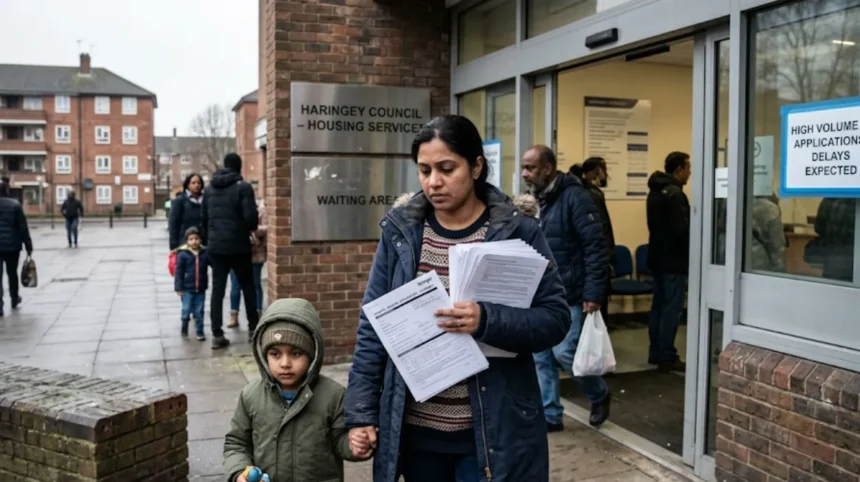
Council housing requests take so long because London faces a severe shortage of social homes combined with record-high demand, creating waiting lists that span decades. North London boroughs like Enfield, Barnet, and Haringey have waiting lists exceeding 100 years for three-bedroom family homes. The assessment process itself takes 6–12 weeks, but the real delay comes from having 323,000 households on London’s waiting list with only 1,148 social rented homes completed annually.
- What Is Council Housing and How Does the Application Process Work?
- Why Are There So Many People Waiting for Council Housing in North London?
- How Long Do Applicants Actually Wait for Council Housing in North London Boroughs?
- What Are the Priority Bands and How Do They Determine Waiting Order?
- Why Does the Initial Assessment Process Take Weeks Instead of Days?
- How Does the Severe Shortage of Council Homes Create Decades-Long Waiting Lists?
- What Impact Do Council Allocation Policies and Local Rules Have on Waiting Times?
- What Can Applicants Do to Speed Up Their Council Housing Application?
- What Are the Future Implications for Council Housing Waiting Times in North London?
What Is Council Housing and How Does the Application Process Work?
Council housing is social rented accommodation provided by local authorities at around 50% of market rates, offering greater security than private renting. The application process requires submitting an online form, providing eligibility documents within 10 days, and waiting 6–12 weeks for assessment before joining the waiting list.
Council housing, officially called “social rented housing,” is accommodation owned by local authorities (councils) or housing associations. Rents are set at approximately 50% of local market rates, making it the most affordable tenure option. The sector provides far greater security than private renting, with tenants holding secure tenancies rather than short-term agreements.
The Housing Act 1996 governs council housing allocation across England and Wales. Part VI of this legislation requires local housing authorities to maintain an allocation scheme that determines priorities. Section 167 mandates that schemes give “reasonable preference” to specific categories of people, including those who are homeless, occupying overcrowded or unsanitary housing, or needing moves on medical or welfare grounds.
The application process follows these steps:
- Submit main application through the council’s housing register online system
- Provide eligibility documentation within 10 days (pay slips, proof of residency, ID)
- Council assesses application within 6–12 weeks (some boroughs aim for 28 days)
- Receive decision by email confirming your application details and priority band
- Join waiting list in your assigned band (A, B, C, or D)
- Bid for properties through the council’s housing choice scheme
Some boroughs have different target timescales. Islington Council aims to decide within 28 days once all supporting information is complete. Hounslow Council contacts applicants within 60 working days after the main application. Tower Hamlets states the full assessment usually takes up to 6 months. Ashford Borough Council aims for seven weeks initially, but current high application volumes extend total processing to approximately 12 weeks.
Why Are There So Many People Waiting for Council Housing in North London?
North London has 22,966 households on waiting lists, with Haringey alone accounting for 12,826 households—the seventh highest waiting list in London. Demand has increased 33% since 2017, adding 81,000 households to London’s total, while social housing stock has declined every year for the past decade.
More than 323,000 households in London are on waiting lists for social housing, representing more than double the population of Cambridge. This total makes up a quarter of England’s entire population on housing waiting lists. The number has increased by over 33% since 2017, with 81,000 additional households added to the register—equal to the total number of households on waiting lists in the East Midlands.
North London’s sub-region comprises three boroughs: Haringey, Barnet, and Enfield. Despite having the lowest total number of households on housing registers among London sub-regions at 22,966, the pressure remains extreme. Haringey makes up the bulk of this figure with 12,826 households, giving it the seventh highest waiting list in London. Enfield has 5,991 households and Barnet has 4,149 households, both below the Outer London average of 7,655 households.
The demand surge reflects multiple factors:
- Stagnant wages combined with rising house prices and rents have made private housing inaccessible for many households
- Dwindling availability of social homes has reduced options for those unable to afford private renting
- Net loss of social homes every year in the past decade means London’s social housing stock continues shrinking despite stabilizing decline rates
- Homelessness at record levels requires 90,000 social rent homes annually for 10 years to end the housing crisis, but councils deliver only 2,200 per year on average
The Centre for London report reveals that in 2021, more than 257,094 people in London had housing needs best met by social housing. To meet this need, London would require 33,000 new homes for social rent annually for 15 years. Current delivery is a fraction of this level—between 2020/21 and 2022/23, only 1,148 completions per year were made for social rented properties.
How Long Do Applicants Actually Wait for Council Housing in North London Boroughs?
In North London, waiting times vary dramatically by bedroom size and borough. Enfield faces 105-year waiting lists for three-bedroom homes. Barnet and Haringey average 15–20+ years for Band D applicants. City-wide, one-bedroom properties wait 844 days (2 years 3 months) while four-bedroom homes wait 2,304 days (6 years 3 months).
Research reveals century-long waits for some family council homes in London. The National Housing Federation analysis found that in Westminster, Enfield, and Merton, families seeking three-bedroom or larger social rented homes could wait over 100 years at current housing availability rates. Specific borough waiting times include:
| Borough | Wait Time (Years) | Property Size |
|---|---|---|
| Westminster | 107 | 3+ bedrooms |
| Enfield | 105 | 3+ bedrooms |
| Merton | 102 | 3+ bedrooms |
| Wandsworth | 82 | 3+ bedrooms |
| Camden | 82 | 3+ bedrooms |
The overall average wait time across London is 27 years, while England’s average stands at seven years. For North London specifically, borough housing chiefs report waits of 12 to 15 years for family homes. Enfield’s average wait for a three-bedroom home is 15 years. New figures reveal London council house waiting times at crisis levels, with families facing 12 to 18-year waits as only 5% of applicants are rehoused each year.
Waiting times differ significantly by property size across London:
- One-bedroom properties: 844 days average (2 years 3 months)
- Two-bedroom properties: Data varies by borough
- Three-bedroom properties: Highly variable—North London households wait 139% longer than South London
- Four+ bedroom properties: 2,304 days average (6 years 3 months)
Inner London versus Outer London disparities are stark. For one-bedroom properties, Inner London averages 1,175 days (3 years 2 months) while Outer London drops to 557 days (1 year 6 months). This disparity exists across all property sizes, reflecting sharper housing need in Inner London boroughs.
Priority bands dramatically affect waiting times. Band D applicants in London may wait 15–20+ years. In Swale, Band A applicants average 1 year for one-bedroom homes while Band B averages 1 year and Band C averages 18 months. For four-bedroom properties, Band A waits 18 months while Band B waits 4.5 years. St Albans data shows Band A waiting 9 months for one-bedroom homes versus Band B waiting 7 months, but Band A waiting 1 year 4 months for three-bedroom homes versus Band B waiting 1 year 5 months.
What Are the Priority Bands and How Do They Determine Waiting Order?
Councils use banding systems (A, B, C, D) or points-based systems to rank applicants by need. Band A represents highest priority—typically statutorily homeless households—who wait months. Band D represents lowest priority—those with no immediate need—who wait 15–20+ years in London. Most councils give reasonable preference to homeless households, those in unsafe housing, or people with medical needs.
Local authorities prioritise households through two main approaches: points-based systems or banding schemes. Points-based approaches rank people by awarding allocation points based on different need categories and sometimes waiting list duration. Banding schemes group households into bands reflecting different types and levels of housing need or the local authority’s particular priorities.
The Housing Act 1996 requires all local authorities to give reasonable preference to specific categories:
- People who are homeless (within Part VII of the Act)
- People owed duties under section 193(2) or 195(2) of the Housing Act 1996 (main housing duties for homeless persons)
- People occupying overweighted, unsafe, or unsanitary housing
- People needing moves on medical or welfare grounds
- Households affected by domestic abuse (recent statutory guidance)
- UK Armed Forces personnel (recent statutory guidance)
Beyond these requirements, local authorities have considerable discretion to decide who receives allocation and what priority level they receive. This creates substantial variation between boroughs. Some councils allow lower-priority households to remain on registers despite unlikely allocation, while others focus deliberately on higher-priority households.
Typical banding structures include:
Band A (Highest Priority): Statutorily homeless households, those in emergency accommodation, people with severe medical needs requiring immediate relocation. These applicants typically wait 9–18 months for appropriate properties.
Band B (High Priority): Households owed prevention duties, those in overcrowded accommodation, people with moderate medical needs. Waiting times range from 7 months to 2 years depending on property size.
Band C (Medium Priority): Households with some housing needs but no emergency status. Average waits reach 18 months for one-bedroom properties.
Band D (Lowest Priority): Those with minimal housing needs, often including working households with stable but expensive private rental situations. In London, Band D applicants may wait 15–20+ years.
The variation in banding implementation creates complexity. Some local authorities separate wheelchair-adapted housing need as a priority band, while others categorise them by bedroom size. This makes analysis of demand challenging. Some councils do not prescribe specific bands for homeless households, instead incorporating them into composite bands taking into account multiple factors. This prevents determination of how long average homeless households wait for secure homes.
Why Does the Initial Assessment Process Take Weeks Instead of Days?
The assessment process requires document collection, verification, and eligibility determination. Councils need 6–12 weeks to verify pay slips, proof of residency, ID, and housing history. Applicants must provide documents within 10–28 days; failure to respond cancels applications. High application volumes and staff shortages extend processing times beyond target timescales.
The initial assessment involves multiple mandatory steps that cannot be completed instantly. After submitting the main application, councils assess it and contact applicants by email within 60 working days according to Hounslow’s process. Tower Hamlets states the full assessment usually takes up to 6 months, though this could be shorter if all required documents are provided at the start.
Document requirements include:
- Pay slips proving employment or training linked to job offers
- Proof of residency in the borough or local area
- ID documentation for all household members
- Housing history including previous addresses and landlord details
- Medical evidence if claiming medical/welfare priority
- Homelessness documentation if statutorily homeless
Applicants face strict deadlines. If required documents aren provided within 28 days of the local authority requesting them, the application gets cancelled. Richmond upon Thames requires eligibility documentation within ten days of submission. Ashford Borough allows two weeks for responses to enquiries and 7–12 weeks for full assessment.
Council workload creates delays. Ashford Borough currently experiences very high application volumes, extending total time from submission to “live” status to approximately 12 weeks despite a seven-week target. Islington used to let around 2,000 homes annually but now lets about 800, indicating reduced capacity alongside increased demand.
The Housing Ombudsman recommends housing applications should be decided in eight weeks, but investigations reveal problems when councils take six months. Centrepoint guidance states councils must come back with a decision within eight weeks of assessment, though it’s hard to predict exact timing. The Housing LIN expects councils to process applications and carry out reviews within eight weeks, though no statutory timescale exists.
Staff shortages compound these issues. Many councils face budget constraints limiting housing department capacity. The combination of rising applications (33% increase since 2017) with reduced lettings (Islington down from 2,000 to 800 annually) creates systemic bottlenecks.
How Does the Severe Shortage of Council Homes Create Decades-Long Waiting Lists?
England built only 1,315 social rent homes per year on average over the past five years, plus 898 existing homes purchased for conversion. Meanwhile, 29,000 council houses were sold or demolished last year while fewer than 7,000 were built. This 22,000-home annual deficit creates waiting lists that would take 119 years to clear at current building rates.
The supply crisis is unprecedented. In the past five years, English councils combined delivered just over 2,200 social rent homes on average per year. More precisely, an average of only 1,315 social rent homes were built by councils in England each year, with an additional 898 existing homes purchased for conversion to social rent.
The loss of stock exceeds new construction dramatically. Last year saw 29,000 council houses either sold or demolished, while fewer than 7,000 were actually built, according to homelessness charity Shelter. This creates an annual deficit of approximately 22,000 homes.
Research shows social housing waiting lists would take 119 years to clear at the current building rate. Shelter contends local authorities are hindered in constructing social homes due to a £29 billion housing debt imposed by the government in 2012, part of a financing agreement for council housing. The burden of servicing this debt has crippled councils, leading them to sell off homes through discounted Right to Buy sales at rates they cannot afford to replace.
London’s situation is particularly severe. Between 2020/21 and 2022/23, only 1,148 completions per year were made for social rented properties in the capital. To meet London’s need, the most recent analysis suggests London would require 33,000 new homes for social rent annually for 15 years. Current delivery is less than 4% of this requirement.
The stock decline has historical roots. The social housing sector in London shrunk dramatically between 1979 and the early 2000s, though this decline stabilised somewhat over the last decade. Social housing landlords in London owned 793,250 affordable homes for rent in 2022, the highest total since 2002. However, despite the loss slowing, London sees a net loss of social homes every year in the past decade.
Land costs exacerbate the problem. In London, land now accounts for 70% of the cost of delivering a home. This makes building social homes with more bedrooms difficult to justify compared to smaller one or two-bedroom properties, despite greater need for larger homes.
The shortage affects all property sizes but hits families hardest. City-wide waiting times range from 844 days (2 years 3 months) for one-bed properties to 2,304 days (6 years 3 months) for four+ bedroom homes. For family-sized homes in East London, waits reach 2,102 days (5 years 9 months) for three-bed properties.
Explore More Help & Resources
How effective are council anti-social behaviour reports?
Who to contact for neighbourhood disturbance complaints?
What Impact Do Council Allocation Policies and Local Rules Have on Waiting Times?
Local authorities have considerable discretion under the Housing Act 1996 to设定 qualifying person classes and allocation priorities. This creates substantial variation between boroughs—some allow lower-priority households to remain on registers while others focus exclusively on highest-need cases. North London’s three boroughs (Haringey, Barnet, Enfield) each have unique policies affecting wait times.
Section 160ZA(7) of the Housing Act provides that “subject to subsections (2) and (4) and any regulations under subsection (8), a local housing authority may decide what classes of persons are, or are not, qualifying persons”. This freedom allows councils to frame allocation policies reflecting local priorities while meeting statutory reasonable preference requirements at sections 166A and 167.
The Court of Appeal recently ruled that part of a London council’s allocation scheme was unlawful, exposing tensions between council freedom and reasonable preference requirements. This judgment highlights ongoing legal scrutiny of how councils balance local discretion with statutory obligations.
Allocation policy variations create waiting time differences:
List retention policies: Some local authorities allow lower-priority households to remain on registers despite being unlikely to allocate social homes, while others focus deliberately on higher-priority households. This affects register totals and waiting times for all bands.
List review practices: Some councils perform periodic reviews removing households who haven actively bid for properties or are unlikely to be allocated homes. This reduces register sizes but may exclude legitimate applicants.
Banding structure differences: Local authorities use different banding schemes separating housing need as priority bands versus categorising by bedroom size. Some separate wheelchair-adapted homes as priority bands while others group them by bedroom count.
Composite banding: Some councils do not prescribe specific bands for homeless households, incorporating them into composite bands taking multiple factors into account. This prevents determination of average waiting times for homeless households.
North London’s sub-region comprises three boroughs with distinct policies. Haringey has 12,826 households (seventh highest in London), Enfield has 5,991 households, and Barnet has 4,149 households. Despite being below the Outer London average, Enfield faces 105-year waiting lists for three-bedroom homes.
The lack of standardised data complicates comparison. London’s 32 local authorities hold unique allocation schemes varying significantly and subject to statutory requirements plus individual council policies. This patchwork of approaches makes detailed comparative regional analysis challenging.
What Can Applicants Do to Speed Up Their Council Housing Application?
Applicants can reduce assessment delays by providing all required documents within the 10–28 day deadline, ensuring documents are complete and accurate at submission. Responding quickly to council enquiries, checking application status regularly, and appealing decisions within 21 days if disagreed helps prevent cancellations. However, waiting list times depend on borough supply, not applicant actions.
Document preparation is the most controllable factor. Applicants must provide eligibility documentation within ten days of submission at Richmond upon Thames. Ashford Borough requires documents within 28 days, with applications cancelled if not provided. Tower Hamlets notes assessments could be shorter if all documents are provided at the start.
Required documents include pay slips, proof of residency, ID for all household members, housing history, and medical evidence if claiming medical priority. Having these ready before submission prevents back-and-forth delays.
Response speed matters. Applicants should call or email the housing officer if no decision comes after five working days, as centres recommend chasing after this period. Quick responses to council enquiries prevent application cancellation.
Active bidding affects outcomes. Some councils remove households who haven actively bid for properties during periodic list reviews. Regular bidding on available properties maintains application status.
Appeal rights exist. If disagreeing with a council decision, applicants have 21 days to request review. This prevents accepting incorrect priority banding that would extend waiting times.
Borough selection affects wait times. Some boroughs have significantly shorter waits—for example, Bromley has shortest waiting times for larger homes of three bedrooms and above, while Sutton has shortest waits for one and two bedroom homes. Applicants eligible for multiple boroughs should consider this.
Cross-boundary schemes exist. The Mayor of London’s Housing Moves scheme helps social tenants victims of domestic abuse and former homeless households through cross-boundary allocations. Similar collaborative models could ease waiting times in pressured areas.
However, applicants cannot reduce waiting list times themselves. Band D applicants wait 15–20+ years regardless of actions. Only improving priority banding through demonstrated increased need (homelessness, medical deterioration, unsafe housing) reduces waiting times.
What Are the Future Implications for Council Housing Waiting Times in North London?
Waiting times will worsen without government intervention. Shelter requires 90,000 social rent homes annually for 10 years to end the housing crisis, but councils deliver only 2,200 per year. The £29 billion housing debtcripples councils, forcing continued Right to Buy sales without replacement. Without ending Right to Buy and increasing Affordable Homes Programme funding to £15.1bn annually, North London waits will exceed current century-long figures.
The trajectory is bleak without policy changes. Current building rates mean waiting lists would take 119 years to clear. London specifically needs 33,000 new social rent homes annually for 15 years but receives only 1,148 per year—less than 4% of requirement.
Government debt constraints block solutions. The £29 billion housing debt imposed in 2012 cripples councils’ ability to construct social homes. Servicing this debt forces councils to sell homes through Right to Buy at rates they cannot afford to replace.
Right to Buy accelerates stock loss. 40% of council houses sold through Right to Buy are now on the private rented sector market, permanently removing them from social housing. Without ending this scheme, social stock continues declining.
Funding gaps persist. The Affordable Homes Programme requires funding up to £15.1bn annually to deliver 30,000+ social homes per year, but current funding falls far short. Longer-term rent settlements and greater flexibility for delivery and improvements are needed.
Land costs block development. London land accounts for 70% of home delivery costs, making larger social homes difficult to justify. Unlocking Green Belt land designated as ‘grey belt’ for social housing-led residential areas could accelerate delivery.
Data transparency limits policy response. The lack of standardised datasets for social housing waiting times undermines national and local decision-makers’ ability to respond effectively. Creating central standardised data sets would enable better funding allocation and policy targeting.
North London faces particular pressure. While having the lowest total waiting list among London sub-regions at 22,966 households, Haringey’s 12,826 households create seventh-highest London pressure. Enfield’s 105-year wait for three-bedroom homes exemplifies the crisis.
The implications span generations. Research shows generations of children in England will grow up homeless unless government addresses council housing debt and increases building rates. Without intervention, North London families face waiting times exceeding current century-long figures.
Why does council housing take so long in North London?
Council housing takes so long because demand massively exceeds supply. More than 323,000 households are on London’s social housing waiting list, while only around 1,148 new social rented homes are completed annually. This shortage creates waiting lists that can stretch for decades in some boroughs.