Key Points
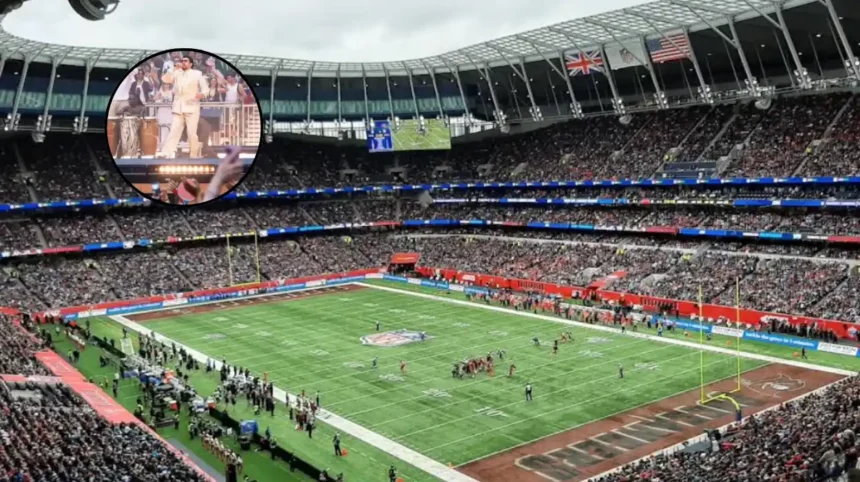
- Historic Milestone: Puerto Rican rapper and singer Bad Bunny (Benito Antonio Martínez Ocasio) became the first Latin American artist to headline a stadium concert in the United Kingdom, performing across two sold-out nights.
- Massive Turnout: The historic concerts drew an estimated 100,000 fans to the Tottenham Hotspur Stadium in North London.
- Community Fiesta: Local traders, volunteers, and residents at the Seven Sisters Latin Village organized a weekend-long cultural festival featuring DJs, dance contests, and a lookalike competition to coincide with the concerts.
- Economic Boost: Food and beverage vendors at the local market reported massive financial gains, expecting to double or triple their typical weekend profits due to a tenfold increase in footfall.
- Political and Social Reform Calls: Community leaders and activists used the global spotlight to renew campaigns for the formal recognition of Latin Americans as a distinct ethnic category on the UK national census to address systemic healthcare and educational inequalities.
Tottenham (North London News) June 29, 2026 – Global music icon Bad Bunny made history this weekend by becoming the first Latin American artist to headline a stadium show in the United Kingdom, triggering a massive, weekend-long cultural celebration across North London. The Puerto Rican rapper, whose real name is Benito Antonio Martínez Ocasio, attracted 100,000 fans across two sold-out nights at the Tottenham Hotspur Stadium. The monumental musical event served as a major catalyst for the local community, as thousands of British and international Latin Americans gathered nearby at the Seven Sisters Latin Village to host a vibrant fiesta, transforming the neighborhood into a hub of music, dance, and political advocacy.
- Key Points
- How Did the Seven Sisters Latin Village Celebrate the Arrival of the Global Superstar?
- Why is Benito Antonio Martínez Ocasio Considered a Global Cultural Force?
- How is Bad Bunny’s Music Driving Political Visibility for UK Latinos?
- Why Are Advocates Demanding a Latin American Category on the UK Census?
- Background of the Development
- Predictions: How This Development Can Affect British Latin Americans
How Did the Seven Sisters Latin Village Celebrate the Arrival of the Global Superstar?
While the main performances took place inside the stadium, a dedicated cultural movement unfolded just fifteen minutes down the road at the Seven Sisters Latin American food market. Local organizers spent months transforming the venue into an extension of the concert experience.
At the forefront of the setup was “La Casita,” a meticulously built replica of a traditional Puerto Rican home placed directly at the market’s entrance. The structure was explicitly inspired by the physical stage design used by Ocasio during his ongoing world tour.
Community members dedicated significant personal time to preparing the venue. As documented by the reporting team at The Observer, María José Gonzales Zevallos, a 30-year-old community coordinator at the Wards Corner community space, stayed up until 3:00 AM painting the replica house in the days leading up to the concert.
By Saturday morning, volunteers had finalized the market layout for a weekend festival packed with reggaeton DJs, high-energy dance competitions, and a Bad Bunny lookalike contest.
The influx of visitors fundamentally altered local commerce. Regular attendance surged dramatically, with organizers tracking roughly 10,000 fans over the weekend—representing a tenfold increase in typical footfall. Local businesses selling traditional staples such as tacos, empanadas, and fresh juices maximized the opportunity, projecting their profits to double or triple over the two-day period.
Among the passionate organizers was Vicky Alvarez, who wore a traditional Puerto Rican straw hat known as a pava—an item heavily popularized by Ocasio on his global tour. Alvarez went so far as to prepare a specialized, air-conditioned room at the market in the hope that the artist might make a surprise appearance.
Why is Benito Antonio Martínez Ocasio Considered a Global Cultural Force?
The sheer scale of the weekend’s crowds reflects Ocasio’s standing as an unprecedented force in modern music. Despite recording and performing almost exclusively in the Spanish language, he currently ranks as the most-listened-to musical artist globally on the streaming platform Spotify.
His cultural reach extends far beyond traditional streaming statistics; his highly publicized Super Bowl halftime performance became the most-watched show of all time across global social media platforms.
Furthermore, financial data underscores his massive draw. Ocasio’s current Debí Tirar Más Fotos tour has officially cemented his status as the very first Latin American artist to cross the $1 billion threshold in career touring revenue.
What makes this financial milestone particularly striking is that it was achieved completely without playing dates in the United States.
Ocasio enacted a strict boycott of US venues due to severe humanitarian concerns that his large-scale concerts could potentially be targeted by targeted immigration raids, choosing instead to focus his massive live operations internationally.
How is Bad Bunny’s Music Driving Political Visibility for UK Latinos?
For the organizers and attendees in North London, the weekend was far more than a high-profile pop concert; it represented a vital moment of visibility for a community that often feels invisible in British public life.
In a direct statement captured by The Observer, community coordinator María José Gonzales Zevallos explained the deep, underlying political resonance of the artist’s work:
“[Bad Bunny] is so proud of being Latin American and that is a very political thing now. He says the things that we’re not allowed to say, we all have a Bad Bunny in us.”
The sentiment highlights a growing friction between the mainstream British appreciation for Latin music and the lived realities of the people who belong to that culture. Community advocates point out a stark contrast: while UK audiences eagerly buy out stadiums for Spanish-language music, the population behind the culture continues to face systemic hurdles regarding institutional recognition and basic state support.
Why Are Advocates Demanding a Latin American Category on the UK Census?
An estimated 500,000 Latin Americans currently reside across the United Kingdom, yet they remain formally uncounted on a national scale because there is no dedicated “Latin American” category included on the official UK national census. This omission leaves the community statistically invisible on major government databases, a factor that activists argue creates severe social and systemic disadvantages.
Progress has occurred incrementally at the municipal level. Last year, the local Haringey Council officially integrated “Latin American” as an explicit ethnicity option on its internal monitoring paperwork.
However, activists emphasize that local changes are insufficient. Jacobo Belitly, a prominent community campaigner, is currently leading a structured political initiative to secure full, formal national recognition before the government administers the next national census cycle.
According to data compiled by community groups, the total absence of a standardized census category causes direct, compounding harm to children and families. Without accurate population data, public schools cannot secure the state funding required to provide necessary English as an Additional Language (EAL) support to students.
Furthermore, the lack of systemic data severely undermines public healthcare delivery. As reported by campaigner Jacobo Belitly, specific medical conditions that carry a statistically higher genetic propensity within the Latin American demographic—such as sickle cell anemia, diabetes, and rheumatoid arthritis—are routinely overlooked by National Health Service (NHS) planners because the population density cannot be verified. Belitly noted that this structural blind spot became hazardous during the global pandemic:
“We saw during Covid-19 that there was a disproportionate impact for Latin Americans. But the powers that be can just say: if I don’t see it in the system, then I can’t do anything about it.”
Belitly concluded with a direct challenge to broader British society regarding the intersection of cultural consumption and political neglect:
“We’re not the first people asking for this, and we won’t be the last. There is definitely a gap between this moment where people are saying: we love music in Spanish, we love Bad Bunny, but then they turn away from these important issues we’re facing.”
Despite these ongoing structural battles, the mood on the ground remained heavily celebratory. Reflecting on the physical and emotional release provided by the historic musical weekend, Vicky Alvarez shared that while her legs often cause her severe pain, the music provides a profound escape:
“When Bad Bunny comes on, I jump right up on my feet, and the pain disappears. There’s nothing that can stop me from dancing.”
Background of the Development
The historic concerts at Tottenham Hotspur Stadium come after a decade of rapid demographic growth and cultural consolidation for the Latin American diaspora in London.
Historically concentrated around hubs in Elephant and Castle and Seven Sisters, British Latin Americans have consistently fought against displacement driven by urban gentrification.
The Wards Corner market at Seven Sisters, in particular, has been the subject of a fierce, multi-year legal and community battle to prevent corporate redevelopment and preserve it as a protected cultural asset.
Simultaneously, the global “Latino Wave” in music—led by streaming figures like Bad Bunny, Rosalía, and J Balvin—has rapidly shifted the UK’s cultural landscape. Ten years ago, Spanish-language tracks rarely penetrated mainstream British radio or filled large arena spaces.
Today, streaming algorithms and shifting youth demographics have turned the UK into one of the fastest-growing consumption markets for reggaeton and Latin trap, creating the exact economic foundation necessary for a Latin artist to successfully fill a 100,000-capacity stadium over consecutive nights.
Predictions: How This Development Can Affect British Latin Americans
The overwhelming success of Bad Bunny’s stadium shows is highly likely to serve as a pivotal turning point for the UK’s Latin American community, accelerating both economic leverage and political mobilization.
From a political standpoint, the massive, highly visible turnout of 100,000 people provides data-driven evidence that grassroots campaigns can leverage to pressure the Office for National Statistics (ONS).
Activists will likely use the media momentum from this weekend to demonstrate that the community possesses the numbers, organization, and cultural footprint to justify a distinct census category.
This could lead more local councils across London to follow Haringey’s example, eventually forcing a review at the national level ahead of future demographic surveys.
Structural Improvements in Public Services
If this momentum successfully translates into official census recognition, it will directly alter public resource allocation for the Latin American population. Schools in boroughs with high concentrations of Hispanic residents will gain access to ring-fenced central government funding for bilingual education and language support.
Within the NHS, health boards will be required to track demographic data more granularly, leading to targeted screening programs and funding allocations for prevalent chronic conditions like diabetes and sickle cell anemia.
Commercial Validation and Protection of Cultural Spaces
Economically, the weekend proved that the Latin American demographic is a massive driver of commercial revenue.
The tenfold increase in footfall and skyrocketing profits at Seven Sisters Village will likely attract major corporate sponsorships and cultural grants to local merchants.
Crucially, this clear economic viability gives community traders stronger legal and financial arguments to defend their physical markets against aggressive urban redevelopment, protecting vital cultural sanctuaries from gentrification.