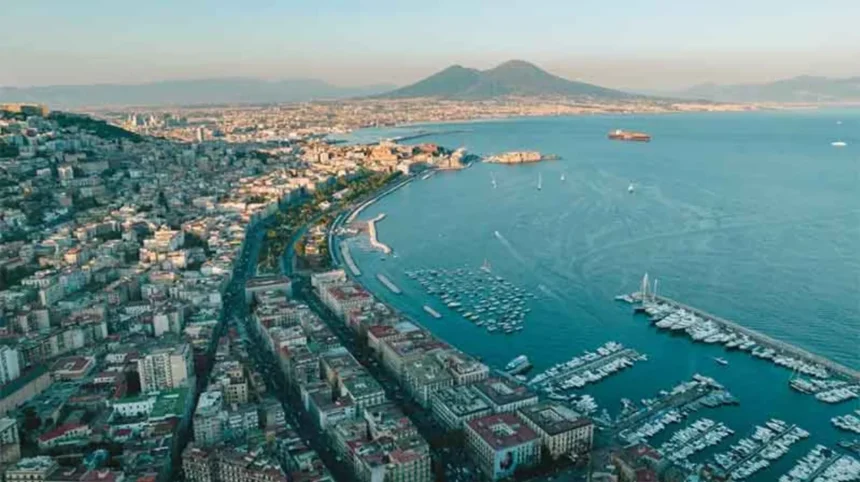
Naples is the largest city in southern Italy and the third largest in the country. Although the city is widely known as the home of pizza, its culinary diversity and local seafood delicacies can rival any global metropolis. However, the overwhelming focus on pizza often overshadows its other local treasures. From art and music scenes to concerts and theatre festivals—and, of course, pizza festivals—there is something for everyone to enjoy every day. There is never a dull moment in this laid-back, vibrant and beautiful city.
Despite signs of urban decay and decadent degradation, Naples remains a city of striking contrasts. Its colourful buildings, castles, palaces, museums, libraries, and monuments stand proudly alongside political and cultural graffiti that adorns its quaint alleyways. Non-intrusive graffiti, including slogans like “No to war and imperialism,” “Hands off Iran,” “Free Gaza,” and “Justice for Julian Assange,” continues to catch the attention of visitors. The sacredness of soccer, along with pubs, bars, cafeterias, restaurants, hotels, ice cream parlours, and roadside drink stalls along the seafront, not only keeps the city lively but also reveals the deep-rooted spirit of this revolutionary and beautiful place. Much like its raw and emotional Neapolitan songs (Canzone Napoletana), the city celebrates its uniqueness in every aspect of life and never surrenders to the monotony of nationalist conformity.
The city was established by Greek sailors, and Hellenistic art, architecture, and culture continue to dominate its landscape. It represents a rare fusion of Greek and Roman civilisations. Over the centuries, Naples has witnessed the rise and fall of empires, emperors, kings, kingdoms, occupations, and wars—making it a city steeped in history and culture.
During the Second World War, Naples also experienced the early heydays of American imperialism, which created a thriving market for the sex trade in the city. Destitute women were freely available to well-fed American soldiers, while blondes and virgins were specifically paid to serve American military officers. Prostitution spread like wildfire as a means of survival in a city heavily bombed during the war. The Americans, however, behaved less like liberators and more like occupiers, effectively founding the sex trade that still lingers in the city’s underbelly today. Brothels and bar owners continue to celebrate the American legacy of profiting from the bodies of young and old women alike.
Despite all the horrors of war, deprivation, and destitution, the people of Naples did not forget to rise up against the Nazis. The historic anti-fascist movement in the city continues to shape its contemporary politics, where eccentric communists and their various sects and incarnations still dominate the mainstream political landscape. The legacy of radicalism continues to influence the city’s political character. Naples could teach political praxis to any novice, yet the Italian left seems to have failed to learn from the city’s inhabitants, who have supported left-wing politics in many forms for many decades for now. However, for some time now, these very tendencies have shown signs of decline.
The election results of November 1946 reveal that the Popular Democratic Bloc—an alliance between the Italian Communist Party (PCI), the Italian Socialist Party (PSIUP), the Italian Republican Party (PRI), and other progressive forces—managed to secure 31.2% of the votes and 25 seats, the highest among all contenders, leaving behind all right-wing forces, including the Liberals and Christian Democrats. Similarly, the city council election of 1952 shows that the left coalition secured 27% of the votes, winning 13 seats. However, the left’s vote and seat share declined when the Socialists joined the centrist coalition, which strengthened the Liberals, Republicans, and Christian Democrats, ultimately leading to the victory of the right-wing coalition.
Further divisions between the Socialists and Communists paved the way for the Italian conservatives to win in the 1956, 1960, and 1962 city elections. Nevertheless, the combined vote share of the left and socialist parties remained formidable and consistently close to that of the conservatives.The city council elections of 1964 and 1970 should have served as a lesson for the Italian left and their fragmented politics. The Christian Democrats, capitalising on the left’s disunity, effectively used the united front strategy to their own advantage and emerged as the dominant force by securing the highest percentage of vote shares.
The red star was shining brightly over the city during the city council election of 1975, when the Italian Communist Party secured its highest share—32.3% of the votes and 27 seats. The combined vote share of the left exceeded 46% in that election. The 1980 and 1983 elections largely replicated the 1975 victory; however, in the 1983 elections, the Italian Socialists and Communists formed an alliance with the Christian Democrats, which ultimately led to the rise and dominance of the Christian Democrats in the city’s politics during the 1987 and 1992 elections.
Despite the victory of the Bassolino coalition (left-wing) in the 1993 city elections, the left and socialist parties remained a divided house, fighting among themselves and thereby empowering right-wing politics in the city. The Bassolino coalition increased its vote share and seat numbers in the 1997 elections, but this time the coalition had shifted toward the centre-left. Once again, the Socialists and Communists were deeply divided in this election as well.
The mayoral and city council election results of 2001 and 2006 reveal the rise of centre-left coalition politics under the Olive Tree banner, led by Rosa Russo Iervolino and Professor Romano Prodi—both of whom were primarily Christian Democrats. The Christian Democrats continued to dominate city politics by forming the De Magistris coalition, which emerged victorious in the 2011 elections. The 2016 and 2021 election was no different for the left, as if “divided to fall” had become a deliberate political strategy of the left-wing politics in the city.
The city mayoral elections teach two political lessons to leftist, socialist, and progressive forces. First, people continue to stand with socialists and communists in all elections, despite their historic blunders of forming alliances with the Christian Democrats. The Italian left and its revolutionary traditions were ultimately destroyed by alliance politics—undertaken in the name of fighting fascists and other reactionaries. Self-doubt in politics has proven to be a recipe for political disaster for the Italian left and socialist forces.
Second, a united front strategy is essential to weaken reactionary and right-wing forces in order to uphold the interests of the people. The Chinese Communist Party has successfully used the united front strategy to weaken reactionary forces in Chinese politics, ensuring that the state and government are run by the working people in China. Puritanism on the left is borrowed from religion and is not a sound political strategy. Similarly, alliances with religious and reactionary forces under the banner of Christian democracy have destroyed leftist and socialist forces—not only in Naples but also in a global context. The Christian Democracts have used the alliance politics to weaken Italian left and socialists.
Nevertheless, the working people of Naples continue to vote for communist and socialist parties and candidates. In the electoral history of Naples, the communists have never received less than 20 percent of the votes. This is not only a formidable vote share but also reveals that the continuity of “nutty communists” and their commitments to rise and fight to uphold the interests of the people of Naples and beyond.