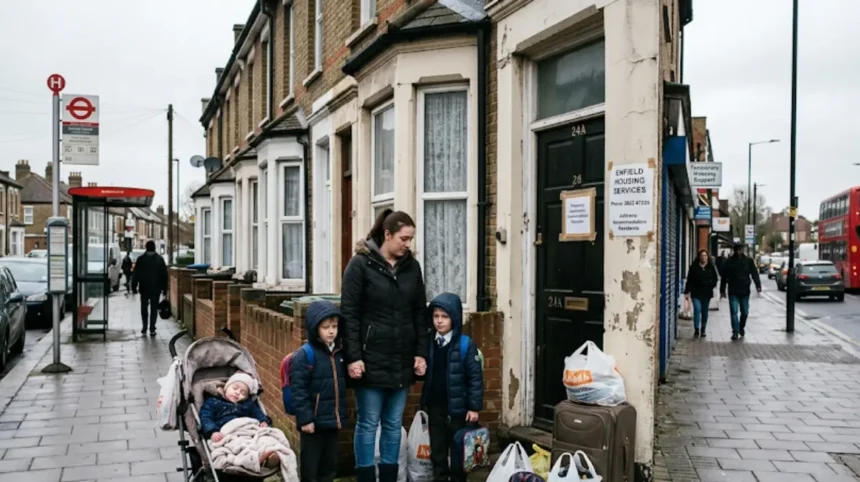
Temporary accommodations are used in Enfield frequently because the borough has a severe shortage of affordable social housing, rising private rents, and a long history of missing housing delivery targets, forcing the council to rely on private rented flats, bedsits, bed‑and‑breakfast hotels, and other interim solutions to meet its legal homelessness duties.
- Why is temporary accommodation so common in Enfield?
- What legal duties force Enfield Council to provide temporary housing?
- How has Enfield’s housing supply performance affected temporary accommodation use?
- What types of temporary accommodation are used in Enfield?
- Why are hotels and B&Bs used so often as temporary accommodation in Enfield?
- How does the private rented sector crisis affect temporary accommodation in Enfield?
- What are the financial impacts of high temporary accommodation use on Enfield Council?
- How long do people typically stay in temporary accommodation in Enfield?
- What solutions are being considered to reduce temporary accommodation use in Enfield?
- What does this mean for residents and the future of housing in Enfield?
Why is temporary accommodation so common in Enfield?
Enfield has exceptionally high temporary accommodation use because there are too few affordable homes and the council has repeatedly missed housing targets, so it must use private rentals, bedsits, and hotels to house people it owes a main duty to under the Housing Act 1996.
More than 11,000 Enfield residents, including around 5,000 children, live in temporary accommodation, with roughly 3,400 households formally in this status at the time of recent reports. This is one of the highest levels in London. The council spends over £66 million a year on temporary accommodation, whereas the same housing would typically cost less than half that amount on the open market.
The root cause is structural: Enfield does not have enough affordable social housing to meet demand. Many households cannot afford private rents in the borough due to rising rents, low incomes, and welfare reforms that reduce support for some tenants. Even before welfare reforms began, temporary accommodation use was already high: in 2008 there were 3,200 households in temporary accommodation, close to the current level. In 2010, Enfield’s use of temporary accommodation was already the fourth highest in England.
What legal duties force Enfield Council to provide temporary housing?
Under the Housing Act 1996, Enfield Council must provide immediate interim accommodation and then temporary accommodation to anyone it accepts owes a “main housing duty” because they are homeless, eligible, and in priority need, which creates a large, ongoing demand for interim homes.
The law requires councils to act quickly when a person is deemed homeless and meets the eligibility criteria. First, the council provides “interim” accommodation while it investigates the case. If the council later accepts that it owes the person a main duty, it must then provide “temporary” accommodation until a suitable permanent home is found. This temporary accommodation is usually a privately rented property, but can also include bedsits, hostels, or bed‑and‑breakfast hotels where no other option exists.
Because Enfield has a high number of people who become homeless or lose their homes, the council must repeatedly discharge these duties. Each new case adds to the stock of people in temporary accommodation. The legal framework does not limit how long temporary accommodation can be used in practice, so placements can stretch from months into years, especially when there is no permanent social housing available to move into.
How has Enfield’s housing supply performance affected temporary accommodation use?
Enfield has missed its overall and affordable housing targets for many years, delivering only about 77% of its overall housing target in recent years and just 28% of affordable housing against a 40% target, which reduces the stock of permanent homes and increases reliance on temporary accommodation.
The government reported that Enfield achieved only 77% of its overall housing target over a three-year period, performing among the worst in London on this measure. Affordable housing targets have also been missed: since 2010, the target has been that 40% of new homes should be affordable, but only about 28% of new housing has been affordable. This under‑delivery limits the supply of permanent affordable homes and removes a price anchor that helps regulate private rents.
Some planning mechanisms have also reduced affordable housing delivery. Permitted Development rules allow developers to convert offices into flats without going through the normal planning process, which means they can avoid the requirement to create affordable housing. This has led to a loss of around 200 affordable homes in Enfield. Low application fees for Permitted Development conversions also encourage speculative applications that never come to fruition, yet the council still counts these in its housing delivery plans, making it harder to meet targets. When targets are missed and new permanent affordable homes are not delivered, the council must continue using temporary accommodation to meet its duties.
What types of temporary accommodation are used in Enfield?
Enfield uses privately rented flats, bedsits, hostels, and bed‑and‑breakfast hotels as temporary accommodation, with a growing proportion of families placed in B&Bs because social housing is scarce and private rents remain high.
The most common form is a privately rented home, where the council pays the rent and often a housing benefit subsidy to a landlord. In some cases, households are placed in bedsits or shared houses where they have limited private space. These are often cheaper for the council in the short term but can be unsuitable for families with children.
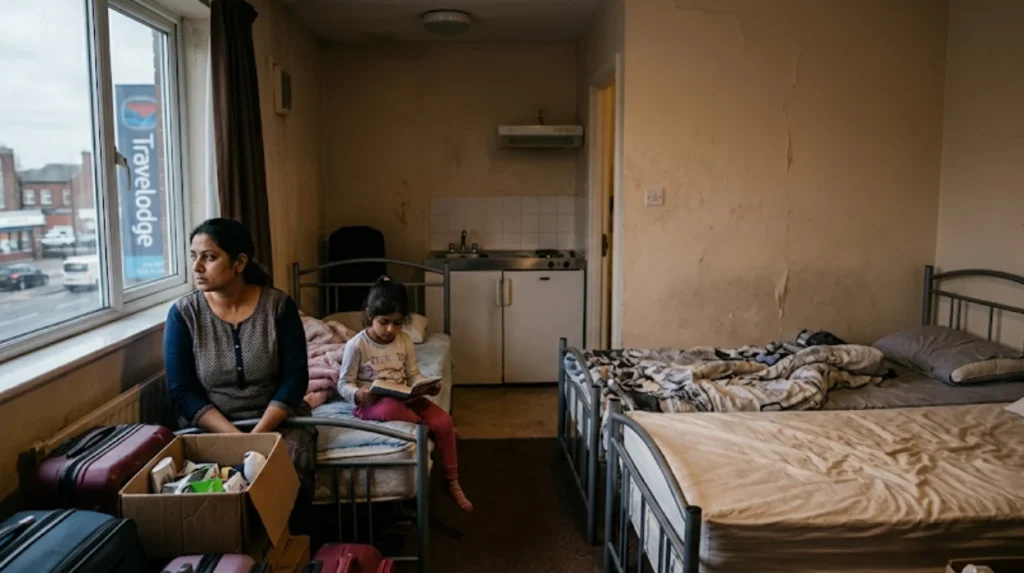
Bed‑and‑breakfast hotels and other B&B accommodation are increasingly used as temporary housing, especially for families stuck for months in hotel rooms. Council reports state that housing a family in a hotel typically costs £45,424 per year, compared with just £4,307 per year if the same family were in a modular home owned by the local authority. The proportion of households in B&Bs is continuing to rise as the council struggles to find other options. These placements are often described as inappropriate for families, yet they remain a necessary interim solution when no better accommodation is available.
Why are hotels and B&Bs used so often as temporary accommodation in Enfield?
Enfield Council increasingly uses hotels and B&Bs because there is a shortage of suitable social housing, the private rented sector is under pressure from high interest rates and rising rents, and hotels are the only available interim option in many cases.
Over the past twelve months, soaring interest rates have pushed the private rented sector into crisis, with landlords raising rents or selling properties, which reduces the number of homes available for temporary placements. As a result, hundreds of Enfield families are housed in hotels and other B&B accommodation, often for months on end. These placements are expensive: the council forecasts an unsustainable £17.8 million overspend on its temporary accommodation budget for the year.
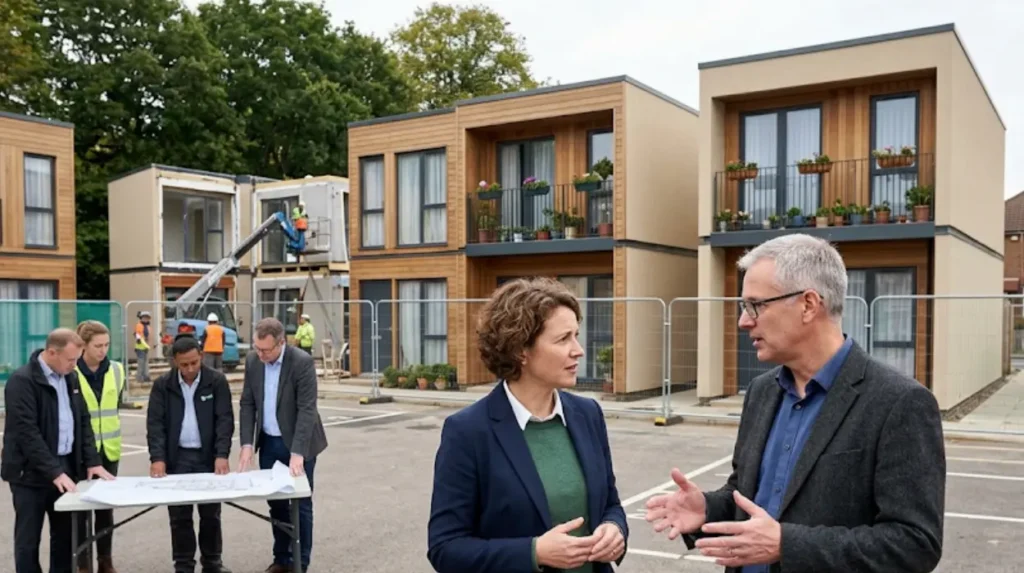
The council acknowledges that B&Bs are inappropriate for families but has been forced to use them because there is no adequate supply of social housing to move people into. In response, the council has discussed measures such as moving families stuck in hotels away from London and the south‑east of England, and considering modular homes on car parks as a lower‑cost temporary solution. These measures reflect the scale of the problem and the inability of the current housing system to provide enough permanent homes.
How does the private rented sector crisis affect temporary accommodation in Enfield?
High interest rates and rising rents have reduced the availability of private rented homes in Enfield, making it harder for the council to find affordable temporary placements and pushing more families into expensive hotel and B&B accommodation.
Landlords have responded to higher mortgage costs and inflation by increasing rents or ending tenancies, which shrinks the pool of properties the council can use for temporary accommodation. This shortage means that even when the council wants to place households in private rentals, there are not enough suitable properties at affordable rents. The result is a shift toward more expensive options like hotels, which are easier to secure quickly but cost the council far more.
The private rented sector crisis also affects how long people stay in temporary accommodation. When there are fewer private rentals available, the council cannot move people to more permanent solutions quickly, so placements in temporary accommodation extend over months or years. This increases both the cost to the council and the hardship for households, who may live in insecure or unsuitable conditions for a long period.
What are the financial impacts of high temporary accommodation use on Enfield Council?
Enfield spends over £66 million annually on temporary accommodation, with hotel placements costing around £45,424 per family per year compared to just £4,307 if the council owned modular homes, leading to a projected £17.8 million budget overspend on temporary accommodation.
These costs are unsustainable for the council and limit the amount of money it can spend on other services. The council acknowledges that housing families in hotels is far more expensive than owning and managing its own temporary housing stock, such as modular homes, which could dramatically reduce costs. Yet the lack of available public land and the complexity of planning and funding new temporary housing slow the shift away from hotels.
High temporary accommodation costs also create pressure on the council’s overall budget, contributing to a budget black hole that the council is trying to plug through various measures, including searching for cheaper accommodation options and relocating some families outside London when possible. The financial strain reinforces the need for longer‑term solutions, such as increasing the delivery of permanent affordable homes, to reduce dependence on expensive interim housing.
How long do people typically stay in temporary accommodation in Enfield?
Many Enfield households remain in temporary accommodation for years, with numerous families living in hotels or B&Bs for months on end, and some placements lasting longer than five years before a permanent offer is considered.
Reports indicate that more than 11,000 residents, including 5,000 children, live in temporary accommodation, and that this situation is anything but temporary for many. The lack of permanent social housing means that people cannot move out of temporary accommodation even when they are eligible for a permanent home, because there are no suitable properties available.
Calls have been made to review placements in temporary accommodation that last longer than five years and consider converting them into permanent offers for tenants, highlighting the scale of long‑term temporary housing use. For families, this means enduring uncertainty, poor living conditions, and limited access to stable community life, schools, and support services.
Explore More Help & Resources
How do Enfield Council handle neighbour noise complaints?
What counts as anti-social behaviour in Enfield housing estates?
What solutions are being considered to reduce temporary accommodation use in Enfield?
Enfield Council is considering modular homes on car parks, moving families out of London and the south‑east, and increasing the delivery of permanent affordable housing to reduce reliance on expensive temporary accommodation such as hotels and B&Bs.
Modular homes owned by the council could provide a much lower‑cost temporary option, with annual costs of around £4,307 per family compared with £45,424 for hotel placements. Installing these on public land such as car parks would allow quicker deployment without the need for lengthy new development projects. The council has also agreed on a policy of moving families stuck in hotels away from London and the south‑east of England where suitable accommodation may be more available and cheaper.
Long‑term solutions depend on increasing the supply of permanent affordable homes. This includes meeting housing targets, delivering more affordable housing on new developments, and reducing the impact of Permitted Development policies that bypass affordable housing requirements. Without a significant increase in permanent social housing, the council will continue to rely on high‑cost temporary accommodation to meet its legal duties.
What does this mean for residents and the future of housing in Enfield?
High temporary accommodation use in Enfield reflects a deep housing crisis that affects thousands of residents, drives up council costs, and undermines community stability, making it essential to deliver more permanent affordable homes to reduce dependence on interim solutions.
Residents in temporary accommodation face insecurity, poor living conditions, and limited access to local services, with many families spending months or years in hotels or B&Bs. The financial burden on the council limits investment in other areas and creates long‑term pressure on public resources.
Addressing the problem requires a combination of short‑term and long‑term measures. Short‑term options include modular homes, relocation policies, and better use of public land. Long‑term solutions depend on delivering more permanent affordable housing, meeting targets, and reforming planning rules to ensure new developments contribute to the affordable stock. Without these changes, temporary accommodation will remain a frequent and costly feature of housing in Enfield.