Key Points
- Enfield Council and e-bike operator Lime have issued conflicting statements regarding the collapse of a deal to launch e-bike hire services in the south of the London borough.
- A deal negotiated under the previous Labour administration in December 2024 aimed to extend Lime services from Haringey up to the A406 North Circular into Edmonton, Palmers Green, and New Southgate.
- The local administration changed hands in May 2026, with a new minority Conservative administration taking power and adopting a more pro-motorist stance.
- Enfield Council removed 22 ‘micromobility’ parking bays in late July 2026, blaming Lime for maintaining a “virtual barrier” at the boundary that blocked users from entering the borough.
- Lime refutes the council’s claims, stating that the company remains keen to enter Enfield but has been actively blocked by the newly installed Conservative leadership.
- Cycling campaign group Better Streets for Enfield expressed disappointment over the removal of parking infrastructure without public consultation.
Enfield (North London News) August 15, 2026 — A high-profile dispute has broken out between Enfield Council and micromobility provider Lime following the breakdown of an agreement that would have seen the company’s dockless e-bikes expanded into the southern parts of the borough.
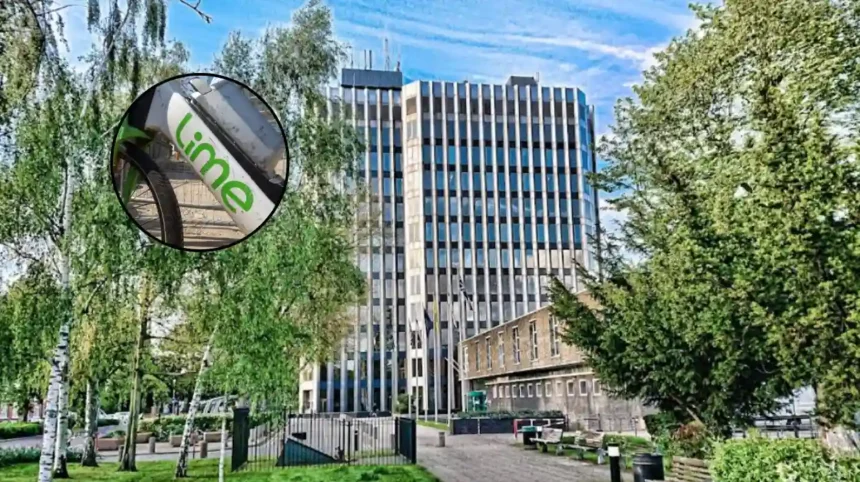
The initial arrangement, announced in December 2024 under the borough’s former Labour administration, was designed to allow Lime to extend its existing transport network from neighbouring Haringey up to the A406 North Circular. This expansion was intended to serve residents across Edmonton, Palmers Green, and New Southgate. However, following the local elections in May 2026, which saw a minority Conservative administration take power at Enfield Civic Centre, the arrangement appears to have completely collapsed, accompanied by counter-accusations from both parties regarding who bears responsibility for the failure.
The conflict escalated at the end of July 2026 when Enfield Council confirmed it had begun dismantling and removing 22 designated micromobility parking spaces. These bays had originally been installed in the south of the borough specifically to accommodate the anticipated influx of Lime e-bikes crossing over from Haringey.
What claims have been made by Enfield Council regarding the collapsed agreement?
According to statements issued by Enfield Council, the decision to dismantle the infrastructure was made because the parking bays were being significantly underused and subjected to periodic vandalism. The local authority claimed that despite authorizing the expansion, Lime failed to make the necessary operational updates on its platform to permit cross-border journeys.
As reported by James Cracknell of the Enfield Dispatch, an official council spokesperson stated:
“Enfield Council had authorised Lime to operate up to the A406. However, the Lime app ringfenced a virtual barrier at the borough boundary, so users could not ride their Lime bikes into Enfield.”
The local authority spokesperson further detailed the background of the infrastructure removals, noting:
“The council originally installed 22 micromobility parking areas south of the A406 [North Circular] to help manage potential future demand from Lime bikes crossing the borough boundary. However, Lime has continued to restrict access into the borough. As a result, these cycle parking facilities have been significantly underused and, on occasion, subject to vandalism.”
The spokesperson added that while Haringey Council maintains an active operational agreement with Lime, the expected overspill into Enfield failed to materialise routinely, leading the council to conclude that allocating dedicated road space was no longer necessary. Consequently, the local authority announced it had taken the decision to formally prohibit Lime from operating within the borough and is currently in the process of reallocating the removed cycle infrastructure to local schools to promote active travel among students.
How has Lime responded to the council’s allegations?
Lime has strongly contested the local authority’s account, describing the council’s assertion that the operator restricted access to the borough as inaccurate and misleading. The company maintains that it has continuously sought to introduce its services to local residents but has been systematically halted by the borough’s political shift.
As reported by James Cracknell of the Enfield Dispatch, Alice Pleasant, a senior public affairs manager at Lime’s UK division, refuted the council’s framing of the situation and confirmed the company’s ongoing appetite for expansion. Pleasant stated:
“We’d love to bring our service to Enfield and our door is always open if the council wants to talk more about how we could work together.”
Representatives for Lime informed the Enfield Dispatch that the firm remains eager to operate across Enfield but asserted that the initiative was effectively blocked by the incoming minority Conservative administration. Lime pointed towards the new council leadership’s transition toward a more pro-motorist policy direction, which contrasts with the pro-cycling frameworks championed by the preceding Labour administration that lost power in May 2026.
What is the reaction from local cycling and active travel campaigners?
The sudden removal of the dedicated micromobility infrastructure has drawn criticism from local sustainable transport advocates, who argue that the decision undermines affordable travel options in areas that need them most.
As reported by James Cracknell of the Enfield Dispatch, a spokesperson for the local cycling advocacy group Better Streets for Enfield stated:
“While it’s true that Lime’s decision to block their hire e-bikes from being ridden across the Enfield border has led to the parking bays being underutilised, we are disappointed that they have been removed without any consultation.”
The campaign group highlighted that the southern sections of the borough where the bays were dismantled include communities with lower average income levels and lower rates of private vehicle ownership. The spokesperson for Better Streets for Enfield further added:
“The part of the borough where the bays were installed includes areas that are deprived or where car ownership is low (unsurprisingly, these often coincide). Bicycles provide a means of transport that not only benefits health and the environment, but is also affordable. Removing parking bays means that many people who would like to cycle can no longer find places to leave their bike close to their destination.”
Furthermore, the advocacy group pointed out that transport infrastructure of this nature will likely be required in the future should Transport for London (TfL) or the Mayor of London implement a unified, capital-wide e-bike framework to streamline the currently fragmented borough-by-borough arrangements.
Explore More Enfield Council News
Enfield Council HMO Planning Applications Surge: Local Housing Rules in Enfield 2026
Enfield Conservatives Defend Pride Flag Decision: Enfield 2026
Background of the particular development
The dispute between Enfield Council and Lime occurs against a broader backdrop of political change and evolving transport governance across Greater London. In May 2026, local governance in Enfield experienced a major political shift when the Labour Party, which had held power and prioritised active travel initiatives such as low-traffic neighbourhoods and expanded cycling tracks, lost its majority.
The Conservative Party subsequently formed a minority administration at the Enfield Civic Centre, bringing a pronounced shift in transport priorities toward motor vehicle access and the management of kerbside space.
Simultaneously, dockless e-bike operators have faced varying degrees of regulatory friction across different London boroughs. While operators like Lime, Forest, and Voi have expanded rapidly across central and inner London, outer London boroughs have struggled to establish consistent regulatory standards.
Issues surrounding street clutter, pavement obstructions for visually impaired and disabled pedestrians, and abandoned bikes have prompted several councils to demand stricter operational controls or complete bans.
In response to these systemic challenges, Transport for London alongside London Councils has been exploring pan-London regulatory mechanisms to standardize parking enforcement, fleet sizes, and operator licensing across all 32 boroughs, aiming to eliminate boundary “geofencing” conflicts such as the one currently seen on the Enfield-Haringey border.
Prediction: How this development can affect local residents and commuters
The breakdown of negotiations and the subsequent withdrawal of micromobility infrastructure in Enfield will primarily impact local commuters, short-distance travelers, and residents living in the southern districts of Edmonton, Palmers Green, and New Southgate.
- Impact on Transport Accessibility: Residents in lower-income areas in south Enfield, where private vehicle ownership rates are statistically lower, will lose an accessible, low-cost micro-mobility option for first-and-last-mile connections to local railway and Underground stations.
- Border Friction for Cross-Borough Commuters: Cyclists traveling north from neighbouring Haringey will continue to experience abrupt motor cut-offs or fines due to geofencing restrictions at the borough boundary, limiting seamless active travel across North London.
- Pedestrian and Street Environment Effects: The removal of dedicated on-road parking bays prevents potential footway clutter caused by randomly parked e-bikes; however, it leaves the area without structured parking facilities should regional e-bike schemes eventually be mandated across London.
- Precedent for Outer London Transport Policy: The stance taken by Enfield Council’s new administration signals a broader policy pivot that may encourage other outer London boroughs to restrict commercial micromobility schemes until standardized, pan-London regulations are formally introduced by Transport for London.