Barnet has a diverse public art landscape stretching across Finchley, Edgware, Burnt Oak, Colindale and Brent Cross Town. It includes historic statues, ceramic commemorative artworks, murals, architectural installations, community projects and contemporary temporary works.
- What types of public art can you find in Barnet?
- Where can you follow the Barnet Legends public art trail?
- Which historic sculptures are worth seeing in Finchley?
- Why is La Délivrance important?
- What is The Archer at East Finchley station?
- Where is the Spike Milligan statue?
- What public art is located around Brent Cross Town?
- What is the Community Mural?
- What is Rainbow of Ribbons?
- What is Yesterday, Tomorrow?
- What is Here we come, here we rise?
- What artwork can you see at Brent Cross West station?
- Where can you see murals in Edgware and Burnt Oak?
- What is Stop and Smell the Flowers in Edgware?
- What public art is in Burnt Oak?
- What public art exists in Colindale?
- How is public art commissioned and created in Barnet?
- How does Barnet’s public art connect with local history?
- What new public art is planned or developing in Barnet in 2026?
- How should visitors explore Barnet’s public art?
- Why is Barnet’s public art significant for visitors and residents?
Public art means artwork created, installed or commissioned for public spaces. In Barnet, these works appear beside Underground stations, parks, high streets, new developments, railway infrastructure and community facilities. The borough council identifies public art as an important part of its cultural and place-making strategy.
The strongest way to explore Barnet’s art is to combine historic landmarks with newer trails. Visitors can see the 1927 La Délivrance at Henley’s Corner, Eric Aumonier’s 1940 Archer at East Finchley Underground station, the Barnet Legends ceramic trail, murals in Edgware and Burnt Oak, and the large-scale installations around Brent Cross Town.
Barnet’s public art also connects directly with its history. As you explore modern artworks and cultural trails, you are crossing land with a deep heritage. Read the full [Insert Anchor Text for History Article Here] to understand its origins and how the borough developed.
What types of public art can you find in Barnet?
Barnet’s public art includes historic statues, community murals, ceramic tributes, architectural artworks and contemporary installations across Finchley, Edgware and Brent Cross Town. These works connect local history, neighbourhood identity, transport infrastructure, regeneration, community participation and cultural memory through accessible artworks.
Barnet’s public art is not concentrated in one gallery or civic square. It is distributed throughout the borough. This makes the streets, transport network, parks and regeneration areas part of the cultural experience.
Historic sculpture forms one important category. La Délivrance at Henley’s Corner dates from the 1920s, while The Archer at East Finchley Underground station dates from 1940. Both works are connected with specific historical settings and demonstrate how sculpture became part of London’s built environment.
Commemorative art forms another category. Barnet Legends consists of 21 ceramic artworks dedicated to people connected with the borough. The subjects include musicians, designers, activists, writers, entertainers and other influential figures.
Murals provide a more contemporary form of public art. Edgware’s Stop and Smell the Flowers and the Burnt Oak mural demonstrate how community participation influences artwork in town centres. Brent Cross Town adds further murals and large installations connected with regeneration and new public spaces.
Architectural public art is also significant. Brent Cross West station features a 250-square-metre architectural frieze by Barnet-raised artist Giles Round. Another large artwork wraps a sustainable energy substation at Brent Cross Town.
Where can you follow the Barnet Legends public art trail?
Barnet Legends forms a trail of 21 commemorative ceramic artworks honouring figures such as George Michael, Amy Winehouse, Vera Lynn and Harry Beck at 21 locations. Designed by Edward Crooks, the series links public places with people who shaped Barnet’s identity.
Barnet Legends is one of the clearest ways to explore public art across the borough. Barnet Council launched the trail in August 2024. Create London curated and produced the project, while artist and architect Edward Crooks designed the artworks.
The trail contains 21 locations. These include the Royal Air Force Museum, Barnet Museum and Finchley Youth Centre. The artworks are positioned on public buildings and other prominent locations, allowing the commemorative pieces to become part of everyday neighbourhood life.
The subjects demonstrate the breadth of Barnet’s cultural history. George Michael and Amy Winehouse represent major musical figures. Dame Vera Lynn represents twentieth-century popular music and wartime culture. Harry Beck represents design through his influential London Underground diagram.
The trail also recognises people whose contributions receive less national attention. Daulat Jiwa founded the Barnet Asian Women’s Association. Eileen Colwell established the first children’s library in Hendon and changed children’s access to reading.
This range makes Barnet Legends more than a collection of celebrity portraits. It presents a broader definition of local heritage. Public art becomes a way to identify people connected with community development, design, activism, entertainment, literature and social change.
The official digital map is particularly useful because the artworks are spread across the borough. A visitor planning a walking route can use the locations to combine several artworks with museums, parks, high streets and transport connections.
Which historic sculptures are worth seeing in Finchley?
Finchley contains several public artworks, including La Délivrance at Henley’s Corner, The Archer at East Finchley station and Spike Milligan’s bronze statue at Stephens House. Together, these works span wartime commemoration, London Underground design, local celebrity and twentieth-century cultural history.
Finchley contains some of Barnet’s most recognisable historic public artworks. The best-known examples have different origins and artistic purposes, creating a useful introduction to the borough’s sculpture.
Why is La Délivrance important?
La Délivrance is a 16-foot bronze statue by French sculptor Émile Guillaume. It depicts a woman holding a sword aloft. The sculpture commemorates the French victory at the First Battle of the Marne in August 1914, when German forces were stopped from capturing Paris.
Lord Rothermere purchased the statue in 1920 and presented it to Finchley. It was unveiled at Henley’s Corner in October 1927. Around 8,000 people attended the unveiling, which was conducted by former Prime Minister David Lloyd George.
The statue stands at the bottom of Regent’s Park Road. Its location beside a major road junction gives it a prominent position within Finchley’s streetscape.
The work is also known locally by informal names, including “The Naked Lady”. The official name remains La Délivrance. Its history demonstrates how public sculpture can carry international historical references while becoming part of local identity.
What is The Archer at East Finchley station?
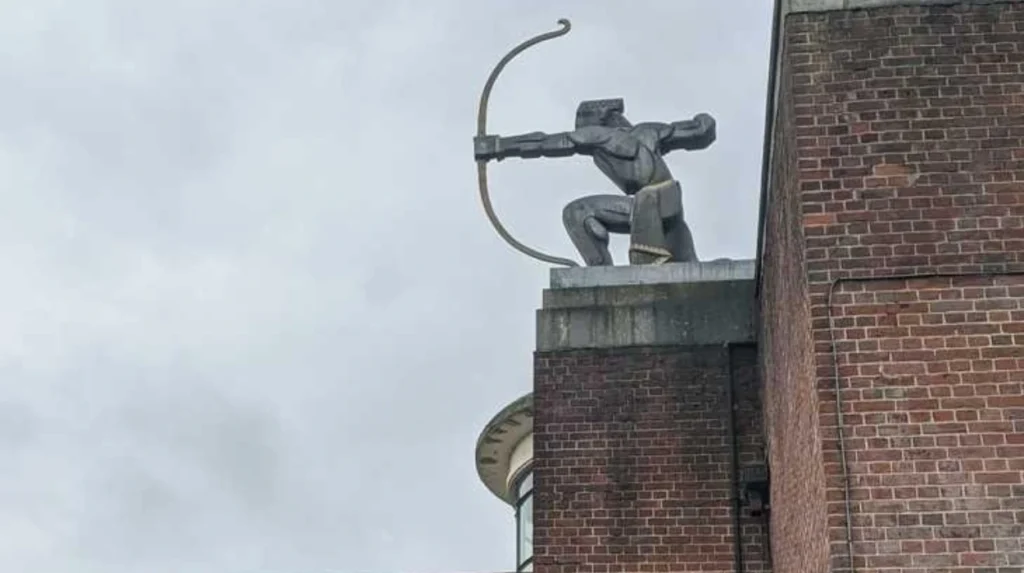
The Archer is a sculpture by Eric Aumonier, installed at East Finchley Underground station in 1940. It depicts an archer and connects the station with Finchley’s historic association with hunting.
Transport for London describes the sculpture as part of a wider pre-war initiative intended to connect Underground stations with their local environments. The Second World War interrupted that programme, leaving The Archer as the only completed work from the initiative.
The sculpture uses beech over a steel support with a lead covering. Its position near the station entrance makes it one of Barnet’s most accessible pieces of historic public art.
Where is the Spike Milligan statue?
A bronze statue of comedian and writer Spike Milligan sits in the grounds of Stephens House in Finchley. Artist John Somerville created the sculpture, which depicts Milligan sitting on a bench. The work was unveiled in 2014.
Brent Cross Town identifies the sculpture as A Conversation with Spike, dated 2014, and places it in the grounds of Stephens House, 17 East End Road.
Stephens House is a Grade II listed house with landscaped gardens. Public access to the estate is subject to its visitor guidance and opening arrangements, so visitors should check access information before planning a visit.
What public art is located around Brent Cross Town?
Brent Cross Town contains murals and installations including Community Mural, Rainbow of Ribbons, Yesterday, Tomorrow, Here we come, here we rise and Brent Cross West artworks. The trail combines community memories, playful sculpture, infrastructure design, environmental themes and station architecture.
Brent Cross Town is one of Barnet’s strongest concentrations of contemporary public art. The development’s art programme places works throughout streets, parks, transport areas and infrastructure.
The official Brent Cross Town art trail identifies several works and their artists. These include Annu Kilpeläinen’s Community Mural, Hanna Benihoud’s Rainbow of Ribbons, Steven Wilson’s Yesterday, Tomorrow, Giles Round’s Time passes & still I think of you, and Lakwena’s Here we come, here we rise.
What is the Community Mural?
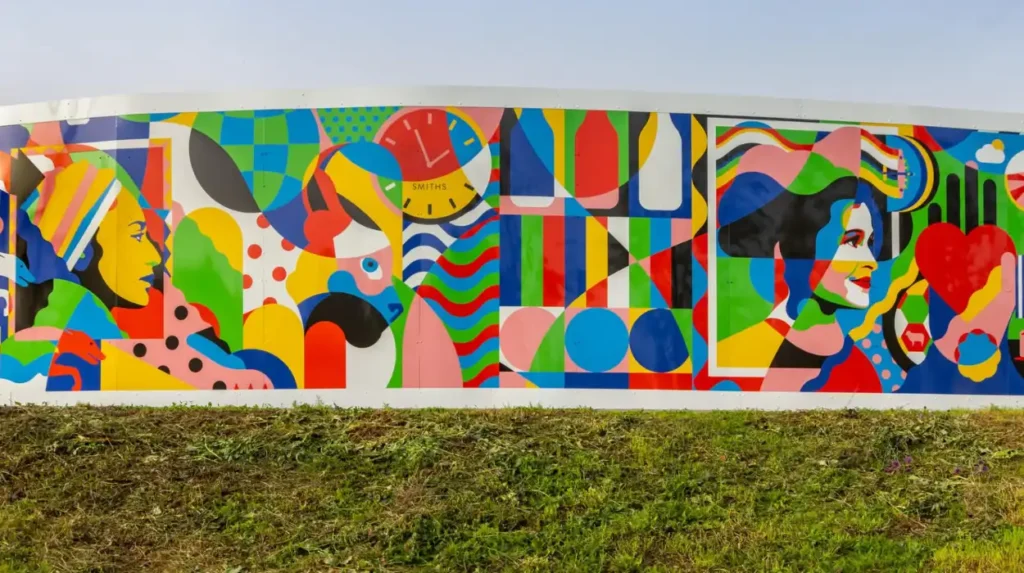
The Community Mural stands at the corner of Claremont Way and Claremont Road. Artist Annu Kilpeläinen developed the artwork using ideas connected with the local community and the history of Barnet botanist William Cattley.
Barnet Council describes the mural as a work inspired by the local community and by a Barnet botanist who lived two centuries ago. Its tropical colours connect historical references with the identity of the new Brent Cross Town neighbourhood.
What is Rainbow of Ribbons?
Rainbow of Ribbons by Hanna Benihoud is located at Claremont Park. The work consists of colourful metal spirals inspired by children playing in the park.
The sculpture uses form and movement to create a playful visual element within the park. Its location demonstrates how public art integrates with everyday recreational spaces rather than remaining isolated from ordinary activity.
What is Yesterday, Tomorrow?
Steven Wilson’s Yesterday, Tomorrow is located within Claremont Park. The artwork uses colourful abstract imagery to reference the people and stories that shaped Brent Cross Town.
The work draws on community memories and local history. It demonstrates the role of participatory research in contemporary public art, where residents’ experiences become source material for a permanent visual installation.
What is Here we come, here we rise?
Here we come, here we rise is a large-scale artwork by artist Lakwena, developed with architecture practice IF_DO and Sarah Castle. It wraps a sustainable energy substation close to the A406 North Circular and M1 junction.
The artwork measures 21 metres high and 52 metres long. Its lenticular design changes visually as people travel past it. Barnet Council states that the artwork forms a new landmark while surrounding infrastructure continues to perform its practical function.
The scale is significant. The highest point is taller than the Angel of the North. Barnet Council estimated that around six million people each year would see the artwork from road and rail.
What artwork can you see at Brent Cross West station?
Brent Cross West station combines large-scale architectural art with community participation, including Giles Round’s 250-square-metre frieze and the volunteer-created ‘Towards Barnet & Towards Brent’ artwork. Together, these works connect transport infrastructure with local identity, memories and community participation.
Brent Cross West is an important destination for visitors interested in public art because the station itself incorporates major artistic commissions.
In November 2023, Barnet Council and Related Argent unveiled a 250-square-metre architectural frieze by Barnet-raised artist Giles Round. The artwork was created for the new mainline station and was positioned as part of the area’s cultural identity.
Another station artwork is Towards Barnet & Towards Brent. Local artist Elisa Cantarelli worked with more than 60 volunteers to create the piece displayed on the station overbridge. Participants included students and teachers from Claremont Primary School and Mapledown School, members of Age UK and local residents.
The project reused bottle tops to form words and colourful dots. The resulting artwork represents the diversity of communities connected by the station.
The overbridge has particular significance because it provides a pedestrian connection across the Midland Main Line. Barnet Council states that it was the first pedestrian crossing over this section of railway since the railway was constructed 150 years earlier.
Brent Cross West also contains a Barnet Legends artwork commemorating activist Muriel Matters. Matters was associated with the women’s suffrage movement and famously used an aircraft from West Hendon to promote the “Vote for Women” campaign.
This concentration of artworks makes the station useful for visitors travelling into Barnet. Public transport infrastructure becomes both a transport destination and a cultural point of interest.
Where can you see murals in Edgware and Burnt Oak?
Edgware, Burnt Oak and Colindale contain community-focused murals and installations that connect public art with regeneration, local identity, environmental awareness, transport and neighbourhood spaces. These projects involve artists, young people, schools, residents, councils and cultural organisations in developing landmarks.
Edgware and Burnt Oak demonstrate how public art operates within established town centres. Their projects focus strongly on local identity, community participation and improvements to public spaces.
What is Stop and Smell the Flowers in Edgware?
Stop and Smell the Flowers is a mural by artist Holly Graham on Station Road, Edgware. Barnet Council unveiled the artwork in March 2024 as part of a cultural programme marking 100 years of Station Road.
The mural was co-designed with the local community. Seventy-five young people participated through workshops involving FUSE Youth Group, Edgware Primary School and Northgate School, alongside a public drop-in session.
The project also connects art with environmental information. A digital screen beside the mural displays imagery developed with Clean Air Barnet and Middlesex University. Students contributed visual material linked to air-quality awareness.
The project therefore combines visual art, local history, youth participation and environmental communication in a single high-street setting.
What public art is in Burnt Oak?
Burnt Oak has a community mural located opposite Burnt Oak Underground station on Watling Avenue. Barnet Council introduced the artwork in 2023 as part of a creative placemaking project.
Local young people from Unitas, the Burnt Oak Partnership Board, Barnet Council and Transport for London contributed to the project. The programme aimed to celebrate the culture, heritage and diversity of Burnt Oak while improving the town-centre environment.
The location beside a major transport interchange gives the mural strong public visibility. It also demonstrates how public art supports town-centre regeneration without requiring a dedicated gallery building.
What public art exists in Colindale?
Colindale Park was developed with public art as part of a wider regeneration project. Barnet Council’s 2021 plans included three public art pieces: two totem fans and a bench. The artworks were funded through a Section 106 agreement associated with development.
Section 106 refers to planning obligations secured under the Town and Country Planning Act 1990. These agreements allow planning authorities to secure contributions from development projects towards infrastructure and community improvements.
The Colindale example demonstrates how public art can form part of planned public-realm investment rather than relying only on independent cultural commissions.
How is public art commissioned and created in Barnet?
Public art in Barnet often emerges through partnerships between the council, artists, developers, transport organisations, schools and residents, with consultation, commissioning, fabrication, installation and long-term stewardship shaping each project. This process places artwork within regeneration, cultural strategy and public-realm improvements.
Barnet’s public art programme uses several commissioning models. Some works are created directly through council cultural programmes. Others form part of major regeneration projects, transport infrastructure or developer-funded public-realm schemes.
Community participation is a recurring mechanism. The Edgware mural involved 75 young people. The Brent Cross West overbridge artwork involved more than 60 volunteers. These projects demonstrate structured participation rather than informal consultation.
Artist selection is another important stage. Projects identify artists whose practices fit the location, subject and community objectives. Barnet Council has also worked with public art organisations such as Create London and UP Projects.
The Barnet Legends trail was curated and produced by Create London, while Edward Crooks designed the ceramic artworks. The project demonstrates how a borough-wide cultural theme can receive a consistent visual identity through a single designer.
Large regeneration schemes use another mechanism. Brent Cross Town integrates public art into new streets, parks, infrastructure and station areas. The approach treats art as part of place-making rather than an independent decorative feature.
Funding also varies. Colindale Park’s planned public artworks formed part of Section 106 funding. Brent Cross Town works sit within a major regeneration programme. Cultural programmes such as Light and Flight receive dedicated public cultural funding.
Installation requires technical planning, fabrication, permissions, structural considerations and maintenance arrangements. Public artworks exposed to weather, traffic and heavy pedestrian use require different management from indoor gallery works.
This process explains why Barnet’s public art looks different from piece to piece. A ceramic portrait, a station frieze, a steel sculpture and a painted mural require different production methods and site requirements.
How does Barnet’s public art connect with local history?
Barnet’s public art connects history with contemporary public space by commemorating influential people, referencing transport heritage, celebrating local communities and incorporating historic stories into regeneration. Barnet Legends, La Délivrance, The Archer and new Brent Cross artworks demonstrate this relationship across different periods.
Public art in Barnet frequently acts as a historical marker. The artwork does not simply occupy a location. It identifies a person, event, landscape feature, community story or historical association connected with that location.
La Délivrance links Finchley to the First World War and the Battle of the Marne. The Archer links East Finchley Underground station with the area’s earlier identity as a hunting landscape.
Barnet Legends takes a different approach. Instead of commemorating a single event, it presents 21 individuals and their contributions to the borough and wider society. Its subjects include figures from music, design, activism, literature and local community life.
Brent Cross Town uses historical references within contemporary regeneration. The Community Mural draws on William Cattley and local botanical history. Yesterday, Tomorrow incorporates memories from people connected with the neighbourhood.
The Brent Cross West station artwork also connects current transport infrastructure with community history. Muriel Matters’ Barnet Legends tribute links the station area with women’s suffrage and West Hendon’s aviation history.
This historical approach gives visitors a reason to examine artworks beyond their visual appearance. The location, subject and commissioning history provide additional information about how Barnet developed.
What new public art is planned or developing in Barnet in 2026?
Barnet’s public art continues to expand through the 2026 Light and Flight programme, including Ascendance, a large projection installation by Matthew Rosier and UP Projects, alongside heritage projects. The programme connects creative work with aviation history, migration, belonging and stories.
Barnet’s public art programme remains active in 2026. The borough’s Light and Flight programme is a year-long cultural initiative supported through a Cultural Impact Award connected with the Mayor of London’s London Borough of Culture programme.
The programme focuses on Barnet’s stories, communities, heritage and aviation connections. It operates across locations including Edgware, Cricklewood, Colindale and Finchley.
One major commission is Ascendance, created by artist Matthew Rosier in collaboration with UP Projects. Barnet Council describes it as a large-scale outdoor projection installation shaped by stories gathered from Barnet residents.
The planned unveiling is scheduled for November 2026 as part of a free multi-day arts and culture festival forming the finale of Light and Flight.
The programme also includes From Barnet with Love, a creative project involving Emma Tominey, Wayward and andre kong studio. The project focuses on heritage, collective memory, local stories, migration and everyday life.
Barnet Council awarded £70,000 to support ten community-led heritage projects in 2026. The funding is intended to help local organisations, artists, residents and partners uncover and share hidden histories.
This direction indicates that Barnet’s public art is developing beyond isolated sculptures. The current model combines public art, heritage research, community participation, cultural programming and regeneration.
For visitors, the practical implication is important. Public art in Barnet is an evolving network. Established works such as La Délivrance and The Archer provide historical anchors, while Barnet Legends and Brent Cross Town provide structured contemporary trails. Light and Flight adds another layer of new commissions and temporary cultural activity.
Ezplore More Area Guide
How Family-Friendly Is Barnet? North London 2026
Best Rainy Day Activities in Barnet 2026
How should visitors explore Barnet’s public art?
Visitors should combine Barnet’s major historic sculptures with organised art trails and contemporary neighbourhood works. A practical route includes Finchley landmarks, Barnet Legends locations, Brent Cross Town, Brent Cross West, Edgware and Burnt Oak public art.
A public art visit works best when locations are grouped geographically. Barnet is a large London borough, so attempting to see every artwork in one short walk is inefficient.
Finchley provides a strong historic starting point. Visitors can combine La Délivrance at Henley’s Corner with The Archer at East Finchley station and, subject to opening arrangements, the Spike Milligan sculpture at Stephens House.
Barnet Legends requires a different approach because its 21 artworks are distributed across the borough. The official digital map provides the most useful route-planning resource because it identifies the locations and helps visitors combine artworks with nearby cultural destinations.
Brent Cross Town is particularly suitable for visitors interested in contemporary public art. The official art trail identifies works in and around Claremont Park, Claremont Road, Brent Cross West and the railway area.
Edgware provides a useful high-street-based art experience. Stop and Smell the Flowers sits within Station Road and connects directly with the area’s centenary programme and environmental awareness work.
Burnt Oak provides another accessible example beside an Underground station. The Watling Avenue mural demonstrates how public art integrates with everyday transport and shopping environments.
Visitors should also check access conditions before visiting artworks inside private or managed estates. Stephens House, for example, is a private estate where public access is granted under the estate’s visitor arrangements.
Photography is particularly effective for comparing different forms of public art. Historic bronze sculpture, ceramic portraiture, painted murals, architectural friezes and large infrastructure installations each respond differently to their surroundings.
The most useful approach is to treat Barnet as a network of public artworks rather than a single attraction. The borough’s strongest cultural feature is the relationship between artwork, location, history and community.
Why is Barnet’s public art significant for visitors and residents?
Barnet’s public art strengthens the cultural identity of neighbourhoods by placing history, creativity and community participation directly into public spaces. Its combination of permanent landmarks, art trails, murals and new commissions creates an accessible cultural network across North London.
Barnet’s public art has practical cultural value because it places creative work outside conventional gallery spaces. Visitors encounter artworks while using transport stations, walking through parks, visiting high streets or exploring regeneration areas.
The programme also supports local identity. Barnet Council’s culture strategy identifies high-quality public art as a way to enhance town centres and green spaces. The strategy cites existing examples including Brent Cross Town installations, Grahame Park murals and artist-led projects in Edgware.
Public art also provides a visible connection between regeneration and cultural development. Brent Cross Town demonstrates this through major installations integrated into new infrastructure and public spaces. The 21-metre-high Here we come, here we rise transforms an operational energy substation into a prominent visual landmark.
Community participation adds another dimension. The Edgware mural involved young people in workshops. The Brent Cross West artwork involved more than 60 volunteers. These projects place residents within the creative process rather than treating them solely as audiences.
Barnet’s public art also provides a useful resource for short leisure visits. Tourists with limited time can focus on one area. Residents can build longer walking routes around the Barnet Legends map. Business travellers staying in North London can use station-area artworks as short cultural stops between appointments.
The future direction remains active. Light and Flight is expanding cultural activity across the borough during 2026, with new commissions, community heritage projects and a planned festival finale.
Barnet therefore offers a broad public art experience covering historic sculpture, contemporary murals, ceramic commemoration, architectural art, community projects and large-scale installations. The strongest examples are distributed across the borough, making public art part of the experience of exploring North London rather than a separate destination.
What public art can you see in Barnet?
Barnet has a wide range of public art, including historic sculptures, murals, ceramic artworks, architectural installations and contemporary commissions. Notable examples include La Délivrance at Henley’s Corner, The Archer at East Finchley Underground station, Barnet Legends and Brent Cross Town’s contemporary artworks.