Key Points
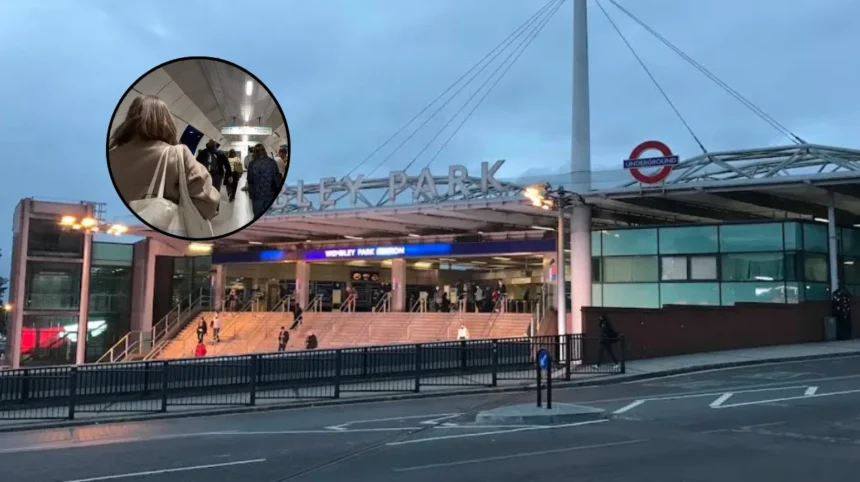
- Cause of Incident: There was a fire alarm at Wembley Park Underground Station, hence activating emergency procedures.
- Network Conditions: There were partial suspensions of services between Harrow-on-the-Hill and Aldgate stations causing massive delays throughout the Metropolitan line network.
- Status of Resolution: It is confirmed by TfL that the fire alarm problem has been sorted out, but the severe delays remain due to the restoration of trains.
- Accepting Tickets: Alternative transportation modes that accept Underground tickets include London Buses, Lioness Line (London Overground), London Northwestern Railway, and Chiltern Railways.
- Advice to Passengers: All travelers are advised to check the status of their journeys prior to traveling and give themselves extra time.
Wembley (North London News) August 24, 2026 – Passengers travelling across London are facing widespread travel disruption following an emergency fire alert at Wembley Park station. As reported by reporter Annabel Stock of London Now, severe delays have rippled across the Metropolitan line after emergency protocols were activated, causing major service hold-ups during peak operational recovery. Transport for London (TfL) and national rail service operators confirmed that while the safety alert has been successfully stood down, significant knock-on delays persist across the entire line while trains and crew are returned to their designated timetables.
What Caused the Disruption on the Metropolitan Line?
As reported by reporter Annabel Stock of London Now, the initial disruption was triggered by a fire alert at Wembley Park Underground station in north-west London. The security and safety alert required operational intervention, temporarily restricting movement along the corridor connecting outer North West London and central London terminus points.
During the height of the response, line status notifications from Transport for London (TfL) recorded a partial suspension of services between Harrow-on-the-Hill and Aldgate, alongside severe delays across the remaining running sections of the network.
Emergency procedures were initiated immediately upon receipt of the alert at Wembley Park. Transport officials confirmed that while the incident has been safely resolved without further incident, the physical halt in train movements created a heavy backlog of sub-surface transport traffic that continues to affect schedule reliability.
How Are Transport Authorities Assisting Affected Passengers?
To mitigate the impact on commuting members of the public, comprehensive ticket acceptance arrangements were enacted across regional public transport networks. As noted by reporter Annabel Stock of London Now, Transport for London confirmed that passenger tickets are being honoured by a range of surface transport operators.
Ticket acceptance covers local London Buses, the London Overground Lioness line, London Northwestern Railway services, and Chiltern Railways.
These multi-modal transport agreements allow commuters heading into and out of stations such as Harrow-on-the-Hill, Wembley Park, and Baker Street to complete their journeys via alternative rail and road routes without incurring additional fares.
What Advice Has Been Given to Travellers?
Transport authorities have issued explicit operational guidance for all individuals travelling through the impacted corridors. As reported by Annabel Stock of London Now, passengers are strongly advised to allow extra time for their journeys and consider alternative routes wherever possible while services undergo normalization.
Travel officials emphasize that customers should explicitly verify live journey status updates on official digital platforms or travel applications prior to setting off, ensuring they can make informed decisions regarding potential re-routing.
Background of the Particular Development
The Metropolitan line is one of the oldest and most heavily utilized radial routes in the London Underground network, serving as a critical artery connecting commuters from Buckinghamshire, Hertfordshire, and outer North West London directly into the City of London.
Wembley Park serves as a principal junction and interchange station along this corridor, connecting the Metropolitan line directly with the Jubilee line and providing major access to national event venues including Wembley Stadium and the OVO Arena Wembley.
Due to the complex interlining of sub-surface lines and high-frequency train schedules, any sudden operational halt at a pivotal junction like Wembley Park rapidly impacts upstream and downstream rail movements. Fire alerts on the Underground network trigger automated safety responses, including station evacuations and signal holds, designed to ensure public protection.
Consequently, even brief alerts generate substantial operational delays due to the time required to clear track sections, reposition rolling stock, and reassign train crews across the network.
Prediction: How Will This Development Affect Outer-London Commuters and Event Attendees?
This development will primarily affect daily commuters, regional workers, and visitors travelling between North West London and central London terminals. In the immediate hours following the incident, passengers utilizing the Metropolitan line will experience extended wait times, heavily congested platforms, and crowded alternative services such as local bus routes and Chiltern Railways connections.
For the commuting audience relying on outer-zone stations—such as Amersham, Chesham, Watford, and Uxbridge—the residual delay profile means journey times into central hubs like Baker Street, Moorgate, and Aldgate could be lengthened significantly.
Furthermore, event attendees travelling towards the Wembley complex may face bottlenecks during peak transit hours until full timetable frequency is completely restored across both the Metropolitan and interconnecting Jubilee line platforms. Over the coming operational days, Transport for London is expected to monitor rolling stock spacing closely to minimize further knock-on disruptions to regular weekday schedules.