Key Points
- Wembley Stadium permitted a pyrotechnic display during The Weeknd’s concert despite an active national emergency alert regarding wildfire risks.
- The UK government and meteorological agencies had explicitly warned the public against using fireworks and barbecues due to tinder-dry conditions.
- Environmental campaigners and members of the public labelled the decision as “irresponsible” and “tone-deaf” given the record-breaking temperatures.
- Stadium officials maintained that the display was strictly controlled and complied with existing safety protocols.
- The incident has sparked a wider debate regarding the regulation of large-scale entertainment events during climate-related weather emergencies.
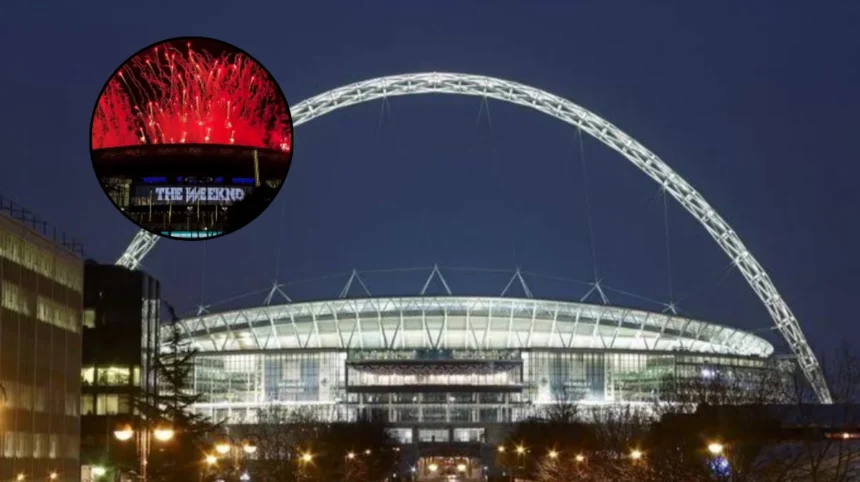
Wembley (North London News) August 18, 2026 – Wembley Stadium is facing significant public scrutiny after a high-intensity pyrotechnic display was executed during Canadian popstar The Weeknd’s concert, occurring mere hours after authorities issued a national emergency warning against activities that could ignite wildfires.
- Key Points
- Why was Wembley Stadium criticised for using fireworks during a wildfire alert?
- What was the official response from Wembley Stadium regarding the safety of the display?
- How did the public and environmental groups react to the decision?
- Did the government provide specific exemptions for professional venues?
- Background of the particular development
- Prediction: How will this development affect large-scale event organisers?
Why was Wembley Stadium criticised for using fireworks during a wildfire alert?
The controversy erupted following the conclusion of the concert at the national stadium, where a scheduled fireworks sequence illuminated the North London skyline. This visual spectacle occurred while the United Kingdom was grappling with an unprecedented heatwave. Earlier that day, the government and various fire services had issued urgent guidance, pleading with the public to avoid any activity that could potentially spark a blaze, specifically citing garden bonfires, barbecues, and the use of fireworks.
As reported by Oliver Price of The Independent, critics argued that the decision to proceed with the pyrotechnics displayed a profound lack of situational awareness. Social media platforms were inundated with footage of the display, followed swiftly by condemnation from environmental groups and concerned citizens who had been instructed by local councils to exercise extreme caution with flammable materials.
What was the official response from Wembley Stadium regarding the safety of the display?
In the wake of the backlash, management at Wembley Stadium released a statement defending the execution of the show. A spokesperson for the venue explained that the pyrotechnics were part of a pre-planned, highly regulated production schedule. They emphasised that these displays are subject to rigorous risk assessments and are operated by professional technicians under strictly controlled conditions within the stadium’s concrete bowl.
According to reporting by Helena Horton of The Guardian, the venue maintained that the professional nature of the display rendered it distinct from the “casual” use of fireworks in public spaces, which was the primary concern of the government’s emergency advisory. The stadium confirmed that the necessary safety mitigations—including the presence of onsite fire safety teams—were fully operational during the event.
How did the public and environmental groups react to the decision?
The disparity between the government’s “do not light” guidance and the stadium’s “all clear” for pyrotechnics drew sharp criticism from climate advocacy organisations. Many questioned why the venue did not opt for alternative visual effects, such as LED light shows or projections, which could have achieved the desired theatrical impact without introducing an open flame source into an environment already under extreme stress.
Local residents and attendees expressed frustration, noting that while they were being asked to cancel small family gatherings involving charcoal grills to protect local green spaces, a major commercial entity appeared exempt from the spirit of the national guidance. Observers noted that the timing of the display—immediately following a day of intense news coverage regarding fire service capacity—created a perception of corporate negligence, regardless of the actual risk levels present within the stadium structure.
Did the government provide specific exemptions for professional venues?
While the government’s messaging was broad, it did not explicitly mandate the cancellation of all professional pyrotechnic displays. The guidance focused primarily on “preventative behaviour” among the general population to reduce the strain on emergency services. However, the lack of a clear directive for large-scale venues left a grey area that allowed event organisers to proceed based on their internal safety protocols rather than a government-wide moratorium on fire-based entertainment.
Legal experts have pointed out that while Wembley likely adhered to the letter of the law, the “social licence” to operate was arguably undermined by the optics of the situation. By ignoring the heightened public anxiety surrounding fire risks, the event organisers inadvertently became a focal point for frustrations regarding how commercial entertainment navigates climate-related environmental shifts.
Background of the particular development
The incident at Wembley occurred against a backdrop of increasing volatility in the UK climate, characterised by more frequent and intense heatwaves. In recent years, the UK Fire and Rescue Services have faced unprecedented pressure during summer months, as dry grass and vegetation become highly combustible. The “Red Alert” issued during the week of The Weeknd’s performance was part of a shift toward more proactive public communication strategies designed to prevent the catastrophic wildfires witnessed in other parts of Europe.
Historically, Wembley Stadium has operated under a strict licensing framework that includes specific provisions for pyrotechnics. These regulations typically require a “Fire Safety Plan” to be submitted to the local authority (Brent Council) and the London Fire Brigade well in advance. While these plans are robust for standard conditions, they are rarely calibrated for “exceptional” weather events, creating a disconnect between long-term event planning and short-term meteorological realities.
Prediction: How will this development affect large-scale event organisers?
This incident is likely to serve as a catalyst for a revision of venue licensing conditions across the United Kingdom. We can expect local authorities and regulatory bodies to introduce “climate-sensitive” clauses into future event permits.
- Mandatory Risk Assessment Updates: Event organisers will likely be required to include a “Weather Sensitivity” annex in their safety plans, outlining specific triggers (such as heatwave alerts or extreme drought levels) that mandate the substitution of pyrotechnics with non-combustible alternatives.
- Increased Regulatory Scrutiny: Local councils are expected to become more interventionist. Rather than relying on the venue’s internal risk assessment, planning departments may exert pressure on promoters to proactively announce “fire-free” shows during high-risk periods to avoid public relations damage.
- Shifting Technological Standards: The industry will likely accelerate the transition toward digital and laser-based visual effects. As climate awareness grows, the “prestige” once associated with traditional fireworks may be replaced by a preference for sustainable, high-tech alternatives that do not carry the risk of accidental ignition.
Ultimately, the reputational fallout from the Wembley event suggests that in an era of climate instability, technical compliance will no longer be viewed as sufficient by a public increasingly attuned to environmental risks. Future tours and stadium events will need to demonstrate greater alignment with broader public safety efforts to maintain community goodwill.