John Clarke, in his piece entitled “Ebola and Imperialism” in Counterfire dated June 4, 2026, appropriately states that
“the outbreak of Ebola in the Democratic Republic of the Congo is not merely an act of nature but a result of healthcare privatization and a range of processes produced by imperialism” to uphold capitalism.
What are the processes produced by capitalism?
First, the weaponization of humanitarian aid structures to cripple local healthcare systems and enforce dependency. As critics of organizations such as the Bretton Woods institutions argue, the vulnerability of West African nations during the Ebola outbreak is a direct outcome of neoliberal policies designed and enforced by Western-dominated international financial institutions.
As reported by Julia Ngozi Chukwuma, Maria Jose Romero, and Elisa Van Waeyenberge in a 2024 paper exploring the role of the World Bank Group in promoting public–private partnerships (PPPs) in healthcare financialization, this approach is detrimental to local healthcare infrastructure. The PPP model often draws both domestic and international resources to support the transformation of public services into private assets. This is profoundly detrimental to strengthening public social service delivery systems, which are built on the twin pillars of accessibility and affordability.
Grossly inadequate public healthcare opens the floodgates for infectious diseases. In a frantic effort to survive, impoverished people push deeper into forest areas, often to produce crops demanded by their Western masters. In 2014, The Conversation highlighted this aspect of colonial exploitation, pointing out how pushing people deep into the forest brings them into contact with viruses while hunting and butchering wildlife. It is also argued that deep deforestation has breached natural barriers to the evolution and spread of specific pathogens. Surprisingly, the same players are now at work privatizing healthcare systems in the DRC. Second, the colonial narrative that attributes the spread of Ebola to the unenlightened attitudes of innocent people is both inaccurate and egregious. It plays into racist assumptions used to camouflage the actual driving forces at work. Third, in an eye-opening article entitled “How Musk’s War on USAID Became a Death Sentence for Millions” in Countercurrents.org dated July 17, 2026, Professor Bhabani Nayak exposes how America’s imperialist wars subdue people, their everyday lives, and their creativity. In the name of regime change and upholding human rights, American imperialism encourages civil wars and seizes upon humanitarian crises such as the Ebola outbreak to dominate, domesticate, and destroy every condition for the growth of radical consciousness—consciousness that could enable progressive transformation free from exploitation and inequality. In the name of efficiency and austerity, the Department of Government Efficiency (DOGE), led by Musk, eliminated $40 billion from USAID between January 20, 2025, and July 4, 2026. There is enough money to wage imperialist wars but not enough for life-saving humanitarian aid.
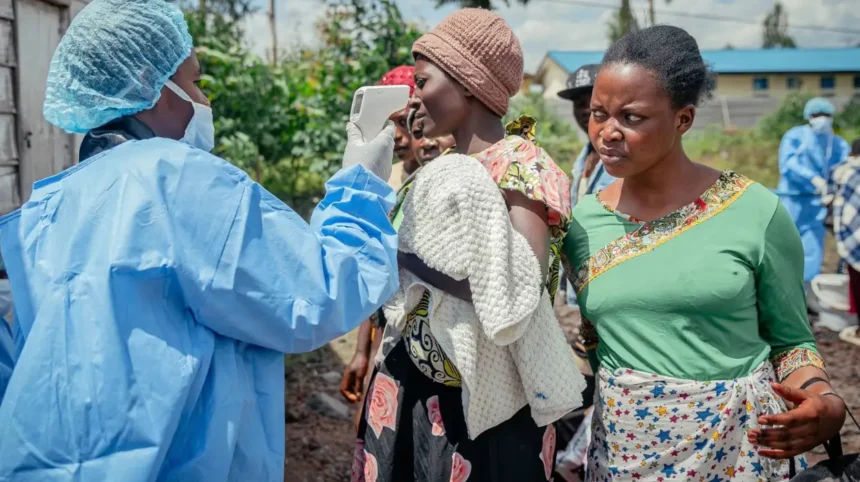
Maya Brownstein of the Harvard T.H. Chan School of Public Health, in an article entitled “Ebola’s Spread Fueled by Cuts in Humanitarian Aid” dated June 18, 2026, stated that the shuttering of USAID and other foreign aid cuts have contributed to the current spread of Ebola—and explored what this might mean for global health security in the future. In combating infectious outbreaks, from preparedness to response, USAID maintained a robust, permanent presence in countries like the DRC. It invested in surveillance systems, strengthened laboratory capacity, and trained local healthcare workers. Once an outbreak is underway, USAID would deploy emergency staff to boost capacity on the ground, supply protective equipment, and coordinate between WHO, UNICEF, local health ministries, and the US Centers for Disease Control and Prevention. But this time, the US and many Western capitalist far-right regimes have drastically reduced foreign aid budgets. This has forced governmental and non-governmental global health and humanitarian organizations to significantly shrink their staff and scale down operations.
Phuong Pham, associate professor in the Department of Global Health and Population, is reported to have stated:
“Viruses don’t respect borders and can use weaknesses in our global health security systems to thrive and propagate. So it is in the best interest of everyone—Americans included—to keep these systems strong.”
Unfortunately, American imperialism under Trump and his Western capitalist minions does not grasp the essence of this statement. One is reminded of Ezra Klein’s remark in his book Why We’re Polarized:
“The US presidency is a sacred trust, its occupant the wielder of unimaginable destructive power, and here, we had handed it over to a human hurricane…”
This human hurricane is unmindful of the lethality rate of the Bundibugyo virus, which has no approved treatment or vaccine; the insurmountable hurdles like civil wars and armed conflicts induced by the very imperial powers; the record death toll of 2,557 out of 5,375 confirmed cases; and a track record poised to surpass the earlier death toll of over 11,000 between 2014 and 2016.
The WHO Constitution declares that the enjoyment of the highest attainable standard of health is one of the fundamental rights of every human being without distinction of race, religion, political belief, or economic and social condition. Yet this pious sentinel of fundamental rights becomes a mute spectator before the policies of “America First”, the declaration that spending on aid is a waste, and the description of African countries as “shitholes”. The colonial powers’ search for profits paved the way for the present pandemic in the Congo. The presence of abundant vital minerals like cobalt, coltan, and gold is its curse. The scramble for control has created some of the greatest horrors. The outbreak of the deadly Ebola pandemic is probably the last nail in the coffin of the people of the Congo, driven by imperialist powers.
The views expressed in this article are the author’s own and do not necessarily reflect (North London News) editorial policy.