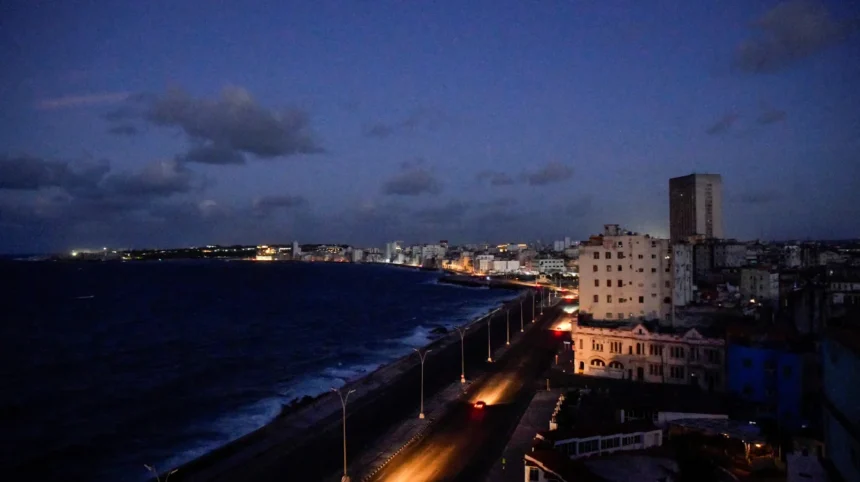
The world may pretend otherwise, but reality bites hard. Western liberal hypocracy and democratic hallowness of American imperialism and crisis in Cuba moves together and exposes the limits of American imperialism and western liberalism. The US oil blockade has triggered an increasingly agonizing energy crisis in Cuba, bringing transportation to a grinding halt. With few vehicles on the streets, fewer students are able to reach school.
Sergio Alfonso Vázquez, 33, a farmer and father of two, says:
“My children rarely go to school. When they do, the teachers don’t show up. I am afraid because they are not learning anything.”
Naima Ariatne Trujillo Barreto, Cuba’s Minister of Education, explained:
“After a night without electricity, getting a child to school, figuring out how to engage him, and conducting the class itself—all of that is a challenge. For teachers, who suffer just as much—without power or with uncertainty about whether they have water at home—concentrating on giving classes has been quite a challenge.”
UNESCO director Anne Lemaistre posted on Instagram:
“Education in Cuba is at risk due to the current energy crisis. It jeopardises the future of an entire generation.”
Cuba has been without diesel for its generators, resulting in power outages of up to 22 hours a day and acute water shortages. The island is also running short of food and medicine, and has depended on aid shipments from Mexico and China.
Since January, US President Donald Trump has cut off international fuel deliveries to Cuba and introduced a new package of aggressive economic measures aimed at starving the Cuban government of cash. Cuba has been under a US trade embargo since 1962, but Trump has significantly ramped up the pressure. The US has also announced criminal charges against the Castro government for allegedly shooting down two small planes operated by the exile group Brothers to the Rescue in 1996.
In response, Cuba’s working class, peasants, and students have engaged in a dual wave of protests: grassroots demonstrations against daily shortages, alongside government-sanctioned rallies directed squarely against the US. University students in Havana have staged unprecedented sit-ins and campus protests, targeting the severe energy crisis and its disruption of education. In neighbourhoods across Havana, Artemisa, and Holguín, the working class has held “cacerolazos”—traditional nighttime pot-banging protests—in response to rolling blackouts and food scarcity.
The Cuban peasantry and global agricultural coalitions such as La Vía Campesina are protesting the blockade’s crippling impact on food production by launching worldwide campaigns for food sovereignty and agroecology. On 17 May 2026, La Vía Campesina launched the Global Solidarity Campaign entitled:
“Against the Blockade! Peasant Solidarity, Agroecology and Food Sovereignty.”
This movement, spanning over 80 countries, brings together peasants, fishers, land workers, and small-scale food producers who collectively hold this unilateral sanction as the direct cause of Cuba’s food and energy crisis.
Cuba has given the world far more than it has received. Its most significant global contributions include unprecedented medical diplomacy, pioneering biotechnology, and a profound influence on world culture through music and sports. Cuba also developed and shared the “Yo, Sí Puedo” (Yes, I Can) adult literacy programme, which has taught millions to read and write across dozens of countries in Latin America, Africa, and Oceania. It has inspired and supported cooperative movements, adopted agroecology, and promoted solidarity and humanist internationalism to build a fairer and more sustainable world.
At present, the imperial militarism of the West—particularly the United States—has gone rampant. It has politically targeted sovereign countries like Venezuela and Iran, and now seeks to punish Cuba’s progressive movement. For nearly 60 years, the Cuban people have shown extraordinary courage in resisting the economic blockade. Their struggle serves as a warning to all countries attempting to escape neoliberal exploitation and the capitalist system in order to pursue a dignified, sovereign project for the benefit of their people.
Mere declarations of solidarity are no longer enough. States that claim to support Cuba in the present crisis must supply oil, create alternative financial mechanisms, safeguard supplies, and exert genuine diplomatic pressure on the US to end the blockade. The international solidarity movement must press their governments so that support for Cuba ceases to be symbolic and becomes effective policy. This energy crisis is not the result of internal failings, as the US presents it, but the culmination of more than six decades of economic blockade. The aim of this sanction is not merely economic pressure—it is to provoke social implosion and regime change, similar to what Trump has sought in Venezuela.
The hypocrisy of multilateralism is put to the test in Cuba. Major powers, including China and Russia, declare solidarity with Cuba and condemn the blockade in international forums, yet they do not take sufficiently strong steps to pressure the US to lift it. Their engagements with issues like Ukraine and Taiwan may prevent them from offering robust support to Cuba. Progressive governments in Brazil and Colombia, while publicly expressing support, are reportedly unwilling to confront the US directly. They should remember that abandoning Cuba weakens all forces that claim to defend the sovereignty of countries across the Global South.
In today’s world, the mutated fascism perpetuated by Trump and his ilk has subverted democratic institutions at home and abroad. For him, institutions are obstacles, not safeguards—as though he alone represents the will of the people, and any opposition from other countries becomes illegitimate. In such a climate, Cuba’s working class must resist this quieter fascism with all their might—not only for their own survival, but as a beacon for the sovereign aspirations of peoples everywhere. Cuba’s struggle is the struggle of all human beings in the world. If Cuba fails, it is not because of Cubans but because of all of us and our silence.