Barnet contains a substantial collection of surviving historic buildings that reflect medieval, Georgian, Victorian, Edwardian and twentieth-century development. The strongest concentration is around Monken Hadley, Chipping Barnet, Totteridge, Hendon, Finchley and Hampstead Garden Suburb. These buildings range from parish churches and manor houses to cottages, almshouses, farm buildings, schools and purpose-built civic structures.
- Which historic buildings still survive in Barnet?
- What is the oldest surviving historic building in Barnet?
- What historic buildings survive around Monken Hadley?
- Which historic buildings survive in Chipping Barnet?
- Does Arkley still have historic buildings?
- Which Georgian buildings still survive in Barnet?
- Which Victorian historic buildings survive in Barnet?
- Are there historic buildings in Hampstead Garden Suburb?
- What historic buildings survive in Totteridge?
- How does Barnet protect surviving historic buildings?
- How many historic heritage assets does Barnet have?
- Which surviving Barnet buildings are best for an architecture-focused visit?
- Why do Barnet’s surviving historic buildings still matter today?
- What should visitors look for when exploring Barnet’s historic architecture?
Barnet Council records 651 listed buildings in its heritage data, alongside 1,221 locally listed buildings, showing the scale of the borough’s architectural inheritance.
The surviving buildings are important because they demonstrate how Barnet developed from rural settlements and historic estates into an established part of Greater London. Several buildings also survive within conservation areas, where architectural character receives additional planning protection.
For visitors, these places provide a practical way to explore Barnet’s history without leaving the modern borough. For residents and business travellers, they offer accessible heritage destinations between everyday activities.
Which historic buildings still survive in Barnet?
Barnet still contains medieval churches, Georgian houses, historic cottages, farm buildings, almshouses, Victorian buildings and twentieth-century architecture. Important surviving examples include St Mary the Virgin, Hadley House, Church Cottages, Arkley Windmill, Garrett’s Almshouses and buildings in Hampstead Garden Suburb.
Barnet’s historic architecture is not concentrated in one building or one period. Instead, it forms a layered architectural record across the borough.
Historic England identifies numerous surviving heritage assets in Barnet, including Hadley House, Hadley Highstone, The Chase, Church of St John, Livingstone Cottage, Monken Cottage, Garrett’s Almshouses and 56 High Street.
The borough also contains conservation areas that protect groups of buildings and their surrounding townscape. Barnet Council identifies areas including Monken Hadley, Totteridge, Mill Hill, Hendon Church End, Finchley Church End, Golders Green, Hampstead Garden Suburb and Wood Street.
This distinction matters. A historic building is not necessarily nationally listed. Some buildings receive statutory protection through the National Heritage List for England, while others are recognised through Barnet’s Local Heritage List.
What is the oldest surviving historic building in Barnet?
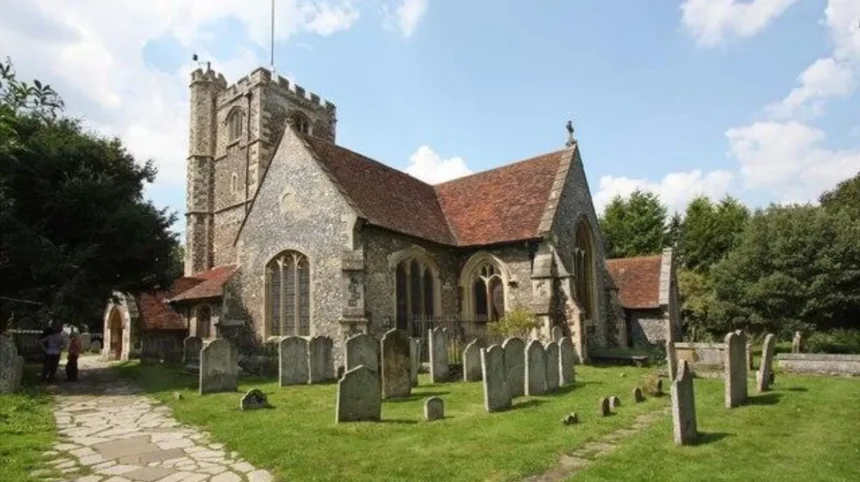
St Mary the Virgin in Monken Hadley is one of Barnet’s most important surviving medieval buildings, with its west tower dated to about 1494. The church retains medieval fabric alongside later restoration, fittings, monuments and architectural additions from subsequent centuries.
The Parish Church of St Mary the Virgin stands on Hadley Green Road in Monken Hadley. Historic England lists it at Grade II*, a high level of statutory protection reflecting special architectural and historic interest.
The west tower is dated to approximately 1494. The church is built principally from flint and ironstone, with extensive nineteenth-century additions. Restoration took place around 1848–1850, under architect George Edmund Street.
The building contains a four-bay nave with a hammerbeam roof. It also retains a rare eighteenth-century copper beacon on the tower. Historic England records stained glass by Warrington dating from 1846 and a monument to Sir Roger Wilbraham created by Nicholas Stone in 1616.
The churchyard adds another layer of historical interest. Recorded burials and monuments include those associated with William Makepeace Thackeray, Hester Chapone and John Monro.
The building therefore demonstrates several architectural periods in one surviving structure. Medieval construction forms the historic core, while Victorian restoration and earlier memorials show how the building continued to evolve.
What historic buildings survive around Monken Hadley?
Monken Hadley retains one of Barnet’s strongest concentrations of historic architecture, including St Mary the Virgin, Hadley House, Church Cottages, Church House, the Rectory, almshouses and other historic properties surrounding Hadley Green and the common.
Monken Hadley is particularly important because its historic character comes from the relationship between buildings, open spaces, roads and the surrounding landscape.
Barnet Council designates Monken Hadley as a conservation area. Conservation areas are places recognised for special architectural or historic interest, with additional planning controls intended to protect their character.
The area also has Article 4 controls. These controls remove certain permitted development rights, meaning specific external alterations require planning consent. The restrictions cover matters such as some dwelling alterations, roof changes, porches, boundaries and exterior painting.
That protection helps explain why the area retains a coherent historic appearance.
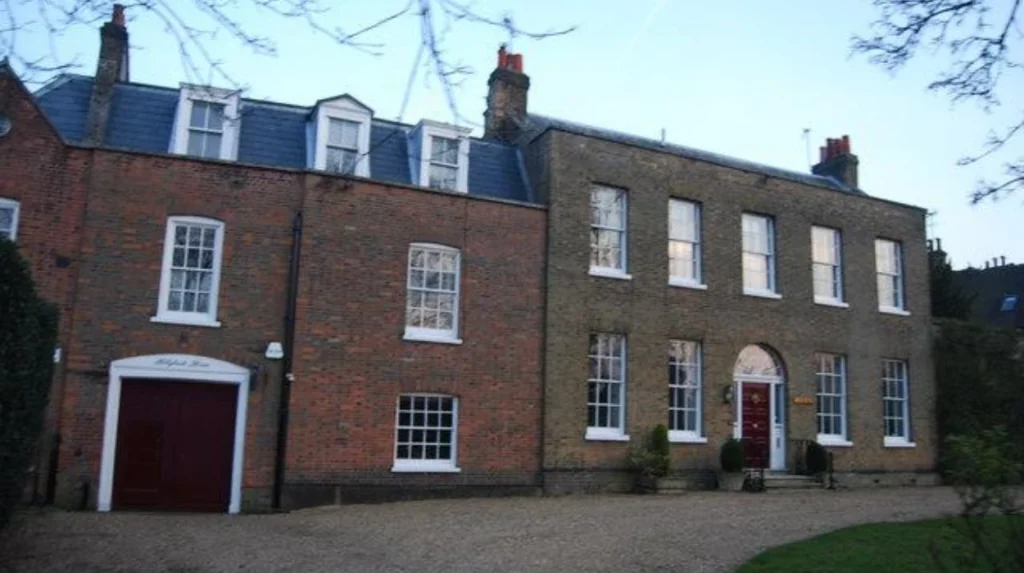
Hadley House
Hadley House is one of the area’s most prominent Georgian buildings. Historic England dates it to approximately 1760 and lists it at Grade II*.
The large red-brick house has a symmetrical principal elevation, sash windows, a central pediment and a classical entrance porch. Its entrance includes fluted Doric columns, a fanlight, panelled door and sidelights.
The building was constructed on the site of a much older manor house. Barnet Council’s conservation appraisal describes the present house as a substantial mid-Georgian property constructed on a grand scale.
Its stable block also survives. The stable block dates from approximately the same period and has Grade II* status as part of the historic group.
Church Cottages
Church Cottages provide a smaller-scale example of nineteenth-century residential architecture. Historic England records Nos. 1, 2 and 3 Church Cottages as Grade II listed buildings.
The cottages date from the mid-nineteenth century. They are two-storey yellow stock-brick buildings with tiled roofs and architectural detailing around their windows and entrances.
Their importance comes partly from group value. Historic buildings do not always derive significance from size or architectural complexity. A terrace of modest cottages can preserve the character of a historic settlement just as effectively as a large country house.
Church House
Church House stands behind St Mary the Virgin and forms part of the historic group around the churchyard.
Barnet’s Local Heritage List describes it as a two-storey red-brick building with sash windows and a red tiled roof. It was formerly a stable and later became a house for priests and refugees from the French Revolution. Since 1910, it has served as parish rooms.
This is a useful example of adaptive reuse. The building survives because its function changed while its architectural identity remained part of the historic settlement.
As you explore the modern site, you are crossing land with a deep heritage. Read the full to understand its origins.
Which historic buildings survive in Chipping Barnet?
Chipping Barnet retains historic buildings along its traditional high street and surrounding streets, including early timber-framed properties, former commercial buildings, civic structures and buildings associated with the historic market settlement and wider medieval landscape.
Chipping Barnet developed around a historic market and transport route. Its surviving buildings reflect the settlement’s transition from a rural market centre into a suburban district.
One notable example is 56 High Street, identified by Historic England as a Grade II listed early seventeenth-century timber-framed building. The property has subsequently received modern alterations but retains its historic structural significance.
Historic buildings in this part of Barnet demonstrate how commercial streets evolved. Shops, houses, inns and other premises frequently occupied the same buildings or neighbouring plots.
The historic street pattern is therefore as significant as individual façades. Visitors walking through the centre can observe changes in building scale, materials, rooflines and frontage design.
Barnet Museum also provides a cultural context for understanding the borough’s historic development. Barnet Council describes the museum in High Barnet as an important part of the borough’s cultural heritage, with collections and exhibitions covering subjects including medieval history and local traditions.
Does Arkley still have historic buildings?
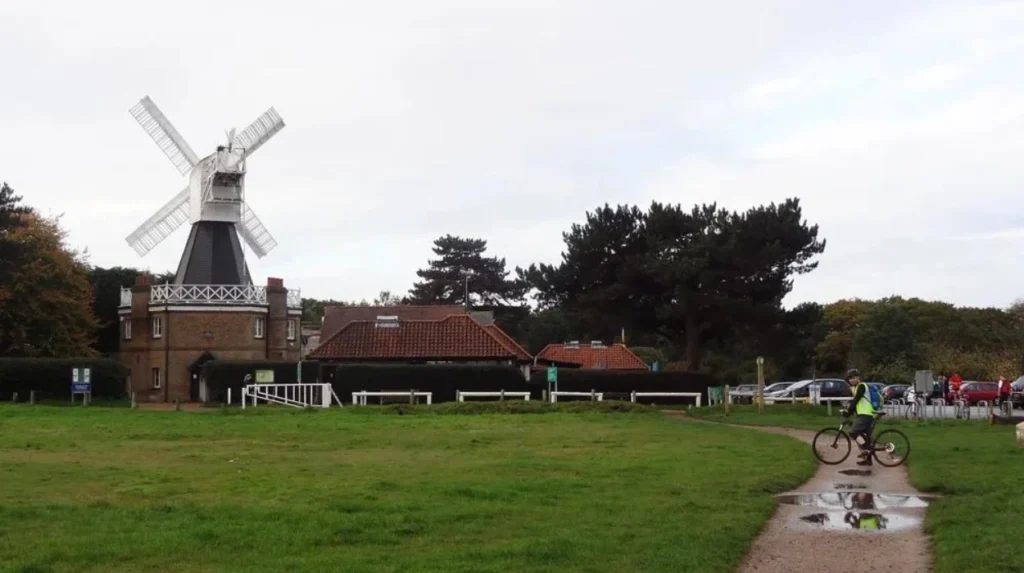
Arkley retains important rural heritage buildings, including Arkley Windmill, Hyver Hall, a historic barn and St Peter’s Church. These structures preserve evidence of Barnet’s agricultural landscape and demonstrate that rural architecture survives alongside modern London development.
Arkley is one of the clearest places to see the agricultural dimension of Barnet’s past.
Barnet’s statutory list identifies Arkley Windmill, Hyver Hall, the barn in the grounds of the windmill and St Peter’s Church among its listed heritage assets.
Arkley Windmill is particularly significant because windmills were once essential components of rural economies. The survival of the structure provides evidence of the area’s former agricultural character.
Historic farm buildings are equally important. Their construction materials and layouts often reflect practical agricultural requirements rather than formal architectural design.
The survival of these buildings demonstrates that Barnet’s history extends beyond suburban expansion. Open land, farms, mills and rural houses formed an important part of the area’s earlier economy.
Which Georgian buildings still survive in Barnet?
Georgian architecture survives in several parts of Barnet, with Hadley House providing the strongest example. Other surviving Georgian properties include historic houses, cottages and estate buildings that use brick construction, sash windows, classical proportions and formal architectural detailing.
The Georgian period generally covers 1714 to 1830, although architectural styles continued beyond these dates. In Barnet, surviving Georgian buildings often reflect the influence of estates, landowners and prosperous residents.
Hadley House is the clearest example. Its approximately 1760 construction date places it firmly within the Georgian period. Its symmetrical brick elevation, classical entrance and sash windows reflect the architectural principles of the era.
Historic England also identifies The Chase as an early eighteenth-century house. It retains an early eighteenth-century core with nineteenth-century façade alterations.
This mixture of original fabric and later alteration is common in historic buildings. Buildings remained useful because owners adapted them to changing needs.
Which Victorian historic buildings survive in Barnet?
Victorian heritage survives through churches, cottages, cemeteries, schools and institutional buildings across Barnet. Examples include Church Cottages, the Anglican Chapel at East Finchley Cemetery and other nineteenth-century buildings within established conservation areas.
The Victorian period transformed Barnet’s architecture as population growth, railways, religious expansion and suburban development increased.
The Anglican Chapel at East Finchley Cemetery is an important example. Historic England dates the chapel to 1854 and identifies Gothic Revival characteristics. It forms part of a larger nineteenth-century cemetery architectural ensemble.
Church Cottages in Monken Hadley are another surviving Victorian example. Their yellow stock brick and compact terraced form reflect nineteenth-century residential construction.
Victorian heritage also survives in religious buildings. The period saw extensive church construction throughout London’s expanding suburbs.
These buildings are important because they demonstrate how Barnet changed from a collection of settlements and rural districts into a densely connected urban borough.
Are there historic buildings in Hampstead Garden Suburb?
Hampstead Garden Suburb contains some of Barnet’s most significant twentieth-century historic architecture, including buildings designed by major architects and planned residential streets created through the Garden Suburb movement.
Hampstead Garden Suburb represents a different architectural period from Monken Hadley.
The development began in the early twentieth century and became internationally recognised for its planned environment, Arts and Crafts architecture, landscaped spaces and relationship between housing and community facilities.
Historic England identifies Hampstead Garden Suburb Free Church as an important surviving building designed by Sir Edwin Lutyens between 1908 and 1910. It combines brick and stone detailing with a tiled roof and reinforced-concrete elements.
The significance of Hampstead Garden Suburb comes from the wider planned environment rather than isolated buildings alone.
Barnet Council identifies Hampstead Garden Suburb as a conservation area.
For visitors, this makes the area particularly useful for architectural walking. Streets, houses, gardens and community buildings collectively illustrate early twentieth-century planning principles.
What historic buildings survive in Totteridge?
Totteridge retains historic houses, cottages, farm-related buildings and landscaped settings that reflect its earlier village character. The Totteridge conservation area protects this distinctive architectural environment and preserves the relationship between buildings, roads, trees and open land.
Totteridge is another important heritage landscape within Barnet.
Its architectural character reflects its history as a village settlement rather than a nineteenth-century urban centre. Historic houses and cottages sit alongside mature vegetation and open spaces.
Barnet Council lists Totteridge among the borough’s conservation areas.
Conservation-area protection is important because historic character depends on more than individual listed buildings. Building lines, boundary walls, mature trees, road layouts and views between properties all contribute to the identity of a historic area.
For visitors interested in architectural history, Totteridge therefore offers a different experience from Chipping Barnet. The emphasis is on historic village character and surviving residential landscapes.
How does Barnet protect surviving historic buildings?
Barnet protects historic architecture through statutory listing, conservation-area controls and local heritage listing. Nationally listed buildings receive legal protection, while conservation areas and local lists help protect wider architectural character and locally significant buildings.
There are several levels of heritage protection relevant to Barnet.
Statutory listed buildings are protected under the Planning (Listed Buildings and Conservation Areas) Act 1990. Barnet Council states that its statutory listed building data represents buildings and structures considered to have special architectural or historic interest.
Listed buildings are assigned grades. Grade II represents buildings of special architectural or historic interest. Grade II* represents particularly important buildings of more than special interest. Grade I is reserved for buildings of exceptional interest.
Barnet also operates a Local Heritage List. Local listing recognises buildings and places that have local architectural or historic merit without giving them the same statutory status as nationally listed buildings.
Barnet’s Local Heritage List was approved in 2020, with further additions approved in 2022.
This system is important because heritage value exists at several scales. A building can be highly significant to a neighbourhood even when it does not meet national listing criteria.
How many historic heritage assets does Barnet have?
Barnet has hundreds of statutory listed buildings and more than a thousand locally listed buildings, alongside conservation areas, historic parks, archaeological sites and the Battle of Barnet battlefield. This makes heritage protection a borough-wide planning responsibility.
Barnet’s planning evidence records 651 listed buildings and 1,221 locally listed buildings. It also identifies five registered historic parks and gardens, archaeological priority areas and the battlefield associated with the 1471 Battle of Barnet.
Barnet Council separately records five nationally registered historic parks and gardens within the borough. They include East Finchley Cemetery and St Marylebone Crematorium, Avenue House Grounds, Golders Green Crematorium, St Pancras and Islington Cemetery and Crematorium, and Hoop Lane Jewish Cemetery.
This wider heritage network changes how historic buildings should be understood. Individual structures are part of larger historic landscapes.
Which surviving Barnet buildings are best for an architecture-focused visit?
The strongest architecture-focused route combines Monken Hadley, Chipping Barnet and Hampstead Garden Suburb. These areas provide medieval, Georgian, Victorian, Arts and Crafts and early twentieth-century architecture within distinct historic environments.
Monken Hadley is the strongest starting point for older architecture. St Mary the Virgin provides a medieval landmark, while Hadley House represents Georgian architecture and Church Cottages provide nineteenth-century residential character.
Chipping Barnet adds historic commercial architecture and early timber-framed buildings.
Hampstead Garden Suburb provides a contrasting twentieth-century environment shaped by planned development and Arts and Crafts principles.
Arkley adds rural architecture, including the surviving windmill and farm buildings.
Together, these locations demonstrate that Barnet’s historic architecture is not confined to one period. The borough contains surviving evidence from medieval settlement through Georgian estate development, Victorian expansion and twentieth-century suburban planning.
Explore More Area Guide
Black Bear Burger Named UK’s Happiest Workplace North London 2026
Barnet’s Journey From Market Town to London Borough 2026
Why do Barnet’s surviving historic buildings still matter today?
Barnet’s surviving historic buildings provide physical evidence of how settlements, estates, religious institutions, agriculture, commerce and suburban communities developed. Their protection preserves architectural character while supporting education, tourism, local identity and responsible future planning.
Historic buildings provide evidence that written records cannot fully reproduce. Their materials, layouts, alterations and relationship with streets reveal how people used places over time.
A medieval church demonstrates religious and community history. A Georgian house illustrates estate development and eighteenth-century architecture. Victorian cottages record nineteenth-century housing patterns. A windmill represents rural production. An Arts and Crafts suburb demonstrates planned twentieth-century development.
Barnet’s heritage therefore has practical relevance beyond architectural appreciation.
Historic buildings also contribute to visitor experiences. Areas such as Monken Hadley and Hampstead Garden Suburb provide walkable heritage environments where architecture forms part of the wider landscape.
For local businesses, heritage areas support cultural tourism and leisure activity. For residents, they provide a stronger sense of place. For planners, they provide evidence that informs decisions about development, conservation and regeneration.
Barnet Council’s heritage framework recognises this wider role through statutory listings, local heritage listing, conservation areas and historic landscape protection.
What should visitors look for when exploring Barnet’s historic architecture?
Visitors should examine building materials, roof forms, windows, entrances, boundary walls, architectural details, dates and relationships between buildings. Comparing medieval, Georgian, Victorian and twentieth-century examples reveals how Barnet’s built environment developed over centuries.
Start with the age and function of a building. A church, manor house, cottage, farm building and civic structure each reflects different historical requirements.
Look at construction materials. Flint, ironstone, red brick, yellow stock brick, timber framing, slate and clay tiles appear across Barnet’s historic buildings.
Then examine architectural details. Sash windows and classical proportions indicate Georgian influence. Gothic Revival detailing often points towards Victorian religious architecture. Arts and Crafts buildings use carefully considered materials, craftsmanship and irregular forms.
The surrounding environment also matters. Historic buildings often retain relationships with gardens, churchyards, commons, roads and boundaries.
This approach turns a simple walk through Barnet into a chronological study of London’s architectural development.
Barnet’s surviving historic buildings are therefore more than old structures. They are protected evidence of the borough’s transformation from medieval and rural settlements into a diverse part of modern London. From the approximately 1494 tower of St Mary the Virgin to the Georgian grandeur of Hadley House, the rural character of Arkley and the planned architecture of Hampstead Garden Suburb, the borough preserves a broad architectural record.
What are the oldest historic buildings in Barnet?
Some of Barnet’s oldest surviving buildings include St Mary the Virgin Church in Monken Hadley, whose west tower dates to around 1494, and early timber-framed properties in Chipping Barnet.