
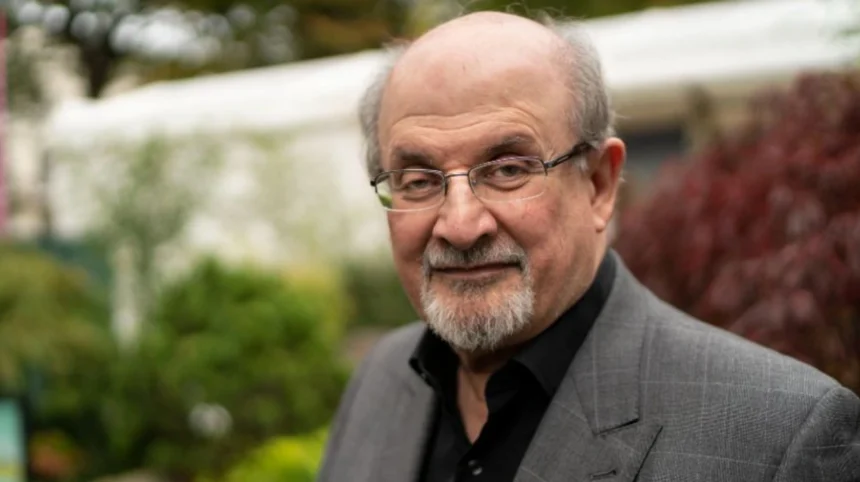
During an interview with Margaret Hoover on her public affairs programme Firing Line Margaret Hoover, broadcast on 4 September 2026, author Salman Rushdie drew a comparison between the Rashtriya Swayamsevak Sangh (RSS) and the Irish Republican Army (IRA). Such a shallow comparison is historically flawed and ideologically incompatible. Whether a mere slip of the tongue or a deliberate provocation, only Rushdie himself knows for certain; yet the impression persists that he is curbing his freedom to fit the prism of American liberal tastes—and their profoundly ahistorical, illiberal sensibilities.
Historically, the IRA and the RSS are fundamentally disparate entities, diametrically opposed in ideology and their political praxis. The IRA, established in 1919, waged a radical and militant struggle for Irish independence from British colonial rule; the RSS, founded just six years later, in 1925, collaborated with the British in its pursuit of a Hindu state. The RSS, notably, took no part in the anti-colonial struggle against British rule in India. The IRA stands in fundamental opposition to capitalism and imperialism; the RSS and its political front, the BJP, by contrast, work to create conditions conducive to the interests of crony capitalists and Yankee imperialism.
Although the majority of the IRA’s membership comes from Catholic communities, the organisation adhered to secular, inclusive, and anti-sectarian principles in practice, deploying them to fortify its united anti-colonial struggle against British rule. After independence, these principles became foundational to the Irish republic. The RSS, by contrast, is a sectarian organisation, implacably opposed to secularism, which seeks to supplant India’s secular state with an exclusionary Hindu Rashtra—a dispensation in which Muslims and other religious minorities would be relegated to the status of second-class citizens. By dividing the Indian population along religious lines, the RSS actively undermined the anti-colonial struggle. Secularism remains anathema to the organisation. The IRA celebrates diversity; the RSS and all its cultural and political fronts promote a dominating singularity of Hindi, Hindutva, and Hindustan—a majoritarianism that stands opposed to the organic diversities which make India beautiful.
The RSS has often demonstrated political alignment, extending explicit solidarity to figures such as Taslima Nasrin and advocating for her asylum in India. In the case of Salman Rushdie, however, while the RSS supported the domestic release of The Satanic Verses, as it annoys religious Muslim population but RSS never championed nor celebrated Salman Rushdie as a secular Indian literary icon of global renown. Meanwhile, the internationally acclaimed artist M.F. Husain left India to live in self-imposed exile in London and Dubai, driven there by the legal and physical threats of Hindutva extremists—threats forged in the ideological crucible of the RSS.
Salman Rushdie is known for his trenchant criticisms of the RSS and Hindutva ideology. He called Hindutva supporter of Prime Minister Mr Modi as “Modi Toadies”. In comparing the RSS with the IRA, Salman Rushdie lends an undeserved historical legitimacy to fascist organisations such as the RSS. IRA is a revolutionary organisation whereas RSS is a reactionary organisation. As a student of history, he fully apprehends the fundamental chasm between the IRA and the RSS; hence, to draw a parallel between them is to do historical injustice to his own principled opposition to religious fundamentalism, across every political and ideological aisle.
The liberal politics of false equivalence of comparing a revolutionary organisation like the IRA with a reactionary one like the RSS creates conditions in which reactionary politics unwittingly breeds hate. Salman Rushdie falls into this quintessentially liberal trap—where conservative reactionaries grow in the very name of freedom that he celebrates. Such a trap is fundamentally antithetical to any form of progressive and democratic transformation of society along the path of peace.